The Municipal Code of Wolf Point, Montana began in-house in 2019 with the assistance of Municipal Code Corporation. This Municipal Code shall be cited as Wolf Point City Code or “WPCC” as an acronym.
WPCC references found within the code maintain a structure by subject matter using a decimal numbering system which identifies the title, chapter, and section (for example: 1.01.010). This complete set of numbers is designed to aid in searching and/or referencing the Municipal Code, and to assist in subsequent codification as new ordinances are added to the Municipal Code.
- The first number in the sequence (1.01.010) designates the TITLE level
- The second series of numbers (1.01.010) designates the Chapter level
- The third series (1.01.010) designates the Section level, and is expressed using three numerical values
- If a fourth series exists comprising letters or numbers beyond the section level, it designates a Subsection level.
The legislation herein may be arranged as an alphanumeric ordered list A, 1, a, (1), (A), (a) to show hierarchal relationships. The legislation may also be arranged as an unordered list (using bullets, discs, squares, etc.) to show items without hierarchal relationships. These list structures assist in subsequent codification as new legislation is added. To forego the naming of each list item and to more granularly reference legislation that employs alphanumeric characters, use “paragraph” followed by the desired alphanumeric reference(s), comma separated. For example, “paragraph B,7,d”, specifically references item “d”, of item “7”, of item “B”—whereas “paragraph B” refers more generally to any or all of list item B’s descendants.
When used herein, “MCA” refers to the Montana Code Annotated.
Vacant titles, chapters, or sections may be designed for future use and may be marked “Reserved” to ease internal expansion. The legislative history identifies the specific legal sources of a section as may be provided in footnotes.
The specific legal sources that comprise this Municipal Code have been adapted during the codification process from the original formatting of the official hard copy. In the event of discrepancies between the online Municipal Code and the official hard copy, the official hard copy governs. Municipal Code Corporation, provides a searchable database of the Municipal Code for easy reference and convenience.
NOTICE: THE MUNICIPAL CODE MAY NOT REFLECT ALL OR THE MOST CURRENT VERSION OF LEGISLATION ADOPTED BY THE CITY COUNCIL THAT HAS YET TO BE UPDATED ONLINE. IN THE EVENT OF CONFLICT BETWEEN THE MUNICIPAL CODE AND A WRITTEN ORDINANCE, THE ORDINANCE TYPICALLY GOVERNS. ALSO, THE MUNICIPAL CODE MAY NOT REFLECT RULES OR OTHER REGULATIONS PROMULGATED UNDER THE AUTHORITY OF THE CODE, INCLUDING TECHNICAL SPECIFICATIONS. FOR MORE INFORMATION CONTACT THE OFFICE OF THE CITY CLERK AT 406-653-1852.
1.08 Saving Clause
1.12 Definitions - Administration
1.16 General Penalty; Construction; Interpretation
1.20 General And Corporate Provisions
1.24 Mayor
1.28 City Council
1.32 City Officers And Employees
1.36 City Clerk-Treasurer
1.40 City Attorney
1.44 Director Of Public Works
1.48 City Judge
1.52 Elections
1.56 City Court
1.60 Comprehensive Plan
1.04.020 Acceptance
1.04.030 Amendments
1.04.040 Code Alterations
Upon the adoption by the council, this city code is hereby declared to be and shall hereafter constitute the official city code of Wolf Point. This city code of ordinances shall be known and cited as the WOLF POINT CITY CODE and is hereby published by authority of the council and shall be supplemented to incorporate the most recent legislation of the city as provided in WPCC 1.04.030. Any reference to the number of any section contained herein shall be understood to refer to the position of the same number, its appropriate chapter and title heading, and to the general penalty clause relating thereto, as well as to the section itself, when reference is made to this city code by title in any legal documents. (1982 Code § 1.00.010, 1.00.020; amd. 2004 Code)
The city code, as hereby presented in printed form, shall hereafter be received without further proof in all courts and in administrative tribunals of this state as the ordinances of the city of general and permanent effect, except the excluded ordinances enumerated in WPCC 1.08.010. (2004 Code)
Any ordinance amending the city code shall set forth the title, chapter and section number of the section or sections to be amended, and this shall constitute sufficient compliance with any statutory requirement that no ordinance or any section thereof shall be revised or amended unless the new ordinance sets forth the revised ordinance or amended section in full. All such amendments or revisions by ordinance shall be immediately forwarded to the codifiers, and such ordinance material shall be prepared for insertion in its proper place in each copy of this city code. Each such replacement page shall be properly identified and shall be inserted in each individual copy of the city code. (1982 Code § 1.00.030; amd. 2004 Code)
It shall be deemed unlawful for any person to alter, change, replace or deface in any way any section or any page of this city code in such a manner that the meaning of any phrase or order may be changed or omitted. Replacement pages may be inserted according to the official instructions when so authorized by the council. The city clerk-treasurer shall see that the replacement pages are properly inserted in the official copies maintained in the office of the city clerk-treasurer. Any person having custody of a copy of the city code shall make every effort to maintain said code current as to the most recent ordinances passed. Such person shall see to the immediate insertion of new or replacement pages when such are delivered or made available to such person through the office of the city clerk-treasurer. Such code books, while in actual possession of officials and other interested persons, shall be and remain the property of the city and shall be returned to the office of the city clerk-treasurer when directed so to do by order of the council. (2004 Code)
1.08.020 Public Ways And Public Utility Ordinances
1.08.030 Court Proceedings
1.08.040 Severability Clause
All general ordinances of the city passed prior to the adoption of this city code are hereby repealed, except such as are included in this city code or are by necessary implication herein reserved from repeal (subject to the saving clauses contained in the following sections), and excluding the following ordinances which are not hereby repealed: tax levy ordinances; appropriation ordinances; ordinances relating to boundaries and annexations; franchise ordinances and other ordinances granting special rights to persons or corporations; contract ordinances and ordinances authorizing the execution of a contract or the issuance of warrants; salary ordinances; ordinances establishing, naming or vacating streets, alleys or other public places; improvement ordinances; bond ordinances; ordinances relating to elections; ordinances relating to the transfer or acceptance of real estate by or from the city; and all special ordinances. (2004 Code)
No ordinance relating to railroad crossings with streets and other public ways, or relating to the conduct, duties, service or rates of public utilities shall be repealed by virtue of the adoption of this city code or by virtue of the preceding section, excepting as the city code may contain provisions for such matters, in which case, this city code shall be considered as amending such ordinance or ordinances in respect to such provisions only. (2004 Code)
- Prior Acts: No new ordinance shall be construed or held to repeal a former ordinance whether such former ordinance is expressly repealed or not, as to any offense committed against such former ordinance or as to any act done, any penalty, forfeiture or punishment so incurred, or any right accrued or claim arising under the former ordinance, or in any way whatever to affect any such offense or act so committed or so done, or any penalty, forfeiture or punishment so incurred or any right accrued or claim arising before the new ordinance takes effect, save only that the proceedings thereafter shall conform to the ordinance in force at the time of such proceeding, so far as practicable. If any penalty, forfeiture or punishment may be mitigated by any provision of a new ordinance, such provision may be, by consent of the party affected, applied to any judgment announced after the new ordinance takes effect.
- Extend To All Repeals: This section shall extend to all repeals, either by express words or implication, whether the repeal is in the ordinance making any new provisions upon the same subject or in any other ordinance.
- Currently Pending Actions: Nothing contained in this chapter shall be construed as abating any action now pending under or by virtue of any general ordinance of the city herein repealed, and the provisions of all general ordinances contained in this code shall be deemed to be continuing provisions and not a new enactment of the same provisions; nor shall this chapter be deemed as discontinuing, abating, modifying or altering any penalty accrued or to accrue, or as affecting the liability of any person, firm or corporation, or as waiving any right of the city under any ordinance or provision thereof in force at the time of the adoption of this city code. (1982 Code § 1.00.040; amd. 2004 Code)
If any section, subsection, subdivision, paragraph, sentence, clause or phrase of this city code or any part thereof is for any reason held to be unconstitutional or invalid or ineffective by any court of competent jurisdiction, such decision shall not affect the validity or effectiveness of the remaining portions of this code, or any part thereof. The council hereby declares that it would have passed each section, subsection, subdivision, paragraph, sentence, clause or phrase thereof irrespective of the fact that any one or more sections, subsections, subdivisions, paragraphs, sentences, clauses or phrases be declared unconstitutional, invalid or ineffective. (1982 Code § 1.00.0500; amd. 2004 Code)
1.12.030 Construction Of Words
1.12.040 Definitions, General - Administration
1.12.050 Catchlines
In the construction of the official code and all ordinances amendatory hereof or supplementary hereto, the following rules shall be observed unless such construction would be inconsistent with the manifest of the city council or expungent to the context:
- Intent To Defraud: Whenever by any of the provisions of the official code an intent to defraud is required in order to constitute an offense, it is sufficient if an intent appears to defraud any person, association or body politic or any combination of persons.
- Liability Of Employers And Agents: When the provisions herein contained prohibit the commission or omission of any act, not only the person actually doing the prohibited thing or omitting the directed act, but also the employer and all other persons concerned or aiding or abetting the person shall be guilty of the offense described and liable to the penalty set forth. (1982 Code § 1.00.050)
- Whenever any word in any section of this city code importing the plural number is used in describing or referring to any matters, parties or persons, any single matter, party or person shall be deemed to be included, although distributive words may not have been used. The singular number includes the plural and words used in the present include the future. When any subject matter, party or person is referred to in this city code by words importing the singular number only, or a particular gender, several matters, parties or persons and the opposite gender and bodies corporate shall be deemed to be included; provided, that these rules of construction shall not be applied to any section of this city code which contains any express provision excluding such construction or where the subject matter or context may be repugnant thereto.
- Words prohibiting anything being done, except in accordance with a license or permit or authority from a board of officers, shall be construed as giving such board of officers power to license or permit or authorize such thing to be done. (1982 Code § 1.00.050E; amd. 2004 Code)
- The word "ordinance" contained in the ordinances of the city has been changed in the content of this city code to "title", "chapter", "section" and/or "subsection" or words of like import for organizational and clarification purposes only. Such change to the city's ordinances is not meant to amend passage and effective dates of such original ordinances. (2004 Code)
Whenever the following words or terms are used in this code, they shall have such meanings herein ascribed to them, unless the context makes such meanings repugnant thereto:
AGENT: A person acting on behalf of another with authority conferred, either expressly or by implication.
CITY: The city of Wolf Point, county of Roosevelt, state of Montana.
CLERK The city clerk-treasurer of the city of Wolf Point.
CODE: The city code of the city of Wolf Point.
COUNCIL: Unless otherwise indicated, shall be construed to mean the city council of this city.
COUNTY: The county of Roosevelt, state of Montana.
DAY: Any twenty four (24) hour period from midnight to midnight.
EMPLOYEES: Whenever reference is made in this code to a city employee by title only, this shall be construed as though followed by the words "of the city of Wolf Point".
KNOWINGLY: Imparts a knowledge that the fact exists which brings the act or omission within the provisions of this code. It does not require any knowledge of the unlawfulness of such act or omission.
LAND, REAL ESTATE AND REAL PROPERTY: Includes lands, tenements, hereditaments, water rights, possessory rights and claims.
LICENSE: The permission granted for the carrying on of a business, profession or occupation.
MCA: Abbreviation for Montana Code Annotated.
MAY OR SHOULD: Is permissive.
MONTH: A calendar month unless otherwise expressed.
NEGLECT, NEGLIGENCE, NEGLIGENT AND NEGLIGENTLY: Impart a want of such attention to the nature or probable consequences of the act or omission as a prudent man ordinarily bestows in acting in his own concern.
NUISANCE: Anything offensive to the sensibilities of reasonable persons, or any act or activity creating a hazard which threatens the health and welfare of inhabitants of the city, or any activity which by its perpetuation can reasonably be said to have a detrimental effect on the property of a person or persons within the community.
OATH: Includes affirmation.
OCCUPANT: As applied to a building or land, shall include any person who occupies the whole or any part of such building or land whether alone or with others.
OFFENSE: Any act forbidden by any provision of this code of the omission of any act required by the provisions of this code.
OFFICERS: Includes officers and boards in charge of departments and the members of such boards. Whenever reference is made in this code to a city officer by title only, this shall be construed as though followed by the words "of the city of Wolf Point".
OFFICIAL TIME: Whenever used, shall mean standard time in the city.
OPERATOR: The Person who is in charge of any operation business or profession.
OWNER: As applied to the building or land, shall include any part owner, joint owner, tenant in common, joint tenant or lessee of the whole or of a part of such building or land.
PERSON: Any natural person, firm, association, joint venture, joint stock company, partnership, organization, company, corporation, business, trust, or their manager, lessee, agent, servant, officer, or employee or any of them.
PERSONAL PROPERTY: Includes every description of money, goods, chattels, effects, evidence of rights in action and all written instruments by which any pecuniary obligation, right or title to property is created, acknowledged, transferred, increased, defeated, discharged or diminished and every right or interest therein.
PROPERTY: Includes both real and personal property.
PUBLIC THOROUGHFARE: Includes streets, alleys, lanes, courts, boulevards, public ways, squares, public places and sidewalks.
QUARTER: Any three (3) month period ending with the last day of March, June, September and December.
RETAILER: Unless otherwise specifically defined, shall be understood to relate to the sale of goods, merchandise, articles or things direct to the consumer.
RIGHT OF WAY: The privilege of the immediate use of the roadway or other property.
SHALL: Is mandatory.
SIGNATURE: Includes affirmation and the word "swear" includes the word "affirm". Every mode of oral statement under oath or affirmation is embraced in the term depose.
STATE: The state of Montana.
STREET: Includes alleys, lanes, courts, boulevards, public ways, public squares, public places and sidewalks.
TENANT: As applied to a building or land, shall include any person who occupies the whole or any part of such building or land, whether alone or with others.
TREASURER: The city clerk-treasurer of the city of Wolf Point.
WHOLESALER: The terms "wholesaler" and "wholesale dealer" as used in this code, unless otherwise specifically defined, shall be understood to relate to the sale of goods, merchandise, articles or things to persons who purchase for the purpose of resale.
WILFULLY: When applied to the intent with which an act is done or omitted, implies simply a purpose or willingness to commit the act or make intent to violate law or to injure another or to acquire an advantage.
WRITTEN IN WRITING: May include printing and any other mode of representing words and letters, but when the written signature of any person is required by law to any official or public writing or bond, it shall be in the proper handwriting of such person, or in case such person is unable to write, by such person's proper mark.
YEAR: Any one fiscal year beginning July 1 and ending July 30 of the following year, unless otherwise expressed.
(1982 Code § 1.00.050E; amd. 2004 Code)
The catchlines of the several sections of the city code are intended as mere catchwords to indicate the content of the section and shall not be deemed or taken to be titles of such sections, nor be deemed to govern, limit, modify or in any manner affect the scope, meaning or intent of the provisions of any division or section hereof, nor unless expressly so provided, shall they be so deemed when any of such sections, including the catchlines, are amended or reenacted. (1982 Code § 1.00.050C; amd. 2004 Code)
1.16.020 Execution Of Fine
- Penalty: Whenever in any provision of this code or other ordinance of the city any act is prohibited or is made or declared to be unlawful, a misdemeanor or an offense, or whenever in any such provision or ordinance the doing of any act is required or the failure to do any act is declared to be unlawful, where no specific penalty is otherwise provided therefor, any person upon conviction for the violation of any such provision of this code or ordinances shall be punished by a fine not exceeding five hundred dollars ($500.00) or by imprisonment not to exceed six (6) months, or both such fine and imprisonment for each such offense. Each day any violation of any provision of any ordinance shall continue shall constitute a separate offense.
- Construction; Interpretation: In the construction and interpretation of this section, the revocation of a license or permit shall not be considered as a recovery or penalty so as to bar any other penalty being enforced. (1982 Code § 1.08.010)
(MCA §§ 7-5-109 and 7-5-4207.)
If the judgment is for a fine alone, execution may issue thereon as on a judgment in a civil case.
(1982 Code § 1.08.020; amd. 2004 Code)
1.20.020 Wards
1.20.030 Corporate Seal
1.20.040 Official Newspaper
1.20.050 Ordinances
1.20.060 Discrimination In Housing
- Designated: The city limits shall be the outermost limits of the outermost additions duly and regularly annexed to the city according to the laws of the state of Montana or any addition to the city duly and regularly annexed after the enactment of this code. (1982 Code § 1.06.010; amd. 2004 Code)
- Exact Legal Description: The exact legal description of all additions or subdivisions referred to above shall be as shown on the official plats thereof on file and of record in the office of the Roosevelt County clerk and recorder. (1982 Code § 1.06.020)
- Division Of City Into Wards: The territory embraced within the corporate limits of the city shall be and the same is, hereby divided into four (4) wards. (1982 Code § 1.02.010; amd. 2004 Code)
- Description Of Wards: Such wards are bounded and described as follows:
- First Ward: All that portion of the city lying and being southerly of the main line of the Burlington Northern Railroad and easterly of Third Avenue South in the city shall constitute the first ward.
- Second Ward: All that portion of the city lying and being southerly of the main line of the Burlington Northern Railroad and westerly of Third Avenue South in the city shall constitute the second ward.
- Third Ward: All that portion of the city lying and being northerly of the main line of the Burlington Northern Railroad and easterly of Fourth Avenue North in the city shall constitute the third ward.
- Fourth Ward: All that portion of the city lying and being northerly of the main line of the Burlington Northern Railroad and westerly of Fourth Avenue North in the city shall constitute the fourth ward. (1982 Code § 1.02.020; amd. 2004 Code)
- Design; Usage: The city shall have a corporate seal of circular form, capable of making an indenture of the following design: On the upper side of the outer circle thereof shall be the words "City of Wolf Point" and on the lower side of the outer circle thereof shall be the word "Montana", and across the center of the circle thereof, the words "Seal" and "Incorporated 1915". The same is hereby adopted and declared to be the seal of the city to be used in all cases required by law and ordinance. (1982 Code § 1.12.010)
- Custodian: The city clerk-treasurer shall be the custodian of the corporate seal and shall affix such to all acts requiring to be so authenticated. (1982 Code § 1.12.020; amd. 2004 Code)
The Herald News, a newspaper of general circulation in the city and county, is hereby designated the official newspaper for the city. (1982 Code § 1.14.010; amd. 2004 Code)
- Style:
- Required Signatures: The style of the ordinances of the city shall be, "Be it ordained by the Council of the City of Wolf Point, Montana," and all ordinances shall be signed by the mayor or presiding officer of the council and by the city clerk-treasurer.
- Publication; Posting: All ordinances passed by the city council may be published once in the official newspaper of the city, or written copies of such ordinance shall be posted in not less than three (3) conspicuous places within the limits of said city, as the council may direct.
- Effective Date: Any ordinance passed by the council shall not become effective until thirty (30) days after its passage, except general appropriation providing for the ordinary and current expenses of the municipality, excepting also emergency measures. In the case of an emergency measure, the emergency must be expressed in the preamble or in the body of the measure and the measure must receive two-thirds (2/3) vote of all members of the council elected. (1982 Code § 1.10.010; amd. 2004 Code)
- Recording: As soon after the passage and approval of any ordinance by the city council as may be, the city clerk-treasurer shall record it in a book kept for that purpose and known as the book of ordinances of the city. The original shall be filed and preserved in the office of the city clerk-treasurer. (1982 Code § 1.10.020; amd. 2004 Code)
- Numbering And Title: All ordinances passed shall be numbered by title and chapter as set up by the city council, and shall be designated by their number thus: The first four digits shall be the year followed by a hyphen and then numbered consecutively, i.e., 2004-01, 2004-02, 2004-03; provided, that a mere omission to comply with this section shall not invalidate any ordinance. (1982 Code § 1.10.030; amd. 2004 Code)
- Passing Of Ordinances: No ordinance shall be passed or tax assessed or levied without the consent of a majority of the whole of the council present. No ordinance shall be passed except at a regular meeting of the council unless two-thirds (2/3) of the whole council vote in favor thereof. Nor shall any ordinance be passed at the same meeting at which it was introduced unless two-thirds (2/3) of the whole council vote in favor of its passage. In all cases, the question of passage of an ordinance shall be taken by the yeas and nays, and such vote shall be entered upon the record. (1982 Code § 1.10.040; amd. 2004 Code)
- Overriding Veto By Mayor: Any ordinance vetoed by the mayor may be passed over the veto by a two-thirds (2/3) vote of the whole number of council members elected, and shall thereupon take effect notwithstanding the veto. Should the mayor neglect or refuse to sign any ordinance or return the same with his objections, in writing, at the next regular meeting of the council, the same shall take effect without his signature. (1982 Code § 1.10.050)
Except when the distinction is based on reasonable grounds, it is an unlawful discriminatory practice for the owner, lessee, manager, or other person having the right to sell, lease, or rent a housing accommodation or improved or unimproved property:
- To refuse to sell, lease, or rent the housing accommodations or property to a person because of sex, race, color, creed, religion, age, disability (physical or mental handicap), familiar status, marital status, political belief or national origin.
- To discriminate against a person because of sex, race, color, creed, religion, age, disability (physical or mental handicap), familial status, marital status, political belief, or national origin in a term, condition or privilege relating to the use, sale, lease or rental of the housing accommodation or property; or
- To make a written or oral inquiry or record of the sex, race, color, creed, religion, age, disability (physical or mental handicap), familial status, marital status, political belief, or national origin of a person seeking to buy, lease, or rent the housing accommodation or property. (1982 Code § 1.16.010; amd. 2004 Code)
1.24.020 Chief Executive Officer
1.24.030 Duties
1.24.040 Powers
1.24.050 Absence Of Mayor
1.24.060 Compensation
- Qualifications: No person is eligible for the office of mayor unless he:
- Is at least twenty one (21) years old;
- Has been a resident of the state for at least three (3) years; and
- Has been a resident for at least two (2) years preceding the election to office of the city or an area which has been annexed by the city.
- Ceases Residency: The office of mayor is considered vacant if the individual elected as mayor ceases to be a resident of the city. (1982 Code § 2.06.010; amd. 2004 Code)
The mayor shall be the chief executive officer of the city and shall see that all ordinances of the city are duly respected, observed and enforced within the jurisdiction of the city as established by state statute. (1982 Code § 2.06.020; amd. 2004 Code)
The mayor shall be present at the meetings of the council. When there is a tie upon any question before the council, the mayor shall cast the deciding vote. The mayor shall have power to veto any resolution or ordinance or any part thereof. He shall sign all warrants on the city treasury and all permits or permissions granted by the council and all contracts made by and on behalf of the city with any other party. (1982 Code § 2.06.040; amd. 2004 Code)
The mayor shall have the power:
- Nonelective Officers:
- Nominate; Appoint: To nominate and, with the consent of the council, to appoint all nonelective officers of the city provided for by the council except as provided in this title.
- Suspend; Remove: To suspend and, with the consent of the council, to remove any nonelective officer, stating in the suspension or removal the cause thereof.
- Execute Ordinances; Supervise Subordinate Officers: To cause the ordinances of the city to be executed and to supervise the discharge of official duty by all subordinate officers.
- Statement Of Affairs: To communicate to the council, at the beginning of every session and more often if deemed necessary, a statement of the affairs of the city with such recommendations as he may deem proper.
- Recommendations: To recommend to the council such measures connected with the public health, cleanliness and ornamentation of the city and the improvement of the government and finances as he deems expedient.
- Approve Ordinances And Resolutions1: To approve all ordinances and resolutions of the council adopted by it and, in case the same do not meet his approbation, to return the same to the next regular meeting of the council with his objections, in writing. No ordinance or resolution so vetoed by the mayor may go into effect unless the same be afterwards passed by a two-thirds (2/3) vote of the whole number of the council.
- Veto; Failure To Return: To veto any objectionable part of a resolution or ordinance and to approve the other parts. If the mayor fails to return any resolution or ordinance as aforesaid, the same takes effect without further action.
- Special Meetings: To call special meetings of the council and, when so called, he must state by message the object of the meeting. The business of the meeting must be restricted to the object stated.
- Annual Financial Statement: To cause to be presented, annually, a full and complete statement of the financial condition of the city.
- Make Bids: To bid on behalf of the city for any property sold at a tax or judicial sale where the city is a party of interest.
- Oaths: To take and administer oaths.
- Call Out Militia: To request that the governor call out the militia to aid the mayor in suppressing riots or other disorderly conduct, preventing and extinguishing fires, securing the peace and safety of the city, or carrying into effect any law or ordinance.
- Exhibition Of Books And Papers: To require of any of the officers of the city an exhibit of his books and papers.
- Pardons: To grant pardons and remit fines and forfeitures for offenses against city ordinances when, in his judgment, public justice would be thereby subserved; but he must report all pardons granted, with the reasons therefor, to the next council.
- Other Duties: To perform such other duties as may be prescribed by law or by resolution or ordinance of the council. (1982 Code § 2.06.030; amd. 2004 Code)
1 See WPCC 1.20.050.
In the absence of the mayor from the city or from his inability from any cause to discharge the duties of his office, the president of the council shall exercise all the powers and discharge all the duties of the mayor. In case of absence or inability of the mayor or president of the council to discharge the duties of his office, the council may appoint one of its number to be acting mayor. (1982 Code § 2.06.050; amd. 2004 Code)
The compensation of the mayor shall be fixed by the city council from time to time and may be apportioned between several departmental budgets as the city council may direct. (2004 Code)
1.28.020 Committees
1.28.030 Quorum
1.28.040 President
1.28.050 Call To Order
1.28.060 Order Of Business
1.28.070 Rules Of Order
1.28.080 Voting; Majority Elects
1.28.090 Compensation
- Regular Meetings: The council shall hold its regular meetings for the transaction of municipal business on the third Monday in each month, and such other meetings to which council may be adjourned or which may be called.
- Special Meetings: Special meetings may be called by the mayor, or at the request of three (3) members of the council, at any time by the city clerk-treasurer on request, after giving reasonable notice thereof, in writing, to all members of the council present in the municipality.
- Location Of Meetings: All meetings shall be held in a place provided therefor by the council. (1982 Code § 2.04.010; amd. 2004 Code)
- Standing Committees: At the first meeting of the council, following the election of a new two (2) year term, and from time to time thereafter, the mayor shall appoint committee members of the council to serve on the following committees, and indicate a chairman for each committee:
Airport board.
Board of health.
Budget/audit.
Equipment replacement.
Finance/investment.
Fire department.
Grievance.
Insurance.
Law enforcement/police commission.
Park/recreation/cemetery.
Personnel, policy and wage.
Planning board/board of adjustment.
Sanitation.
Streets and alleys.
Water and sewers.
(1982 Code § 2.04.020; amd. 2004 Code) - Special Committees: The mayor may appoint such special committees as deemed necessary for the efficient operation of the city. (1982 Code § 2.04.030)
- Duties Of Committees:
- Each committee chairman will be responsible for calling a meeting of their respective committees from time to time and to also meet with various department heads and the public to address matters of concern.
- Following the committee's review or investigation of matters, if action is necessary, a recommendation, along with the source of funding will be presented to the city council for their approval.
- Minutes are requested from each committee as documentation of their investigation and review and ultimate recommendation to the city council. (1982 Code § 2.04.040; amd. 2004 Code)
A majority of the members of the council constitutes a quorum for the transaction of business, but a lesser number may meet and adjourn at any time stated and may compel the attendance of absent members under such rules and penalties as the council may prescribe. (1982 Code § 2.04.050)
At the first meeting of the council, following the election of a new two (2) year term, the council shall elect one of its members as president of the council who, in the absence of the mayor, is the presiding officer and may perform the duties of the mayor. In the absence of the president, the council may appoint one of its members to act in his place. (1982 Code § 2.04.060)
The council shall convene and be called to order by the mayor, or in his absence, by the president of the council, and in the absence of both the mayor and president of the council, by the appointed council member, at seven o'clock (7:00) P.M. on the days designated for said meeting and the city clerk-treasurer shall proceed to call the roll and record in the minutes the names of all members present and announce whether or not a quorum is present. (1982 Code § 2.04.070; amd. 2004 Code)
At all meetings of the council the order of business shall be as follows:
- Opening and reading aloud by the city clerk-treasurer, bids received in answer to the call for bids as requested by the council.
- Approving and correcting, if necessary, minutes of the last regular meeting and minutes of special or intervening meetings.
- Citizen's petitions.
- Temporary committee reports.
- Standing committee reports.
- Presentation of communications/correspondence.
- Unfinished business.
- New business.
- Department head reports.
- Mayor's report to the council.
- Requests for absence.
- Approval of claims and payroll.
For good cause, the mayor may change the order of business to accommodate an individual addressing the council. (1982 Code § 2.04.080; amd. 2004 Code)
The proceedings of the council shall in all cases be governed by "Robert's Rules Of Order", so far as the same are applicable. (1982 Code § 2.04.100)
The ayes and nays must be called and recorded on the final passage of any ordinance, bill or resolution or making of any contract, and the voting on the election or appointment of an officer must be viva voce and the majority of the whole number of members elected is requisite to appoint or elect an officer, and such vote must be recorded. (1982 Code § 2.04.090)
The compensation of the council members shall be fixed by the city council from time to time and may be apportioned between several departmental budgets as the city council may direct. (2004 Code)
1.32.020 State Statute Adopted
1.32.030 Bonds
1.32.040 Salaries
1.32.050 Annual Leave
1.32.060 Sick Leave
(See also policy and procedure manual on file in the office of the city clerk-treasurer which includes job descriptions for all city positions.)
- Required By Law: The city shall be governed by such officers as are required by the statutes of Montana, and all management and administration of the city shall be conducted by officers required and/or allowed by state statutes. (1982 Code § 1.04.010)
- Powers And Duties: All officers of the city, elected or appointed, shall conduct their offices in accordance with the powers and duties set forth by the laws of Montana, and by any specific ordinance or resolution of the city council. (1982 Code § 1.04.020)
- Qualifications: All officers, elected or appointed, shall possess the qualifications as required by state statute, and the term of such office and salary received for such term shall all be governed by state statutes. (1982 Code § 1.04.030)
All portions of the state statutes which are referred to here or which in any way control or affect the matters mentioned herein, are hereby adopted by this reference thereto and are made a part of the official code of the city. (1982 Code § 1.04.060)
City will provide fidelity bond insurance coverage for key individuals within the organization. (2004 Code)
The salaries of the officers and employees of the city shall be set annually by resolution or ordinance of the city council. (1982 Code § 2.00.010)
- Each permanent full time employee shall earn annual vacation leave credits from the first day of employment. Vacation leave credits earned must be credited at the end of each pay period. However, employees are not entitled to any vacation leave with pay until they have been continuously employed for a period of six (6) calendar months. Vacation leave credits are earned at a yearly rate calculated in accordance to the schedule provided by state law. (1982 Code § 2.02.010; amd. 2004 Code)
- Dates For Annual Leave: Dates when an employee's annual vacation leave shall be granted are to be determined by agreement between each employee and his department head with regard for the best interests of the city and employee. (1982 Code § 2.02.020)
(MCA §§ 2-18-611 and 2-18-612.)
Sick leave1 shall be granted employees according to state law. (1982 Code § 2.02.030)
1MCA § 2-18-618.
1.36.020 Appointment; Term
1.36.030 Job Qualifications; Requirements
1.36.040 Compensation
1.36.050 Administrative And Supervisory Powers
1.36.060 Duties
There is hereby created the office of city clerk-treasurer. The separate office of treasurer is hereby abolished and combined into the position of city clerk-treasurer. (2004 Code)
The mayor shall, with the consent of the council, appoint a city clerk-treasurer for the city who shall hold office for the duration of her/his appointment or until removed by the mayor or council. (1982 Code § 2.08.010; amd. 2004 Code)
The city clerk-treasurer must possess the ability to understand, interpret and articulate the statutory job requirements; perform clerical and accounting functions normally associated with a city clerk-treasurer's office; must be able to prepare financial reports, journals, ledgers, and related financial documents; possess the ability to use various office machines; and must be able to communicate effectively both in writing and orally. (2004 Code)
The compensation1 of the city clerk-treasurer shall be fixed by the city council from time to time and may be apportioned between several departmental budgets as the city council may direct. (2004 Code)
1MCA § 7-5-4110.
The city clerk-treasurer shall have general administrative and supervisory powers over all of the administrative activities of the city office and the financial activities, including, but not limited to, all of the financial accounting functions, budget preparation and control, payroll, utility and all other billing functions of the city. (2004 Code)
- Prescribed By Statute: The city clerk-treasurer shall have all of the duties as are more fully set forth in the state statutes. (1982 Code 2.08.020)
- Other Duties: Other duties include the following:
- Financial Statements: The clerk-treasurer shall prepare and present to the council at each regular monthly meeting a full and complete statement of the financial condition of the city, which statement shall set forth all data from the records of his/her office which may be requested by the mayor and the council or required by law. (1982 Code 2.08.030; amd. 2004 Code)
- Accounting Functions; Municipal Budget: Perform all of the accounting functions as prescribed by statute and the BARS (budgetary, accounting, reporting system) accounting system.1 The city clerk-treasurer shall also prepare and submit a municipal budget, under the direction of the council, according to the local government budget act.2
- Claims And Payments3: At each regular meeting of the council, the city clerk-treasurer shall present all claims against the city which have been filed with her/him during the time since the last regular meeting. All presentation and payment of claims shall be governed by the provisions of state law.
- Tax Related Duties4: It is the duty of the city clerk-treasurer to perform such duties in the collection of taxes, license fees, or assessments as are prescribed by law or ordinance. It is the duty of the city clerk-treasurer to perform such duties in and about the assessment, levy, and collection of taxes and assessments as may be prescribed by law or ordinance.
- Deposit of public funds in financial institutions.5
- Utility Billing: Supervises the billing of all utility services charges relating to the operation of the municipal utilities (i.e., water, sewer, solid waste) as per state statute.
- Destruction Of Municipal Records6: Upon the order of the city council and with the written approval of the local government records destruction subcommittee provided for in MCA § 2-6-403, a city officer may destroy records that have met the retention period, as contained in the local government records retention and disposition schedules, and that are no longer needed by the office.
- Payroll; Personnel Files: Oversees the payroll functions and corresponding payroll records/reports; maintains individual personnel files.
- Insurance Claims: Maintain files relating to insurance claims; i.e., workers' compensation claims, property claims and liability claims.
- Report On Administrative/Financial Departments: Prepares and submits to the mayor and council a monthly report of the activities of the administrative/financial departments under his/her jurisdiction.
- Zoning Commission Clerk: The city clerk-treasurer may be ex-officio clerk of the zoning commission and keep its records and notify the zoning commission of the filing of applications for permits and other matters that come before the commission. (2004 Code)
1MCA §§ 7-6-609 through 7-6-616.
2MCA 7-6, Part 40.
3MCA §§ 7-6-4301, 7-6-4302, 7-6-4303.
4MCA §§ 7-6-4402, 7-6-4403, 7-21-4102.
5MCA §§ 7-6-201 and 7-6-202.
6MCA § 7-6-4124.
(MCA §§ 7-4-4591, 7-4-4502, 7-6-4601.)
1.40.020 Appointment; Term
1.40.030 Qualifications
1.40.040 Compensation
1.40.050 Duties
There is hereby created the office of city attorney. (2004 Code)
The mayor shall appoint, with the approval of the council, a city attorney who shall hold office for the duration of his appointment or until such time as he shall be removed by the mayor or council. (1982 Code § 2.14.010)
The city attorney shall have an undergraduate college degree and juris doctor degree from an accredited law school, and three (3) years of legal experience. The city attorney must be a member of the Montana bar association and licensed to practice law before the Montana supreme court and federal district court. (2004 Code)
The compensation of the city attorney shall be fixed by the city council from time to time and may be apportioned between several departmental budgets as the city council may direct. (2004 Code)
The city attorney shall advise the council, its committees or any officer on such legal questions as may arise in relation to the business of the city. (1982 Code § 2.14.030; amd. 2004 Code)
1.44.020 Appointment; Term
1.44.030 Qualifications
1.44.040 Compensation
1.44.050 Administrative And Supervisory Powers
The office of director of public works is hereby created. (1982 Code § 2.24.010)
The mayor may appoint, with the advice and consent of the city council, a director of public works who may hold office for the duration of his appointment or until his successor is appointed. The director of public works shall be chosen by the mayor on the basis of his administrative qualifications with special reference to his actual experience and knowledge in respect to the duties of his office hereinafter set forth. (1982 Code § 2.24.020)
The director of public works shall be required to have any combination of education and experience equivalent to graduation from high school, supplemented by college and/or advanced courses of study in the areas of engineering, management, or similar fields. Six (6) years of progressively responsible public works experience, including three (3) years in a supervisory or administrative capacity, involving the management of materials, personnel, budgets, and purchasing. Survey and engineering experience is desirable. The director of public works must possess appropriate valid Montana operator's license. (2004 Code)
The compensation of the director of public works shall be fixed by the city council from time to time, and the compensation fixed may be apportioned between the several departmental budgets as the city council may direct. (1982 Code § 2.24.030)
The director of public works shall have general administrative and supervisory powers over all streets and alleys, airport facilities, waterworks, sewage collection and disposal facilities, garbage collection and disposal, street lighting, building inspection and permits, and the various departments of the city heretofore created to administer such public works. The director of public works may head one or more departments as the city council may direct, and shall at all times be responsible for coordination, administration and supervision of all departments charged with maintaining such public works. To that end, he shall have power and shall be required to:
- Prepare And Administer Budget: Prepare a preliminary budget for all departments under his jurisdiction and be responsible for its administration after adoption.
- Supervise Purchases; Review Claims: Supervise the purchase of all materials, supplies and equipment for which funds are provided in the budget, and to review all claims submitted relating to activities of departments under his jurisdiction and recommend action thereon to the city council.
- Supervise Department Heads: Supervise the department heads in keeping proper inventory records of city property chargeable to the various departments; and in keeping records of repairs and maintenance of city equipment and public works.
- Recommend Employment, Suspension Or Removal Of Employees: Recommend to the mayor and city council persons to be employed by the departments under his jurisdiction, and the suspension or removal of such employees. Recommendations for suspension or removal shall be in writing and shall specify the cause for such recommendation.
- Coordinate And Direct Activities Or Departments: Coordinate and direct activities or departments under his jurisdiction, including the temporary shifting of employees of one department to another as the needs of the various departments dictate, and the division of an employee's services between two (2) or more departments.
- Prepare And Submit Monthly Activity Reports; Attend Council Meetings: Prepare and submit a monthly report to the city council of activities of departments under his jurisdiction, and attend all meetings of the city council and keep the council advised of the financial condition and future needs of the departments and make such recommendations as he may deem advisable.
- Supervise And Direct Activities Relating To City Parks: Supervise and direct the activities relating to city parks under the directions and policies established by the board of park commissioners. Employees engaged in park activities shall be under the jurisdiction of the director of public works.
- Investigate Complaints: Investigate all complaints relating to departmental activities under his jurisdiction and report such complaints to the city council with his report or recommendation in respect thereto.
- Inspect And Supervise Construction And Maintenance Work: Inspect and supervise all construction and maintenance work performed pursuant to contracts awarded by the city. (1982 Code § 2.24.040)
- Act As Zoning Administrator: Act as zoning administrator and review all building permit applications to determine zoning compliance1 (2004 Code)
1See WPCC 10.04.040 paragraph A.
1.48.020 Term
1.48.030 Qualifications; Training; Substitutions
1.48.040 Agreement For Shared Costs
1.48.050 Compensation
A justice of the peace of a court established pursuant to MCA § 3-10-101(3), may act as the city judge upon passage of a city ordinance authorizing the action and upon approval of the ordinance by resolution of the board of county commissioners. (2004 Code)
A justice of the peace designated to act as the city judge for a city or town under MCA § 3-11-205 shall serve as city judge for the duration of the justice's term as justice of the peace, which is a term of four (4) years or until the agreement provided in MCA § 3-11-205 terminates. (2004 Code)
- Qualifications; Training: Must be certified by the Montana supreme court within six (6) months of appointment, meet any continuing education requirements and shall attend all mandatory state required training courses, when scheduled.
- Substitutions: Under certain circumstances, a substitute city judge may be called to sit as city judge according to Montana statutes. (2004 Code)
The city and county have entered into an agreement, dated August 14, 2003, to share equally in the costs of the justice of the peace/city judge clerical support services including any COLAS given by the county. (2004 Code)
The compensation of the city judge shall be fixed by the city council from time to time and may be apportioned between several departmental budgets as the city council may direct. (2004 Code)
1.52.020 Registration Of Electors
1.52.030 State Statute Adopted
All general, regular and special elections of the city shall be governed and conducted, and the ballots prepared and the votes cast, counted and canvassed as provided by the election laws of the state of Montana. (1982 Code § 1.04.040)
The registration of electors of the city shall be in accordance with the election laws of the state of Montana, and no person shall vote in any city election unless registered and qualified as per the state statutes. (1982 Code § 1.04.050)
All portions of the state statutes which are referred to here or which in any way control or affect the matters mentioned herein, are hereby adopted by this reference thereto and are made a part of the official code of the city. (1982 Code § 1.04.060)
1.56.020 When Open
1.56.030 Docket
(MCA §§ 3-10-101, 3-11-101, and 3-11-201 through 3-11-206.)
There is hereby established within the city a city court with all the power, authority and jurisdiction established in accordance with the constitution and the laws of Montana. (1982 Code § 2.12.010)
The city court shall be open daily, Saturdays, Sundays, and legal holidays excepted, at the courtroom designated by the city council, commencing at such hour as the city judge may designate whenever there are cases for disposition. (1982 Code § 2.12.020; amd. 2004 Code)
The city judge shall keep a docket of proceedings in said court, in which shall be entered, daily as they occur, a synopsis of the proceedings in each case, from the arrest to final judgment and an entry of the appeal, if any appeal be taken. (1982 Code § 2.12.030)
Pursuant to title II, chapter 38, Revised Codes of Montana, the "Comprehensive Area Plan For Wolf Point, dated June 1973" as adopted on April 8, 1974, is hereby adopted by reference by the city council. A copy of said plan is on file in the director of public works office. (Correspondence dated 4-8-1974)
2.08 Debt Management
2.12 Special Improvement District Revolving Fund
2.16 Capitalization Of Fixed Asset Policy
2.20 Systems Development Charges
2.24 Reimbursement For Water And Wastewater Placement Or Extension Costs
2.28 Transfer Of Property Between Government Units
(MCA §§ 7-7-4201 et seq., 7-7-4401 et seq., 7-12-4101 et seq., 7-12-4301 et seq., 7-12-4401.)
2.04.020 Contract Advertisement
2.04.030 Advertisement Form; Sealed Bids; Right To Reject
2.04.040 Opening Bids
2.04.050 Letting Of Contract
2.04.060 Bond
Except for those exemptions authorized by state statute, all contracts for the purchase of any automobile, truck, other vehicle, road machinery, other machinery, apparatus, appliance, equipment, or material or supply of any kind in excess of the amount allowed by state statute without bidding, or for construction, repair or maintenance in excess of the amount allowed by state statute without bidding, must be let to the lowest responsible bidder after advertisement for bids. (1982 Code § 3.02.010; amd. 2004 Code)
All contracts shall be advertised in the official newspaper and otherwise, as the council may direct, by order or resolution duly entered on the minutes. (1982 Code § 3.02.020; amd. 2004 Code)
The advertisement for bids shall be in such form as the party having the matter in charge may direct, and shall contain a general reference to the subject matter of the proposed contract, its terms and conditions, with such specifications as nature of the same will permit, or a designation of the place where such specifications may be seen, and may require security to accompany each bid; also, a notice that sealed bids or proposals will be received thereon by the city clerk-treasurer at a day and time therein specified; also that the city reserves the right to reject any and all bids. The advertisement shall show by whom it is ordered, published, and shall be signed by the city clerk-treasurer. (1982 Code § 3.02.030; amd. 2004 Code)
The bids shall be opened by the city clerk-treasurer in the presence of the council or authorized representatives of the council. The city clerk-treasurer shall present and open bids received at or prior to the time called for opening bids. The city clerk-treasurer shall advise the council as to bids received after the time and date specified in the call for bids. (1982 Code § 3.02.030; amd. 2004 Code)
After the bids shall have been opened and read as authorized by the council, the contract to which the same relates may be let or awarded by the party having the matter in charge to the lowest responsible bidder, subject to the approval and ratification of the council entered upon the minutes. (1982 Code § 3.02.040; amd. 2004 Code)
The committee or officer having the matter in charge may, upon letting or awarding any contract as hereinbefore provided, fix the amount of bonds or undertaking to be given by the contractor, conditioned for the faithful performance of said contract, which shall be executed by at least two (2) securities or by an approved surety company to be approved by the party having the matter in charge and by the mayor. (1982 Code § 3.02.050; amd. 2004 Code)
2.08.020 Authority To Adopt
2.08.030 Limitation On Amount Of Bonded Indebtedness
2.08.040 Special Provisions Relating To Water And Sewer Systems
The city has power to contract an indebtedness on behalf of the city upon the credit of the city, by borrowing money, issuing bonds, issuing notes, entering into leases, entering into lease-purchase agreements, or entering into installment purchase contracts for the purposes authorized by state statutes. (2004 Code)
The general scope of this chapter is to provide a systemic body of regulations to facilitate and control the operation of the city. It is understood that from time to time in the past it has been necessary, and that from time to time in the future it shall become necessary to pass and adopt certain ordinances for the financing of certain and various city projects and special improvement and/or maintenance districts within the city. (2004 Code)
Except for those exemptions authorized by state statutes, the city may not issue bonds or incur other indebtedness for any purpose in an amount that with all outstanding and unpaid indebtedness exceeds the limit authorized by state statute. (2004 Code)
- The city may incur an additional indebtedness by borrowing money or issuing bonds beyond the amount authorized by state statutes for the purpose of constructing a sewer system, procuring a water supply, or constructing or acquiring a water system for the city that owns and controls the water supply and water system and devotes the revenue from the water supply and water system to the payment of the debt.
- The additional total indebtedness that may be incurred by borrowing money or issuing bonds for the construction of a sewer system, for the procurement of a water supply, or for both of the purposes, including all indebtedness that is contracted and that is unpaid or outstanding, may not exceed the limitations provided for by state statute. (2004 Code)
2.12.020 Source Of Funds
2.12.030 Loans To Meet Payments On Bonds And Warrants
2.12.040 Administration
(MCA § 7-12-4221 et seq.)
There is hereby created and established a fund to be known and designated as the special improvement district revolving fund in order to secure prompt payment of any special improvement district bonds, or sidewalk, curb, and alley approach warrants issued in payment of improvements made therein, and the interest thereon as it becomes due. (Ord. 3.01, 5-17-1982, eff. 6-30-1982)
The provisions of the MCA § 7-12-4222 are hereby adopted by this reference and are made a part hereof for funding the revolving fund. (Ord. 3.01, 5-17-1982, eff. 6-30-1982)
The provisions of MCA § 7-12-4223 are hereby adopted by this reference and are made a part hereof for loans from the revolving fund to meet payments on bonds and warrants. (Ord. 3.01, 5-17-1982, eff. 6-30-1982)
The provisions of the MCA §§ 7-12-4224 through 7-12-4227 are hereby adopted in their entirety in regard to liens arising due to loans from the revolving fund, covenants to utilize revolving fund, investments of surplus revenue and utilization of excess money in revolving fund. (Ord. 3.01, 5-17-1982, eff. 6-30-1982)
2.16.020 Fixed Assets
2.16.030 Capitalization Policy
2.16.040 Valuation Of Assets
2.16.050 Inventory
(See MCA § 7-6-616 for capital improvement program.)
The following definitions for fixed assets will be used by the city:
BUILDINGS: A fixed asset account which reflects the acquisition value of permanent structures used to house persons and property owned by the city. If buildings are purchased or constructed, this account includes the purchase or contract price of all permanent parts of such buildings. If the buildings are acquired by gift, the account reflects their appraised value at the time of the acquisition.
IMPROVEMENTS OTHER THAN BUILDINGS: A fixed asset account which reflects the acquisition value of permanent improvements, other than buildings, which add value to the land. Such improvements can be fences, retaining walls, sidewalks, pavements, gutters, tunnels, and bridges. If the improvements are purchased or constructed, this account contains the purchase or contract price. If improvements are obtained by gift, it reflects the appraised value at the time of acquisition.
LAND: A fixed asset account which reflects the acquisition value of land owned by the city. If land is purchased, this account includes the purchase price and other costs as noted above. If land is acquired by gift, the account reflects its appraised value at the time of acquisition.
MACHINERY AND EQUIPMENT: Tangible property used in the operation of the city with a useful life beyond the current fiscal year, such as machinery, tools, vehicles, furniture and furnishings. (Res. 734-98, 12-18-1998)
A fixed asset of the city is property that meets all of the following requirements:
- Must be tangible in nature, real property;
- Must have a useful life of three (3) years, unless otherwise ordered; however, each purchase is to be evaluated on the basis of its unique characteristics;
- Must be of significant value; and
- May be acquired through donation, purchases or may be self-constructed. (Res. 734-98, 12-18-1998)
This policy establishes the criteria for capitalization or determining value of the fixed asset. The asset value for donations is fair market value at the time of the donation. The asset value, when purchased, is the initial cost plus all costs related to the placing of the asset into operation. The cost of self-constructed assets includes both the materials used and the cost of the labor involved in the construction of the asset.
- Values Used: The following values will be used for determining significant values when capitalizing fixed assets:
All equipment and machinery, buildings and improvements that have a cost below these significant values will be expended at the time of purchase.Land $1.00 Equipment and machinery $1,000.00 Buildings $1,000.00 Improvements other than buildings $1,000.00 - Distinction Between Maintenance Cost Versus Additions Or Betterment: The distinction between maintenance cost versus additions or betterment and their respective treatment for capitalization of fixed assets are as follows:
- Maintenance Costs: Maintenance costs are those expenditures which are necessary to keep an asset in its intended operating condition but which do not materially increase the value or physical properties of the asset. Maintenance costs are never to be capitalized and should be charged against the appropriate expenditure account in the current period.
- Additions: Additions refer to a physical extension of an existing asset or the acquisition of an entirely new asset which does not replace an existing asset. Additions will be capitalized at cost when acquired or when construction is completed, providing they are of tangible nature, have a useful life of greater than one year, and are of significant value.
- Betterment: Betterment exists when a part of an existing asset is replaced by another, and the replacement provides a significant increase in the life or value in the difference between the cost of the new asset and the cost of the asset which it replaces.
- Appearance On Budget: All items to be recorded as a fixed asset must appear on the budget as a capital outlay expenditure (900). Each object shall be tagged with the bar code inventory tag and/or recorded on the inventory schedule. (Res. 734-98, 12-18-1998)
- Valuation Basis: Generally the city will record assets at historical cost. Sources of historical cost data include:
- Invoices.
- Warrants.
- Minutes of city council meetings.
- Vendors.
- Purchase orders.
- Contracts.
- General ledger.
- Maintenance records.
- If historical cost is not available, reasonable estimates of appraisal of values as of the date of acquisition will be used.
- Land: The cost of land includes all expenditures in connection with its acquisition, such as, purchase price, appraisal and negotiation fees, title search fees, surveying fees, clearing land for use, demolition or removal of structures; and filling costs.
- Buildings And Improvements: The cost of structures and improvements includes all expenditures in connection with their acquisition such as: purchase price, fixtures attached to the structure, architect fee, insurance during construction, legal fees, and appraisal fees.
- Equipment: The cost of equipment includes: purchase price, freight charges, sales taxes, and installation charges. (Res. 734-98, 12-18-1998)
An annual physical inventory should be taken to verify the fixed asset inventory records and the general ledger fixed asset accounts. The following guidelines will apply when employees of the city update inventories of fixed assets:
- Inventory tag number.
- Vendor.
- Fund.
- Source of funds - project number.
- Date purchased.
- Cost - original.
- Location.
- Who has control.
- Date sold or disposed of. (Res. 734-98, 12-18-1998)
2.20.020 Scope
2.20.030 Construction
2.20.040 Definitions - System Development Charges
2.20.050 Charge Imposed; Rates; Review
2.20.060 Due Date; Collection
2.20.070 Exemptions
2.20.080 Segregation And Use Of Revenue
2.20.090 Appeals
The city council has determined that it is reasonable and necessary to enact a systems development charge for the purpose of recovering a fair share of the cost of additional capacity street, sewer, water and park facilities from those facilities. The council finds that the public would benefit from a logical long range approach to the financing of necessary central facilities by shifting the burden of additional capacity improvements from existing taxpayers and service charge payers, avoiding crisis when facilities become inadequate and minimizing, when possible, debt financing. The systems development charge herein prescribed is designed and calculated to be of such an amount as will eventually create reasonable reserves to pay the public's fair share of basic and essential service facilities as the needs arise. (Ord. 3.10, 1-17-1983)
The systems development charge provided in this chapter is separate from and in addition to any applicable tax, assessment, charge or fee otherwise provided by law. The city council shall have the authority to review each application herein. (Ord. 3.10, 1-17-1983)
The systems development charge provided in this chapter is separate from and in addition to any applicable tax, assessment, charge or fee otherwise provided by law. The city council shall have the authority to review each application herein. (Ord. 3.10, 1-17-1983)
As used in this chapter the following words and terms, unless the context otherwise requires, shall have the meanings ascribed to them in this section:
ADDITIONAL CAPACITY FACILITIES: Public facilities or the capacity provided therein, which include, but are not limited to:
- Water: Participation in water mains over eight inches (8") in diameter; water pump stations; water reservoirs; and all additions to, or expansion of the city's water treatment and distribution system, except those lines eight inches (8") or less in diameter.
- Sewers: Participation in sewer mains over eight inches (8") in diameter; public storm drains over eighteen inches (18") in diameter; sewerage lift stations and all expansions or additions to the sewerage collection and treatment system except sewer mains eight inches (8") in diameter or less.
- Streets: Signalization; channelization; right of way acquisition and participation in arterial and collector streets.
- Parks: Participation in acquisition and development of land for neighborhood and community parks, open space, historic structures and city beatification.
APPLICATION OF CHARGE: Notwithstanding any term, definition or language herein to the contrary, it is the intent of the city council that the systems development charges shall be assessed only on those parcels of land which are undeveloped and which do not have, and have not had, such services. The fee shall be paid on the entire lot or parcel of land in any case involving seven thousand two hundred (7,200) square feet or less; but in the event applicant owns a larger parcel of land and is building on only a portion thereof, the applicant may elect to deter payment of charge on the balance of the parcel; provided, that sufficient utilizable area remains for future construction.
BUILDING AREA: The gross floor area of a building or the land area occupied by a structure other than a building; as the terms "building" and "structure" are defined in the uniform building code, latest edition.
IN THE CITY: All areas within the corporate limits of the city of Wolf Point, Montana, and all areas within the city's zoning jurisdiction.
LAND AREA: All surface area of any parcel, including building area, excepting any portion of the parcel within a recorded right of way or easement for public street or alley.
MCA: Montana Code Annotated.
PARCEL OF LAND OR PARCEL: A platted lot or any other tract of land which is or may be lawfully occupied by a single structure or other uses including the yards and other open spaces required under the zoning ordinance1 or reasonably attributed to an existing or proposed use. (Ord. 3.10, 1-17-1983; amd. Ord., 8-15-1983; 2004 Code)
1WPCC 13
- Sewer System Charge:
- Sewer Availability Charge: Any party desiring to connect to the city sewer system shall be subject to a sewer availability charge of two hundred fifty dollars ($250.00) per service unit.
- Service Unit: For the purpose of this chapter, a service unit will be computed as equivalent user units according to the following schedule:
Facility Type/Parameter Sewer/Water Available Charge Units Assembly Hall 30 seats or less 1 EU each additional 10 seats 1/3 EU Bars/taverns 5 seats or less 1 EU Each additional 10 seats 1/5 Eu Barber shop/beauty shop First chair 1 EU Each additional chair 1/2 EU Car wash Each stall 2 EU Church 45 seats or less 1 EU Each additional 100 seats 1/3 EU Dentist office First chair 3 EU Each additional chair 2 1/2 EU Doctor's office First examining room 1 EU Each additional examining room 1/2 EU Hospital Per bed 1 EU Launderette/laundromat First machine 2 EU Each additional machine 1 1/3 EU Motel/hotel First unit 1 EU Each additional unit 1/4 EU Mobile home park (seasonal) First trailer space 1 EU Each additional space 1/4 EU Nursing home Per bed 1/2 EU Offices 10 employees or less 1 EU Each additional 5 employees 1/2 EU Residences/apartments/mobile homes Per living unit 1 EU Restaurant First 3 seats 1 EU Each additional seat 1/4 EU Drive-in First stall 1 EU Each additional stall 1/3 EU Schools Elementary First 10 students 1 EU Each additional 20 students 1 EU Junior high/high First 10 students 1 EU Each additional 15 students 1 EU Service stations Full/self service without wash rack 1 EU Additional per wash rack 2 EU Stores First 1,000 square feet 1 EU Each additional 1,000 square feet 1/2 EU Swimming pool First 15 lockers 1 EU Each additional 20 lockers 1 EU Theaters, movie 50 seats or less 1 EU Each additional 50 seats 1/3 EU Theaters, drive-in First 25 parking spaces 1 EU Each additional 25 spaces 1/3 EU Warehouses 10 employees or less 1 EU Each additional 5 employees 1/2 EU
- Water System Charge:
- Water Availability Charge: Any party desiring to connect to the city water system shall be subject to a water availability charge of two hundred fifty dollars ($250.00) per service unit.
- Service Unit: For other purposes of this chapter, a service unit will be computed as equivalent user units according to the schedule found in paragraph A,1.
- Street System Charge:
- Imposed: The street system charge is imposed on all parcels of land in the city, except those parcels exempt under this chapter, based on parking spaces.
- Charge: The street system charge is one hundred dollars ($100.00) per required parking space, with a minimum of two hundred dollars ($200.00) for a single-family unit and four hundred dollars ($400.00) for a duplex.
- Space Requirements: Parking space requirements will be consistent with the zoning regulations1, except no commercial, industrial or other use shall have less than five (5) parking spaces.
- Determination Chart: The street system charge will be determined consistent with the following chart:
Single-family $200.00 Duplex $400.00 Multiple-family $100.00/space Commercial $100.00/space Industrial $100.00/space All other $100.00/space
- Park System Charge: The park system charge is imposed on all parcels of land used for residential purposes in the city, except those parcels exempted under this chapter based on the number of bedrooms. The park system charge will be determined based on the following chart:
Single-family $100.00 Duplex $200.00 Multiple-family $50.00 per bedroom
(Ord. 3.10, 1-17-1983; amd. 2004 Code)
1See WPCC 13
- Payment Due: The systems development charge is immediately due and payable upon and concurrently with, the issuance of a valid building permit or of a valid permit for connection to the sewer or water system of the city, whichever occurs first. The city clerk-treasurer shall collect the systems development charge before issuing any building permit or before permitting any connection to the water or sewer system of the city, and shall decline to issue such permit or to permit such connection until the systems development charge has been paid in full.
- Nonpayment Reported To Council: Whenever the full and correct systems development charge has not been paid or collected for any reason, the director of public works shall report to the council the amount of the uncollected charge, the description of the real property to which the charge is attributable, the date upon which the charge was due, and the name of the owner according to the records of the Roosevelt County tax assessor and of the purchaser under a recorded sales agreement of the described land, if such purchaser is in possession, or is disclosed by the tax assessor's public records.
- Notice Of Hearing: The city council, by motion, shall then set a public hearing and direct the director of public works to give notice of that hearing to each such owner or contract purchaser, together with a copy of the director of public works' report concerning the unpaid charge, said notice to be mailed by certified mail to the address for said parcel appearing on the assessor's records at least ten (10) days prior to the hearing.
- Hearing; Council Action:
- Lien: Upon public hearing, the council may accept, reject or modify the director of public works' report, and if it finds that any charge is unpaid and uncollected, the council, by motion, may direct the city clerk-treasurer to docket the unpaid and uncollected charge in his record of liens, and upon completion of the docketing the city shall have a lien against the described land for the full amount of unpaid charge, interest and the city's actual costs of serving notice upon the owners or contract purchasers. That lien shall be enforced in the manner provided in MCA.
- Termination Of Service: In the event said land is not subject to lien, said notice shall state the date upon which service shall be terminated if payment is not forthcoming, said date of termination shall be no sooner than twenty (20) days after the date of the notice. (Ord. 3.10, 1-17-1983; amd. Ord., 11-21-1983)
- Full Exemption: Any parcel of land which on the effective date hereof has established use:
- Of streets, by an existing structure or a valid building permit issued for the property, and
- Of water, by an existing connection to the city water system or a water tap order issued for the property, and
- Of sewers, by an existing connection to the city sewer system or a valid sewer connection permit issued for the property on or before the effective date hereof, is exempt from the systems development charge to the extent of the structure then existing on the land or covered by the building permit issued for the land on or before the effective date hereof and to the extent of the parcel of land under single ownership and without further improvement, as it is constituted on that date.
- Temporary Exemption: Any parcel of land located within the city on the effective date hereof for which a valid and complete building permit was issued and for which both a valid water tap order and sewer connection permit are issued before the effective date hereof shall be exempt from systems development charge to the extent of the structure covered by that building permit and the land as it was constituted on the effective date hereof. Issuance of the water tap orders and sewer connection permits are subject to the availability of the respective services under current city policy, and thus, in no case is it intended that this chapter alter limitations or requirements otherwise imposed for issuance of these tap orders or connection permits. By this exemption it is intended to allow any structure under construction and having valid permits to be completed without any additional cost for systems development charge. In addition, any such existing structure which has not previously hooked up to available water or sewer mains may do so within thirty (30) days without payment of the systems development charge to the extent that such connections are available within that time. After the thirty (30) day period that portion of the systems development charge proportioned to the services to which connection is subsequently made, shall become due and payable on issuance of the subject permits.
- Exemption For Certain Additions And Alterations: Alterations, which do not increase the floor space of a structure or increase the land area occupied by the structure, are exempt from all portions of the systems development charge. Additions to structures which are constructed on land previously charged the systems development charge and which have paid or committed themselves to payment of same, or which claim an exemption under paragraph B are exempt from that portion of the systems development charge attributed to the existing development. Additions to single-family dwellings, which do not constitute the addition of a "living unit" as defined by the building code, are exempt from all portions of the full systems development charge.
- Change In Use: A change in use results whenever an application for a building permit is filed to expand an existing structure or construct a new structure on a parcel of land which had an established use of all facilities upon the effective date hereof. When such a change or use occurs, a systems development charge is imposed, but credit shall be given for all systems development charge portions of the computed systems development charge in an amount equal to what would otherwise be the charge for the existing structure and use. The credit so computed shall not exceed the calculated systems development charge. No refund shall be made on account of such credit.
- Annexations: Any structure located on a parcel of land annexed to the city after the effective date hereof shall be exempt from the systems development charge, to the extent of the structure existing at the time of annexation, until such time as it may be connected to the municipal sewer or water system. Upon such connection, the systems development charge shall be paid.
- Systems Development Charge Applicable To Properties Exempt From Building Permit: A parcel of land that is exempt from applying for or paying a fee for a building permit is not thereby exempt from paying any part of the systems development charge. Prior to the commencement of any construction upon such a parcel, the owner or builder shall notify the city that such construction is imminent. The director of public works shall, as soon as he learns that construction has commenced, calculate the systems development charge, if any, which shall become immediately due and payable. No connection to the sewer or water facilities of the city may be made unless the appropriate systems development charge has been paid or the lien and installment payment method has been applied for. (Ord. 3.10, 1-17-1983)
All funds derived from the systems development charge are to be segregated by accounting practices from all other funds of the city, and that portion of the systems development charge collected for street facilities shall be used for no purpose other than for additional capacity street facilities; that portion of the systems development charge collected for sewers shall be used for no other purpose than for additional capacity sewerage facilities; and that portion of the systems development charge calculated for water shall be used for no other purpose than for additional capacity water facilities; that portion of the systems development charge, collected for parks shall be used for no other purpose than additional capacity park facilities for the residents and inhabitants of Wolf Point. Priorities for the use of revenue within each fund shall be based on the policies and priorities set forth by the city council in the capital improvement program. A minimum of ten percent (10%) of all revenues collected herein shall be used for planning purposes. (Ord. 3.10, 1-17-1983)
- Notice Of Appeal: Any person who is aggrieved by any decision required to be made by the director of public works under this chapter may appeal that decision to the city council by filing a written request with the city clerk-treasurer within ten (10) days after said decision, describing with particularity the decision of the director of public works from which the person appeals.
- Council Action: The council shall at its next regular meeting hear and consider the appeal. In determining the appeal, the council shall determine whether the director of public works' decision is correct and may affirm, modify, extend or overrule that decision. (Ord. 3.10, 1-17-1983; amd. 2004 Code)
2.24.020 Applicability
2.24.030 Definitions - Reimbursement For Water And Wastewater Placement Of Extension Costs
2.24.040 Requirement For Payment
2.24.050 Reimbursement
- The intent and purpose of this chapter is to provide an equitable procedure for the reimbursement of a portion of the costs of constructing certain water and wastewater facilities to private parties who paid for the initial installation of those facilities. No person shall acquire any vested rights under the terms and provisions of this chapter.
- The intent of the chapter is to allow for reimbursement of a portion of the costs of installation of water and sewer mains within the city's service area from persons who desire to connect service lines to such installations. (Ord. 3.12, 8-18-1986)
- Applies: The provisions of this chapter shall apply only to special benefit facilities constructed after the effective date hereof, except in those cases where the city has entered into a written agreement with the developer which provides that any reimbursement procedure adopted by the city will be applicable retroactively to the development which is the subject of the agreement.
- Does Not Apply: This chapter is not applicable in situations where water and sewer mains are extended by a subsequent developer or developers. (Ord. 3.12, 8-18-1986)
For the purposes of this chapter, the following words and phrases used herein are defined as follows:
CUSTOMER: Any person receiving water and/or wastewater service either directly or indirectly from the city water and/or wastewater system.
DEVELOPER: An applicant who requests use of the city water and/or wastewater general facilities to provide water and/or wastewater service to special benefit facilities which will be installed by the applicant to serve properties owned or controlled by the applicant.
EXTENSION: The act or process of extending special benefit facilities for the purpose of providing water and/or wastewater service to properties situated within the city's water or wastewater service areas or upon which the city permits service.
SPECIAL BENEFIT FACILITIES: Water or wastewater facilities which are owned and controlled by the city or the developer and which provide service solely to specific properties located within the city's water or wastewater service areas. Typical special benefit facilities include water and sewer mains and water and sewer booster pumping stations serving small areas. (Ord. 3.12, 8-18-1986)
- Payment Required: Any prospective customer who desires to connect a service line or lines to a water or sewer line or other special benefit facility which has been placed or extended at the expense of persons other than the city shall pay a reimbursement fee to the city.
- Determination Of Fee: This fee shall be determined by the director of public works and shall be based upon the costs of the line or lines or facility involved or upon some other cost formula established by agreement between the developer and the city at the time of approval of the developer's plans for special benefit facilities. This fee shall be in addition to and not in lieu of any fees which may be imposed by the city for systems development charges. This fee shall not include any interest charges.
- Applicability: This fee applies only to service connections and does not apply to additional extensions of existing main lines or facilities or to main extensions from the special benefit facility. (Ord. 3.12, 8-18-1986; amd. 2004 Code)
- Conditions For Reimbursement: Developers who meet the following conditions shall be entitled to reimbursement from revenues derived from the reimbursement fees established by this chapter:
- Special benefit facilities must be extended by the developer at developer's expense. Costs of special benefit facilities which are financed through special improvement districts shall not be reimbursed.
- Total project costs for the extension of the special benefit facilities must be at least ten thousand dollars ($10,000.00).
- Developer shall provide to the city sufficient verifiable cost data to determine the appropriate reimbursement fee to be charged to prospective customers.
- Developer shall enter into a standard reimbursement agreement with the city at the time the city approves the developer's application for the special benefit facilities.
- Installation of special benefit facilities must be done in compliance with all rules, regulations, resolutions and ordinances of the city including, but not limited to, standards for design and construction of the facilities.
- Violation of any of the conditions listed in this section may be grounds for denial of any reimbursement to developer.
- Terms And Conditions Of Reimbursement Payments: All reimbursement payments to developers shall be subject to the following terms and conditions:
- Reimbursements are payable solely from revenues derived from payment of reimbursement fees as established in this chapter. Reimbursement payments are limited to reimbursement fees actually collected, less all administrative costs incurred by the city. In no event will reimbursement payments exceed the actual cost to the developer of extending the special benefit facilities.
- Reimbursement fees paid to the city shall be accumulated and paid annually to developer.
- Reimbursement payments shall not include any interest charge.
- Reimbursement payments to developer shall be limited to reimbursement fees paid to the city on or before the seventh anniversary of the date of acceptance of the special benefit facilities by the city, or commencement of service for those facilities not owned by the city. Any reimbursement fees paid to the city after said anniversary date shall be retained by the city and used for construction of additional water and/or wastewater system facilities. (Ord. 3.12, 8-18-1986)
(MCA § 7-8-101 et seq.)
The city is authorized to sell or trade to any county or political subdivision, as the interests of its inhabitants require, any property, however held or acquired, which is not necessary for the conduct of city business, without an ordinance, public notice, public auction, bids, or appraisal. Proceeds, if any, shall be distributed according to law. (Res. 748-2000, 7-17-2000)
3.08 City-County Planning Board/Zoning Commission
3.12 Board Of Adjustment
3.04.020 Members Of Board
3.04.030 Agreement With County Board Of Health
3.04.040 Roosevelt County Sanitarian
The mayor may appoint, with the consent of the council, a Montana licensed physician to the office of health officer, which officer shall hold office for the duration of his appointment or until such time as he shall be removed by the mayor and the council, and which officer shall be the secretary of the city board of health. (1982 Code § 2.28.010)
The board of health shall consist of the health officer and one council member appointed by the mayor, and one other person to be appointed by the mayor. The board of health shall be regulated in all respects by state law1 (1982 Code § 2.28.020; amd. 2004 Code)
1MCA § 7-31-4101
Nothing in this chapter shall prevent the city council from entering into an agreement with the county of Roosevelt for all or any part of the care provided under the county board of health. (1982 Code § 2.28.030)
The Roosevelt County sanitarian is hereby appointed as the representative of the health officer. Such representative is hereby granted authority to conduct investigations of health, building sanitation and nuisance complaints and report the same to the health officer. (Res., 8-19-1985)
3.08.020 Duties, Obligations And Authority
3.08.030 Jurisdictional Limits
(MCA § 76-1-101 et seq. The bylaws of the city-count} file.)
There is hereby created and established a city planning board to be known as the Wolf Point-Roosevelt County planning board. (Ord. 205, 11-11-1968)
The Wolf Point-Roosevelt County planning board shall have all of those duties, obligations and authority allowed and conferred upon such boards pursuant to state law. (1982 Code § 2.30.020)
The jurisdictional limits of the Wolf Point-Roosevelt County planning board shall be the incorporated limits of the city and all other lands in Roosevelt County within four and one-half (4 1/2) miles thereof or as the same shall be further amended by resolution of the council of the city of Wolf Point and the board of county commissioners of Roosevelt County. (Ord. 205, 11-11-1968)
3.12.020 Membership
3.12.030 Chairman
3.12.040 Meetings
3.12.050 Rules And Regulations
3.12.060 Boundary Recommendations
3.12.070 Records
3.12.080 Reports
(MCA § 76-2-321 et seq.)
There is hereby created a board to be known and designated the board of adjustment of the city. (1982 Code § 2.34.010; amd. 2004 Code)
- Appointment: The board shall consist of five (5) members to be appointed by the mayor. The members may or may not be members of the council, at the discretion of the mayor, but must be residents of the city.
- Term: The mayor shall appoint one member of the board to hold office for one year, two (2) members to hold office for two (2) years, and two (2) members to hold office for three (3) years. Thereafter as each member's term expires, the mayor shall appoint a board member to serve for a term of three (3) years until his successor is appointed.
- Removal: Any board member may be discharged from office at any time by the mayor with the concurrence of a majority of the council. (1982 Code § 2.34.010; amd. 2004 Code)
At the first meeting of the board, they shall elect one of their number chairman, and then at the May meeting each year thereafter, the board shall meet and organize by electing a chairman to serve as such chairman for one year. (1982 Code § 2.34.030)
The board shall hold such meetings and meet at such places from time to time and have such hearings as the board may determine. (1982 Code § 2.34.030; amd. 2004 Code)
The board of adjustment shall adopt such rules and regulations as it may deem necessary to carry into effect the provisions and purposes of this chapter. (1982 Code § 2.34.030)
The board of adjustment shall recommend the boundaries of the various original districts and appropriate regulations to be enforced. (1982 Code § 2.34.040)
The city clerk-treasurer may be ex officio clerk of the board of adjustment and keep its records and notify it of the filing of applications for permits and such other matters that come before the zoning commission. (1982 Code § 2.34.020)
The board shall make a preliminary report and hold public hearings thereon before submitting its final report to the city council. The city council shall not hold its public hearings or take action until it has received the final report of the zoning commission. (1982 Code § 2.34.050)
4.08 Peddlers And Itinerant Vendors
4.12 Vendors; City Parks And Public Places
4.16 Pawn Shops
4.20 Taxicabs
4.24 Advertising And Bill Posting
4.28 Medical Marijuana Providers, Marijuana-Infused Providers And Marijuana Dispensaries Ordinance
4.04.020 Beer And/Or Wine
4.04.030 Liquor
- Definitions: The following words and phrases used in this chapter shall be defined as follows:
BEER: A malt beverage containing not more than seven percent (7%) alcohol by weight.
LIQUOR OR LIQUORS: An alcoholic beverage except beer and table wine.
MALT BEVERAGE: An alcoholic beverage made by the fermentation of an infusion or decoction, or a combination of both, in potable brewing water, of malted barley with or without hops of their parts or their products and with or without other malted cereals, other carbohydrates, or products prepared from carbohydrates and with or without other wholesome products suitable for human food consumption.
MOTOR VEHICLE: Every vehicle which is self-propelled by which any person or property is or may be transported or drawn upon a public highway.
PUBLIC DISPLAY OR EXHIBITIONISM OR BEER, MALT BEVERAGE, WINE, TABLE WINE OR LIQUOR: The carrying and exhibiting of open cans or bottles of beer, or the carrying and exhibiting of glasses or other types of container, either empty or containing beer, malt beverage, wine, table wine, or liquor, from retail liquor or beer establishments to, in, on, or within any motor vehicles or upon any public place within the city, but does not include carrying or transporting such beer, malt beverage, wine, table wine or liquor from retail liquor or beer establishments in sacks, boxes, cases, carton's or other similar, containers with unbroken seals or containers when no display or exhibitionism is made.
PUBLIC DRINKING: The drinking or consuming of beer, malt beverage, wine, table wine or liquor in, on, within or upon any motor vehicle or any public place in the city.
PUBLIC PLACES: All motor vehicles, streets, avenues and alleys in the city, but does not include any premises licensed for the retail sale of liquor, malt beverage, wine, table wine or beer by the Montana department of revenue.
TABLE WINE: Wine that contains not more than sixteen percent (16%) alcohol by volume and includes cider.
WINE: An alcoholic beverage made from or containing the normal alcoholic fermentation of the juice of sound, ripe fruit or other agricultural products without addition or abstraction, except as may occur in the usual cellar treatment of clarifying and aging, and that contains more than one-half percent (0.5%) but not more than twenty four percent (24%) of alcohol by volume. Wine may be ameliorated to correct natural deficiencies, sweetened, and fortified in accordance with applicable federal regulations and the customs and practices of the industry. Other alcoholic beverages not defined in this definition but made in the manner of wine and labeled and sold as wine in accordance with federal regulations are also wine. (1982 Code § 9.06.010; amd. 2004 Code) - Public Drinking; Public Display; Exhibitionism: "Public drinking" and "public display and exhibitionism of beer, malt beverage, wine, table wine or liquor" as defined in paragraph A is hereby prohibited and it shall be unlawful for any person to engage in "public drinking" as defined in said paragraph A within the limits of the city; and it shall be unlawful for any person to engage in "public display or exhibitionism of beer, malt beverage, wine, table wine or liquor" as defined in said paragraph A within the city limits. (1982 Code § 9.06.020; amd. 2004 Code)
- Penalty: Any person violating any of the provisions of this chapter shall be deemed guilty of a misdemeanor and, upon conviction thereof, shall be subject to penalty as provided in WPCC 1.16.010. (1982 Code § 9.06.030; amd. 2004 Code)
- License Required; Fee; Prorated Fee; Refund:
- License Required; Fee: Any person who desires to engage in the business of selling beer and/or wine in the city under the provisions of state law shall after acquiring a state license for such activity then obtain a license therefor from the city and shall pay therefor an annual license fee, not to exceed a sum equal to five-eighths (5/8) of the fee for an all beverage license or one hundred percent (100%) of the fee for a beer or beer and wine license collected by the department from such license allowed under MCA § 16-4-501 as may be amended or renumbered from time to time.
- Prorated Fee; Refund: Where a license hereunder is issued for a period commencing subsequent to the first of any current year for which such license may be issued, the pro rata fee only shall be charged for the balance of the current year, but nothing herein shall be construed to entitle any licensee hereunder to a refund of any portion of the license fee in the event of his discontinuing such business or the suspension or revocation of his license prior to the expiration of such year. (1982 Code § 5.06.010; amd, 2004 Code)
- Application; Form; State License Required; Fee:
- Required: Every person required by this chapter to obtain a license must, before commencing such business, file with the city clerk-treasurer an application, in writing, directed to the council of the city.
- Form; State License Required: Such application shall be substantially the same in form as shall be prescribed by the state department of revenue to carry out the provisions of the Montana alcoholic beverage code and must be accompanied by satisfactory evidence that the applicant is the owner and holder of a subsisting license or permit issued by the department under the provisions of such code and at the same location for which application for license is being made.
- Fee; Principal Acknowledgement: Such application must be accompanied with the license fee specified for the business applied for, and if such applicant is an agent, such applicant must accompany such application with principal's acknowledgment of such. (1982 Code § 5.06.020; amd. 2004 Code)
- Issuance Of License; Endorsement; Record:
- Issuance: Upon the filing of the application prescribed herein, accompanied by the evidence required, and upon payment of the required license fee, the city clerk-treasurer shall issue and deliver to the applicant a license to carry on the business of which the applicant owns and holds a subsisting license issued to such applicant for such business at such location by the department and the same shall refer to this chapter by its number and as the "Wolf Point Beer Regulations".
- Endorsement; Record: The city clerk-treasurer shall endorse upon each application and accompanying documents, if any, in his office, and shall keep an appropriate index thereof, which shall show the date filed, the name of the applicant and character and location of the business and an appropriate file number, if any, by which said application and accompanying documents, if any, may be found. (1982 Code § 5.06.030; amd. 2004 Code)
- Term Of License: All licenses issued in any year shall expire on June 30 of such year, provided, in case the holder of any such license shall be in default for the payment of such license fee, or any part thereof, such license shall immediately terminate. (1982 Code § 5.06.010; amd. 2004 Code)
- Transfer: A transfer of any such license may be made on application to the city, accompanied by satisfactory evidence of an approval of the transfer of the license issued by the state department of revenue of this state for such license. (1982 Code § 5.06.010)
- Display Of License: Any and all licenses issued under the provisions of this chapter shall be at all times prominently displayed in the place of business of such business. (1982 Code § 5.06.040)
- Hours Of Business: The privileges granted by any and all licenses issued under this chapter are suspended and inoperative and shall remain suspended and inoperative between the hour of two o'clock (2:00) A.M. and the hour of eight o'clock (8:00) A.M. of the same day. It shall be unlawful for any licensee under this chapter, to sell and deliver beer or wine or permit the same to be consumed on his premises during said period; provided, however, that such general suspension and inoperativeness shall not apply to the mere drinking of beer or wine in a room of a bona fide residence or a hotel licensed hereunder. (1982 Code § 5.06.050; amd. Ord., 5-17-1982; 2004 Code)
- Restrictions On License: It shall be unlawful for any licensee or any other person, to sell, dispose of or give away beer to any person who shall appear to be in an intoxicated or disorderly condition, or to allow or permit any person under the legal age as determined by state law for purchase of alcoholic beverages, or any intoxicated or disorderly person to congregate, be or remain in or upon his premises, or to be employed therein. (1982 Code § 5.06.080)
- Inspection And Regulation: Every person shall be subject to regulation, inspection, control and supervision under the general police power of the city and all laws in force, or which may hereafter be adopted, in and of such police power and regulation, and each and every license shall be subject to suspension and revocation as hereinbefore provided. (1982 Code § 5.06.090)
- Report Of Convictions: In the case of a conviction of any licensee hereunder of any violation of this chapter in the city court, the city judge shall, within ten (10) days thereafter, whether or not an appeal has been taken from the judgement of conviction, transmit to the state department of revenue of the state of Montana, a certified copy of the record of conviction. (1982 Code § 5.06.060)
- Revocation; Suspension: If any license issued by the state department of revenue under the provisions of the Montana alcoholic beverage code shall be revoked, or shall be suspended under the provisions of said code, the companion license issued under the provisions of this chapter shall be automatically revoked or suspended for said period; and in the event such action by the state department of revenue shall, on appeal, be modified or set aside, the suspension or revocation of the license issued under the provisions of this chapter shall likewise be automatically affected. (1982 Code § 5.06.070)
- Definitions: The following words and phrases when used in this paragraph shall have the meanings respectively ascribed to them: CLUB: A national fraternal organization with permanent quarters or rooms, except college fraternities, or associations or individuals organized for social purposes and not for profit, with a permanent membership and in existence for two (2) years. COUNCIL: The council of this city. INTERDICTED PERSON: A person to whom the sale of liquor is prohibited under the laws of the state. LICENSE: An all beverage license issued by the city to a qualified person under which it shall be lawful for the license to sell or dispense all alcoholic beverages at retail as provided in this paragraph. STATE LIQUOR STORE: Stores operated by the Montana department of revenue located in various cities, towns, villages and communities of the state in which are sold all alcoholic beverages that are legal in the state of Montana. All other words and phrases used in this paragraph, the definitions of which are not herein given, shall be given the ordinary meaning. (1982 Code § 5.08.010)
- State License Required:
- Qualified Applicants: Licenses may be issued to qualified applicants, as herein provided, whereby the licensee shall be authorized and permitted to sell alcoholic beverages at retail in accordance with the provisions of this section. Qualified applicants shall include persons, hotels, clubs and fraternal organizations. (1982 Code § 5.08.020)
- State License Required: No person, club or fraternal organization shall be entitled to a license under this section unless such person, club or fraternal organization shall have, in respect to the same premises for which a license under this section is sought a subsisting license issued under the Montana alcoholic beverage code. (1982 Code § 5.08.050; amd. 2004 Code)
- Application; Required Information; Evidence; Fee:
- Written Application: Prior to the issuance of a license as herein provided, the applicant shall file with the city clerk-treasurer an application, in writing, signed by the applicant and directed to the council.
- Required Information: Such application shall specify the location by street and number of the premises where the business is to be carried on under the license applied for, the names of the person conducting the business of the same. If a partnership or if a fraternal order, such fact must therein be set forth.
- Evidence Of Required Licenses: The application must be accompanied by satisfactory evidence that the applicant has the licenses as herein provided for.
- Fee: The application must be accompanied with the license fee, as provided in paragraph D, specified for the business applied for. (1982 Code § 5.08.030; amd. 2004 Code)
- License Fees; Annual Fee; Prorated Fee; Refund:
- Annual Fee: Each licensee under the provisions of this section shall pay an annual license fee, not to exceed a sum equal to five-eighths (9%) of the fee for an all beverage license or one hundred percent (100%) of the fee for a beer or beer and wine license collected by the department from such licensee allowed under Montana law.
- Prorated Fee; Refund: Where a license hereunder is issued for a period commencing subsequent to the first of the current year, a pro rata charge may be made therefor, but nothing herein contained shall be construed to entitle any licensee hereunder to any refund of any portion of the license fee in the event of the discontinuing of such business or the suspension or revocation of his license, except that he shall be entitled to a pro rata refund in the event that his business is discontinued by virtue of the Montana alcoholic beverage code being, by referendum petition, rendered inoperative and awaiting such time as it may be passed upon at an election.
- Fees Exclusive: The license fees herein provided for are exclusive of and in addition to other license fees chargeable in this city for the sale of beer and malt beverages. (1982 Code § 5.08.020)
- Issuance:
- Issuance By City Clerk-Treasurer: Upon the filing of the application prescribed herein, accompanied by the evidence required and upon payment of the required license fee, the city clerk-treasurer shall issue and deliver to the applicant a license to carry on the business of which the applicant owns and holds a subsisting license issued to such applicant for such business at such location by said department, and the same shall refer to this section by its number and as the "Wolf Point Liquor Regulations". (1982 Code § 5.08.030; amd. 2004 Code)
- Information On License; Signature Required: Every license issued under this section shall set forth the name of the person to whom issued and location by street and number of the premises where the business is to be carried forth under such license. If it is a partnership, it shall set forth further names of the persons conducting the business. Such license shall be signed by the licensee. (1982 Code § 5.08.040)
- Filing; Index: The city clerk-treasurer shall file each application and accompanying documents, if any, in his office and shall keep an appropriate index thereof, which shall show the date filed, the name of the applicant and character and location of the business and an appropriate file number, if any, by which said application and accompanying documents, if any, may be found. (1982 Code § 5.08.030; amd. 2004 Code)
- Term Of License: All licenses shall expire on June 30 each year. (1982 Code § 5.08.040; amd. 2004 Code)
- Posting Of License: Such license shall be posted in a conspicuous place on the premises in respect to which it is issued and shall be exhibited to any member of the police department. (1982 Code § 5.08.040)
- Compliance Required: It shall be the duty of each and every person having any connection whatsoever with an all beverage license issued under this section to comply fully with all state laws relating thereto. (1982 Code § 5.08.090)
- Transferability; Exception: Such license shall be nontransferable; however, a transfer of any such license may be made on application to the council, accompanied by satisfactory evidence of the consent of the state department of revenue to such transfer of the license by it issued under the Montana alcoholic beverage code. (1982 Code § 5.08.040)
- License Separate And Distinct: Every license issued under the provisions of this section is separate and distinct, and no person, except the licensee named therein, shall exercise any of the privileges granted thereunder, and all licenses are applicable only to the premises in respect to which they are issued. (1982 Code § 5.08.040)
- Hours Of Sale: No liquor shall be sold, offered for sale or given away upon any premises licensed to sell liquor on any day between two o'clock (2:00) A.M. and eight o'clock (8:00) A.M. of the same day. (1982 Code § 5.08.060; amd. Ord., 5-17-1982)
- Restrictions:
- Prohibited Sale Or Delivery: No licensee shall sell, deliver or give away or cause or permit to be sold, delivered or given away, any liquor to:
- Any minor actually under legal age for purchase of alcoholic beverages as determined by state law.
- Any intoxicated person or any person actually, apparently or obviously intoxicated.
- A habitual drunkard.
- An interdicted person.
- Liquor From Other Than State Liquor Store: It shall be unlawful for any licensee to sell or keep for sale and/or have on his premises for any purpose whatever, any liquor except that purchased from a state liquor store. (1982 Code § 5.08.060; amd. 2004 Code)
- Prohibited Sale Or Delivery: No licensee shall sell, deliver or give away or cause or permit to be sold, delivered or given away, any liquor to:
- Exceptions To City License: It shall be unlawful for any person who has not been issued a license under this section to sell or keep for sale any alcoholic beverage; provided, however, that nothing herein contained shall be deemed to apply to those engaged in the sale of alcoholic beverages:
- State Liquor Stores: At the various state liquor stores, or
- Railroad Dining Or Buffet Cars: In the dining or buffet car of any railroad in connection with regularly operated train service, when the person serving such liquor is in the employ of said railroad and is acting within the scope of his employment in so doing, provided, a license has been issued to said railroad under said code by the Montana department of revenue and the same, or a duplicate thereof, is displayed in such car. (1982 Code § 5.08.070)
- Renewal Of Suspended License: After suspension or revocation of a license, the council shall have the power to renew the same if, in their discretion, a proper showing therefor has been made. (1982 Code § 5.08.080)
- Penalty: Any person who shall violate any of the provisions of this section shall, upon conviction thereof, be subject to penalty as provided in WPCC 1.16.010. (1982 Code § 5.08.100)
4.08.020 Application; Fee; Term
4.08.030 Issuance; Transferability; Restrictions
4.08.040 Exemptions
4.08.050 Peddling Prohibited
4.08.060 Revocation; Renewal
4.08.070 Penalty
(See definitions found in MCA § 7-21-2301(2).)
- City License Required: It shall be unlawful for any itinerant vendor to peddle or attempt to peddle any article within the city limits without first having procured a license to do so in the manner prescribed. (1982 Code § 5.02.010)
- Proof Of County License: Each applicant shall provide proof of the issuance of a county license as provided by MCA § 7-21-2303 at the time of application for a city license. (2004 Code)
Any person desiring to procure a license to engage in the occupation of peddling in the city shall make application for such license to the city clerk-treasurer, and if such license is issued, the applicant shall pay to the city clerk-treasurer the sum of thirty dollars ($30.00), which such license shall be valid for a period of one year from date of issue. No shorter term licenses shall be issued. (Ord., 12-12-1983; amd. 2004 Code)
The city clerk-treasurer shall thereupon issue to the applicant a receipt for the amount paid and deliver such receipt to the applicant and shall thereupon issue to the applicant such license; no license shall be transferable and no license shall authorize more than the person named therein in his own right to peddle thereunder. (Ord., 12-12-1983; amd. 2004 Code)
Bona fide nonprofit organizations such as the Boy Scouts, Girl Scouts, and school or church organizations are exempt from the city licensing requirement. Proof of tax exempt status may be required prior to granting an exemption. (2004 Code)
The practice of going in and upon private property in the city by solicitors, peddlers, hawkers, itinerant merchants and vendors of merchandise not having been invited to do so by the owner or occupant of the private property for the purpose of soliciting orders for the sale of magazines, goods, wares and merchandise and/or for the purpose of disposing of and peddling or hawking the same is hereby declared to be unlawful. (Ord., 12-12-1983)
Every license under this chapter shall be issued upon the condition and understanding that such license may be revoked by the city for cause at any time. When a license is once revoked, another license shall not be reissued to the same within six (6) months from the date of cancellation of the preceding license except upon the vote of the council. (Ord., 12-12-1983)
Any person who shall violate any of the provisions of this chapter shall, upon conviction, be subject to penalty as provided in WPCC 1.16.010. (Ord., 12-12-1983)
4.12.020 Application
4.12.030 Review Of Application And Site
4.12.040 Permit Fee; Deposit
4.12.050 County Or State Sanitarian Permit
4.12.060 Posting Of Permit
4.12.070 Revocation Of Permit; Renewal
4.12.080 Penalty
The practice of going in and upon public parks and public property for the purpose of selling or soliciting orders for food, beverages, wares, merchandise or other goods, products and services without first having obtained a permit from the city is hereby declared unlawful. The manner of obtaining said permit is prescribed herein. (Ord., 10-17-1988; amd. 2004 Code)
Any person, group or organization desiring to engage in selling or soliciting of sales for goods and services in public parks or other public property shall make application for a permit in a manner approved by the city. Such application shall state the following information:
- The name, address and occupation of the applicant;
- The proposed location;
- The size and type of selling facility and nature and type of sales; and
- The number of days of sale proposed (maximum 4 days per permit). (Ord., 10-17-1988)
Upon receipt of such application and the permit fee and deposit as required in this chapter, the director of public works or other official as designated by the city council shall review such application and site location to determine if the proposed location will damage or otherwise be detrimental to the public parks or area. In the event that the location or type of concession stand or proposed sales are not approved by the director of public works or other designated person, the applicant may request review of such decision by the city council. The decision of the city council on said matter shall be final. (Ord., 10-17-1988; amd, 2004 Code)
- Deposit: Prior to issuance of a permit, the applicant shall deposit with the city clerk-treasurer a deposit of one hundred dollars ($100.00) in the form of cash, cashier's check, certified check or money order. Such deposit shall be retained by the city until the sales site is inspected by city personnel for damage and/or cleanliness. The city shall retain such portion of the deposit as is required to repair any damage to the site or clean the site. Any excess damage will be accessed to the applicant and no further permit will be issued to said applicant until payment of the amount owing.
- Permit Fee: The applicant shall also pay to the city the permit fee of twenty five dollars ($25.00) per day for each day or partial day of sales or solicitation for sales. (Ord., 10-17-1988; amd. 2004 Code)
No permit shall be issued until the applicant submits proof of compliance with county or state sanitarian permit requirements in the case of food or beverage sales. (Ord., 10-17-1988)
Every transient retail merchant doing business under the provisions of this chapter shall at all times keep said license conspicuously posted in said place of business. (2004 Code)
Every permit under this chapter shall be issued upon the condition and understanding that such permit may be revoked by the city for cause at any time. When a permit is once revoked, another permit shall not be reissued to the same person within six (6) months from the date of the cancellation of the preceding permit except upon the vote of the council. (Ord., 10-17-1988)
Any person who shall violate any of the provisions of this chapter shall, upon conviction thereof, be subject to penalty as provided in WPCC 1.16.010. (Ord., 10-17-1988)
4.16.020 Purchase From Minor
4.16.030 Register Required
4.16.040 Inspection By Police
A license must be obtained by each pawnbroker in the city. Applications for said license will be obtained from the city clerk-treasurer. The fee for such license shall be one hundred dollars ($100.00) per year. (1982 Code § 5.16.030; amd. 2004 Code)
No dealer in a pawnshop shall purchase any property from a minor without the written consent of the parent or guardian of such minor. (1982 Code § 5.16.020; amd. 2004 Code)
Every person that carries on the business of a pawn shop in the city, with the exception of dealers in used furniture, must, at the time of the transaction, enter in a register kept for that purpose, in the English language, an accurate description of any and all property sold to him, together with the name and residence of the seller, the date of such entry for further record, and must, thereafter, upon the sale of any such property so purchased, enter in such register at the same place the time of sale, the name and address of any and all purchasers of such property. Such entries must show the amount paid for and received for such property and must be kept up to date. (1982 Code § 5.15.010; amd. 2004 Code)
The owners and keepers of pawn shops shall keep a record of all articles purchased and pawned to them. The record and the articles purchased or pawned are subject to inspection by all police officers of the city. The record of all articles purchased or pawned shall be furnished to the police department on a weekly basis. (1982 Code § 5.16.010; amd. Ord., 12-19-1994)
4.20.020 Application
4.20.030 License Fee; Term
4.20.040 Liability Insurance
4.20.050 Cancellation Of License
It shall be unlawful for any person to operate any taxicab, bus or other vehicle for hire for the purpose of carrying passengers within the city without first obtaining license for such operation issued by the city clerk-treasurer in accordance with the provisions of this chapter. (1982 Code § 5.12.010; amd. 2004 Code)
Any person desiring to obtain such license shall file a written application therefor with the city clerk-treasurer setting forth the name of the manufacturer of the vehicle to be operated thereunder, the motor, serial and model numbers of the vehicle and the state motor vehicle license number. (1982 Code § 5.12.010; amd. 2004 Code)
A separate license shall be issued for each vehicle operated under the provisions of this chapter, and the charge for each such license shall be one hundred dollars ($100.00) per year per vehicle. All licenses hereunder shall expire on December 31. In case a license is issued for a period less than one year, the charge therefor shall be that portion of one hundred dollars ($100.00) which the period for the license is issued bears to one year; provided, that no license shall be issued for less than three (3) months and the minimum fee in no case shall be less than twenty five dollars ($25.00). (1982 Code § 5.12.040; amd. 2004 Code)
Before a license shall be issued by the city clerk-treasurer, the applicant to whom a permit shall have been awarded by the city council shall deliver to the city a certificate of liability insurance in the minimum amount of one hundred thousand dollars/three hundred thousand dollars ($100,000.00/$300,000.00) executed by a company duly authorized under the laws of the state to do business. The insurance policy shall contain an endorsement that the insurance company issuing such policy will not allow the same to be cancelled for any purpose without serving notice of cancellation upon the city. In the event of failure of licensee to carry and keep such policy or policies in force or to properly renew such policies, the city clerk-treasurer shall immediately cancel the license therefor. (2004 Code)
The council may cancel any license issued for the operation of any vehicle for hire upon a second conviction of the holder of such license or violation of other provisions of this chapter or the provisions of this code relating thereto. No provision of this chapter shall apply to trains. (1982 Code § 5.12.050)
4.24.020 Consent Required
4.24.030 Exceptions
It shall be unlawful for any person to scatter or throw upon the public thoroughfares any handbills, posters, advertisements or papers. Nothing herein shall be construed to authorize any person to obstruct the public thoroughfares or create any nuisance therein. These provisions shall not interfere with or prevent the posting of notices required by law to be posted. (1982 Code § 5.10.010)
It shall be unlawful for any person to post, paint, tack or otherwise attach any notice or other advertising matter to any fence, wall or building or other property until first obtaining the consent of the owner of such property. No person shall post, paint, tack or otherwise attach any notices or advertising matter to any of the telegraph, telephone, electric or such poles. (1982 Code § 5.10.030)
The provisions of this chapter shall not apply to any civic, charitable, church or youth organization, provided such civic, charitable, church or youth organization receives permission from the city council to distribute or attach signs, bills, pictures or advertising matter. (1982 Code § 5.10.030)
4.28.020 Authorization And Regulations
4.28.030 Compliance - MT Medical Marijuana Act
4.28.040 City License Required; Application And Fee
4.28.050 Location
4.28.060 Penalty
The sale of medical marijuana and marijuana-infused products within the City of Wolf Point impacts public health, safety or welfare; and (Ord., 7-16-18)
Pursuant to MCA § 50-46-328, the City of Wolf Point is authorized to regulate or prohibit providers of medical marijuana and marijuana-infused products within the City of Wolf Point's jurisdictional area; (Ord., 7-16-18)
The Council of the City of Wolf Point, based upon input from the public, has determined that public health, safety or welfare will be served by adopting reasonable regulations concerning providers and dispensaries within City limits; (Ord., 7-16-18)
No person or entity shall distribute medical marijuana or marijuana-infused products within the city limits or Wolf Point, Montana, except in compliance with the Montana Medical Marijuana Act (MCA § 50-46-301, et. seq) and this ordinance. (Ord., 7-16-18)
Any Dispensary1 as that term is defined by MCA § 50-46-302 (6), shall apply for and obtain a City License prior to beginning to distribute marijuana or marijuana-infused products. Dispensaries already in operation will have 30 days to obtain a license. (Ord. 7-16-18)
1See definition found in MCA § 50-46-302(6)
The application for a City Dispensary License shall be accompanied by a license fee of one hundred dollars ($100.00). The purpose of the license fee is to offset the costs associated with regulating dispensaries with the city limits. (Ord., 7-16-2018)
To qualify for a City License, the applicant shall demonstrate:
- Compliance with the Montana Medical Marijuana Act;
- Approval by the MT Dept. of Health and Human Services to dispense Medical marijuana or marijuana-infused products.
- The location of the proposed Dispensary is in Zone C1 or C2, according to the City Zoning Ordinances
Any person who shall violate any of the provisions of this chapter shall, upon conviction, be subject to penalty as provided in WPCC 1.16.010. (Ord. 7-16-18)
5.08 Litter Regulations
5.12 Building Sanitation
5.16 Eating And Drinking Establishments
5.20 Abandoned Iceboxes, Refrigerators, Uncovered Wells
5.24 Nuisance Vegetation
5.28 Flood Damage Prevention
5.32 Social Host
5.36 Gang Activity
5.04.020 Responsibility
5.04.030 Prohibited Conditions
5.04.040 Building Debris
5.04.050 Destruction Of Buildings
5.04.060 Animals And Fowl
5.04.070 Dead Animals And Fowl
5.04.080 Notice To Abate
5.04.090 Nuisances On Unoccupied Property
5.04.100 Removal By City
5.04.110 Invasion Of Private Property
5.04.120 Penalty
As used in this chapter, the following words and terms shall have the meanings ascribed to them in this section:
NUISANCE: Anything which is injurious to health and morals, indecent or offensive to the senses or an obstruction to the free use of property so as to interfere with the comfortable enjoyment of life or property.
PREMISES: Any lot or parcel of land or property, including any building or portion thereof; improved or unimproved. (Ord., 8-16-1999)
Any person owning, leasing, occupying, or having charge or possession of any premises in the city, and the agent thereof, shall keep and maintain such premises and the right of way abutting such premises in a safe, clean, orderly, sanitary and aesthetic condition. (Ord., 8-16-1999)
The following conditions do not comport with a safe, clean, orderly, sanitary and aesthetic condition and are prohibited:
- Buildings which are abandoned, boarded up, partially destroyed1, or partially constructed or uncompleted buildings after building permits have expired.
- Improperly maintained landscaping which is visible from streets, including, but not limited to:
- Untrimmed hedges;
- Dying trees, shrubbery, lawns, and other desired plant life from lack of water or other necessary maintenance; and
- Trees and shrubbery growing uncontrolled without proper pruning.
- Overgrown vegetation exceeding a height of eight inches (8") or more, or which is unsightly and likely to harbor rats or vermin.
- Dead, decayed, or diseased trees, weeds, and other vegetation.
- Trash, garbage, or refuse cans, bins, boxes, or other such containers stored in front or side yards visible from public streets and rear yards.
- Lumber, junk, trash, debris, or salvage materials maintained upon any premises which are visible from a public street, alley, or adjoining property.
- Abandoned, discarded, or unused furniture, stoves, sinks, toilets, cabinets, or other household fixtures or equipment stored so as to be visible at ground level from a public alley, street, or adjoining premises.
- Premises having a topography, geology, or configuration which, as a result of grading operations or improvements to the land, causes erosion, subsidence, unstable soil conditions, or surface or subsurface drainage problems or potentially injurious to adjacent premises.
- Abandoned, wrecked, dismantled, or inoperative automobiles, trailers, campers, boats, and other motor vehicles which are accumulated or stored in yard areas.
- The accumulation of dirt, litter, or debris in vestibules, doorways on the premises, or adjoining walkways.
- Mounds of soil, dry grass, weeds, dead trees, tin cans, abandoned asphalt or concrete, rubbish, refuse, or waste or other unsanitary material of any kind.
- Building exteriors, walls, fences, driveways, or walkways which are broken, defective, deteriorated, in disrepair, or defaced due to any writing, inscription, scratch, or other marking commonly referred to as "graffiti".
- Any unsightly, partly completed, or partly destroyed buildings, structures, or improvements in the city which endanger or injure neighboring properties or the public health, safety, or general welfare.
- Any other condition which is or may reasonably become infested or inhabited by rodents, vermin or wild animals or may furnish a breeding place for mosquitoes, or threatens or endangers the public health, welfare, and safety or may reasonably be expected to cause disease, adversely affects and impairs the economic welfare of adjacent property, is offensive to the senses, or obstructs the free use of property so as to interfere with the comfortable enjoyment of life or property by an entire community or neighborhood or by any number of persons. (Ord., 8-16-1999; amd. 2004 Code)
1See WPCC 8.08.060
It shall be unlawful for any person owning or occupying a building or lot within the city limits to permit lumber, debris or other material to remain on any lot when said lumber, debris or other material constitutes an unusual fire hazard, or to permit the same to remain on any lot when such debris constitutes a menace to the people of the city by reason of danger from falling materials, and to fail to commence to remove lumber, debris or other material or to place the same in a safe condition within twenty four (24) hours after being notified of such fire hazard or dangerous condition by the fire chief, chief of police, director of public works or other official of the city. (Ord., 8-16-1999)
The city council has authority to declare any building to be a nuisance which in the opinion of the city council is so dilapidated or in such condition as to menace the public health or safety of persons or property, and to cause the destruction or removal of the same at the expense of the parties creating, causing, committing or maintaining said building or property. (Ord., 8-16-1999)
It shall be unlawful and deemed a nuisance for any person to permit or house upon any yard, lot, place or premises or upon any street or sidewalk within the limits of the city, any animal or fowl which causes an unsanitary condition or an offensive odor. (Ord., 8-16-1999)
It shall be unlawful and deemed a nuisance for any person to place or fail to remove, if responsible for, any dead animal, fowl, or portion thereof, within the limits of the city. Dead animals, fowl or portions thereof are to be disposed of in accordance with the provisions of state law. (Ord., 8-16-1999)
It shall be the duty of director of public works or chief of police, when so required, to notify the author of any nuisance in the city, either verbally or by written notice, to abate such nuisance; provided such notice shall be written and required to be served in order to maintain a prosecution for violation of such. If such nuisance is not abated within seven (7) days after the notice aforesaid, then it shall become the duty of the chief of police or the director of public works to file a complaint, under oath, before the city judge setting forth the facts of the violation concerning nuisances and an action will forthwith be commenced. (Ord., 8-16-1999)
In case any such nuisance shall be about or upon any unoccupied lot owned by an unknown person or a person absent from the city whom the officers cannot locate, the chief of police or director of public works may cause such nuisance to be removed or abated which shall be done at the expense of the owner. If the suit for the recovery of costs of abating such nuisance be not brought against the owner of the property, the council may assess such costs, plus reasonable administrative costs, to the property and such costs shall, as other taxes, be collected. (Ord., 8-16-1999)
When judgment shall be rendered against the person for creating, keeping or maintaining any nuisance, it shall be the duty of the court before whom the conviction is had to instruct the defendant in such action to forthwith abate and remove such nuisance, and if the same is not done by such offender within forty eight (48) hours, the same may be abated and removed by the authority of the chief of police or director of public works. Any person having been found guilty or creating, keeping or maintaining any nuisance, who shall neglect or refuse to abate or remove such nuisance within forty eight (48) hours after notification, shall be subject to a penalty for each day of noncompliance thereafter. (Ord., 8-16-1999)
When any nuisance is of such character and is so situated that the same can be abated without invasion or destruction of private property and the further continuance thereof is likely to result in expense to the city or injury to any person, it shall be the duty of the chief of police or director of public works to abate or remove the same. Any person guilty of maintaining any nuisance shall be liable for all costs and expenses of abating the same, which, when such nuisance shall have been removed by any city official, said costs and expenses shall be taxed as a part of the cost of any such action against the party liable, and be recovered after the same shall have been ascertained, when done by the city, under authority of the city officials. (Ord., 8-16-1999)
Any person who shall violate any of the provisions of this chapter shall, upon conviction thereof, be subject to penalty as provided in WPCC 1.16.010. Each day of such conduct constitutes a separate offense. (Ord., 8-16-1999)
5.08.020 Littering From Vehicles
5.08.030 Littering From Pedestrians
5.08.040 Throwing Or Breaking Glass Objects
5.08.050 Posting Of Litter Regulations
5.08.060 Penalty
For the purpose of this chapter, the following terms, phrases and words shall have the meanings given herein:
FOOD, DRINKS AND LIKE ITEMS: Pertain only to those prepared and sold for immediate consumption and for which it is reasonably conceivable that the container is to be thrown away or discarded. They will in no instance mean the usual packaged foods or drinks usually sold in grocery stores or markets for home preparation and consumption.
TO LITTER: The throwing, scattering, depositing, or dropping of any waste materials such as paper, containers, boxes, bottles, cans, wrappers, or like items of whatsoever material or whatsoever use upon any street, public way, alley, public premises or sidewalks, or upon private premises. (1982 Code § 7.04.010)
It shall be unlawful for any person to litter, throw, toss, drop or push any of the materials mentioned in WPCC 5.08.010 from any car, truck, public conveyance or other type vehicle, either moving or standing still, upon any street, alley or public parking lot, or any private premises. (1982 Code § 7.04.020)
It shall be unlawful for any pedestrian to litter, discard, throw, toss, place or drop any of the materials mentioned in WPCC 5.08.010 upon any street, alley, public grounds, public parking lot or sidewalk or any private premises except in specially designated containers or places. (1982 Code § 7.04.030)
It shall be unlawful for any person to throw and break, or attempt to break, any bottle or other glass object against a building, on a street, alley, sidewalk, or parking lot, or any private premises, and to leave the broken sections thereupon. (1982 Code § 7.04.040)
It shall be required of all places of business engaged in selling at retail, foods, soft drinks, beer, coffee or like items where the container is usually to be discarded after consumption of the product, such as hot lunches, sandwiches, coffee, soft drinks, beer, ice cream and like items, to post in a conspicuous place near where said items are displayed or dispensed, a copy of WPCC 5.08.010 through WPCC 5.08.040. A copy shall be supplied by the city. (1982 Code § 7.04.050; amd. 2004 Code)
Any person violating the provisions of this chapter shall, upon conviction thereof, be subject to penalty as provided in WPCC 1.16.010. (1982 Code § 7.04.060; amd. 2004 Code)
5.12.020 Leased Buildings
5.12.030 Unsanitary Buildings
5.12.040 Vacating Unsanitary Buildings
5.12.050 Penalty
- Prohibited Actions: No person shall cause, allow or permit anything to be done in or about any building or structure, dangerous or prejudicial to health.
- Power To Inspect: For the purpose of enforcing this chapter, the health officer may cause any building in the city to be inspected at any time. (1982 Code § 7.10.010; amd. 2004 Code)
No person in possession, charge or control of any building or any part thereof shall allow the same to be occupied by any person as a dwelling or lodging house unless such building or such part thereof is in a clean and wholesome condition. (1982 Code § 7.10.020)
- Declared Nuisance: Any building or part thereof, by reason of its unsanitary condition or of its being infected with disease, is unfit for human habitation or which from any other cause is a source of sickness among the inhabitants of this city or which otherwise endangers the public health, is hereby declared to constitute a public nuisance.
- Examination: It is hereby made the duty of the city health officer to cause an examination to be made of any building alleged to be a public nuisance for any of the foregoing reasons; such examination to be made by the board of health.
- Notice To Abate: If the board shall find and report that a public nuisance exists, the city health officer shall serve notice upon the owner of the building directing him to abate the nuisance and to place the building in a condition which shall not endanger the public health within such reasonable time as the board of health shall recommend.
- Failure To Comply: The failure of a person so notified to obey said notice shall constitute a violation of this chapter and the city health officer shall, after expiration of the specified time, abate the nuisance by ordering the vacating of such premises as required for the public health of the city. (1982 Code § 7.10.030)
- Notice To Vacate: Whenever it shall be decided by the city health officer that any building or part thereof is unfit for human habitation by reason of its being so infected with disease or from other causes as to be likely to cause among the occupants any disease, and notice of such decision shall have been affixed conspicuously in the building, or part thereof, so decided to be unfit for human habitation and personally served upon the owner, agent or lessee, if same can be found in the city, or the person in possession, charge or control of such building, requiring all persons therein to vacate such building or parts thereof for the reasons to be stated therein as aforesaid, it shall be the duty of the health officer to see that such building or part thereof is vacated within less than ten (10) days.
- Police Assistance: The city health officer shall have the power and authority to call upon the police department, or upon any member thereof, for such assistance as may be necessary to enable him to enforce the provisions of this chapter. It shall be the duty of any member of the police department so called upon to tender such assistance as may be required of him by the health officer. (1982 Code § 7.10.040; amd. 2004 Code)
Any person who shall violate any of the provisions of this chapter shall, upon conviction thereof, be subject to penalty as provided in WPCC 1.16.010. (1982 Code § 7.10.050)
5.16.020 Copies On File
5.16.030 Penalty
MCA 50-50, "Food Establishments" is hereby adopted by reference in its entirety as though written herein and set out and is hereby made a part hereof with the exception of the section pertaining to penalties, which section is provided for in this chapter. (1982 Code § 7.08.010; amd. 2004 Code)
Three (3) copies of such code, with the amendments herein, are on file and of record in the office of the city clerk-treasurer. (1982 Code § 7.08.010; amd. 2004 Code)
Any eating and drinking establishment within the city which does not meet the requirements of MCA 50-50 shall, upon conviction thereof, be subject to penalty as provided in WPCC 1.16.010. (1982 Code § 7.08.020; amd. 2004 Code)
5.20.020 Uncovered Wells And Cisterns
5.20.030 Penalty
It shall be unlawful for any person, firm or corporation to leave or permit to remain outside of any dwelling, building or other structure, or within any unoccupied or abandoned building, dwelling or other structure under his or its control, in a place accessible to children, any abandoned, unattended or discarded icebox, refrigerator or other container which has a door or lid, snaplock or other locking device which may not be released from the inside, without first removing said door or lid, snaplock or other locking device, or by first fastening, bolting or locking same in such a manner that it is impossible to open same by the use of the hands. (1982 Code § 9.10.010)
Every person owning, occupying or controlling premises within the city limits upon which there is a well or cistern, either in use or abandoned, shall at all times except when necessary to open it, keep such well or cistern covered with a locked, substantial cover so that it cannot be opened by children who might be attracted to such well or cistern. (1982 Code § 9.10.020)
Any person who shall violate any of the provisions this chapter shall, upon conviction thereof, be subject to penalty as provided in WPCC 1.16.010. (1982 Code § 9.10.030)
5.24.020 Nuisance Vegetation; Height
5.24.030 Notice To Destroy
5.24.040 Noncompliance
All weeds, grass and other wild and uncared for vegetation on premises located within the city are hereby declared and determined to be nuisance vegetation. (Ord., 10-16-1995)
- Responsibility: No owner of any lot, place or area within the city, or the agent of such owner, shall permit nuisance vegetation exceeding the height of eight inches (8") on such lot, place or area from the centerline of the alley to the face of the curb which includes the sidewalk and boulevard, but not including the street. The street will be the responsibility of the city.
- Nuisance Declared: The existence of such nuisance vegetation shall constitute a public nuisance. (Ord., 10-16-1995; amd. 2004 Code)
- Notice:
- The City Clerk-Treasurer shall give notice to all owners of property which lies within the city limits that the existence of such nuisance vegetation constitutes a public nuisance. The notice shall also notify the property owners that they must exterminate or remove all such nuisance vegetation on any lot, place or area within the city limits from the centerline of the alley to the face of the curb which includes the sidewalk and boulevard but not including the street.
- The notice shall further inform such property owners that upon their failure to remove or exterminate such nuisance vegetation, the city may proceed to have such nuisance vegetation removed or exterminated and assess the cost thereof to their respective properties. Public notice shall be given by publishing the notice in a prominently displayed ad in the official newspaper.
- Notice to Remove: The city shall also notify each owner or agent of property upon which nuisance vegetation exists, in writing, of the existence of the nuisance vegetation, and the owner or agent shall be required to remove or exterminate such nuisance vegetation within five (5) days of notice.
- Service of Notice: Notice may be service personally by authorized city personnel or mailed to the last known address of the owner or agent. The time of service shall commence to run of the day of mailing, if mailed, or the date of service, if personally served. (Ord. 2005-2)
- Charges are provided herein, including penalty, will be assessed for each time the city removes the weeds. The assessed amount together with costs and penalties shall constitute a lien on the noncomplying real property and if not paid will be taxes as a special assessment again the real property. (Ord. 10-16-1995; amd. 2004 Code)
- Cost of Removal By City: Failure to remove the offending nuisance vegetation may cause the city to remove the nuisance vegetation and charge the cost thereof against the real property together with an administrative cost equal to ten percent (10%) for the removal cost and penalty of twenty-five dollars ($215.00) for the first time the city provides the cutting/removal, fifty dollars ($50.00) for the second cutting/removal and seventy-five dollars ($75.00) for the third and any following times the city provides cutting/removal per season.
- Preparation Of Resolution: The city clerk-treasurer shall, each year, prepare a resolution containing a list of all lots or parcels of land in the city from which the nuisance vegetation was exterminated or removed at city expense which remains unpaid. Such list shall contain, opposite the number of such lots or description of such parcels of land, the name of the owner, if known, and the amount of cost as reported to the city clerk-treasurer for exterminating or removing such nuisance vegetation and the penalty charge.
- Lien: The city clerk-treasurer shall present a resolution to the city council with the appropriate documentation provided by the Director of Public Works, and when the same is approved by the city council and signed by the mayor in the same manner as other resolutions or special assessments, the assessment therein provided shall be a lien upon and against the lots or parcels of land. A copy of the resolution shall be certified to the county treasurer by the city clerk-treasurer for collection in the same manner as other taxes. (Ord. 10-16-1995); amd. 2004 Code)
5.32.020 Definitions - Social Host
5.32.030 Prohibited Acts
5.32.040 Penalties
Consumption of alcoholic beverages by minors at parties or gatherings where minors consume alcoholic beverages presents numerous problems for the City of Wolf Point, minors, law enforcement, the judicial system and the health system.
Alcohol abuse is linked to numerous health issues for our youth, including sexual assault, unprotected sexual activity, teenage pregnancy, sexually transmitted diseases, physical assault and academic difficulties.
The City Council of the City of Wolf Point finds and declares that the purpose of this ordinance is:
- to protect public health, safety and general welfare;
- to enforce law prohibiting the consumption of alcohol by minors; and
- to reduce the cost of providing police services to parties, gathering or events that call for a response by requiring that social hosts ensure minor are not consuming alcoholic beverages. (Ord. 12-20-2010)
ALCOHOL: Ethyl alcohol, also call ethanol, or the hydrated oxide of ethyl.
ALCOHOLIC BEVERAGE: A compound produced and sold for human consumption as a drink that contains more than 0.5% of alcohol by volume; the term also includes, but is not limited to, beer, hard cider, liquor, malt beverages, table wine and wine.
BEER: A malt beverage containing not more than 7% of alcohol by weight.
GATHERING: A party or event where a group of three or more persons has assembled or is assembling for a social occasion or social activity.
HARD CIDER: An alcoholic beverage that is made from the alcoholic fermentation of the juices of apples or pears and that contains not less than 0.5% alcohol by volume and not more than 6.9% alcohol by volume, including but not limited to, flavored, sparkling or carbonated cider.
LIQUOR: An alcoholic beverage except beer and table wine.
MALT BEVERAGE: An alcoholic beverage made by the fermentation of an infusion or decoction, or a combination of both, in potable brewing water, of malted barley with or without hops or their products and with or without other malted cereals with or without the addition of un-malted or prepared cereals, other carbohydrates, or products prepared from carbohydrates and with or without other wholesome products suitable for human food consumption.
TABLE WINE: Wine that contains not more than 16% alcohol by volume and includes cider.
WINE: An alcoholic beverage made from or containing the normal alcoholic fermentation of the juice of sound, ripe fruit or other agricultural products without addition or abstraction, except as may occur in the usual cellar treatment of clarifying and aging, and that contains more than 0.5% but not more than 24% of alcohol by volume. Other alcoholic beverages not defined in this Section but made in the manner of wine and labeled and sold as wine in accordance with federal regulations are also wine.
IMMEDIATE FAMILY: A spouse, dependent child or children, or dependent parents.
PERSON: Any individual, business or association, partnership, corporation or other legal entity and an individual acting or purporting to act for or on behalf of a legal entity, unincorporated association or society.
PARENT: Any person having legal custody of a juvenile, including a natural parent, adoptive parent, step-parent, legal guardian, person to whom a court order has given temporary or permanent legal custody.
PREMISES: Any home, yard, farm, field, land, apartment, condominium, hotel or motel room, or other dwelling unit, hall or meeting room, park, pavilion, or any other place of assembly, public or private, whether occupied on a temporary or gathering, or other social function, and whether owned or leased, rented, or used with or without permission or compensation.
SOCIAL HOST: Any person who conducts, allows, organizes, supervises, controls, permits or aids another in conducting, allowing, organizing, supervising, controlling, or permitting a party, event, or gathering of any number of individuals. The term shall include, but is not limited to the following:
- Any person or persons who own, rent, lease or otherwise control the premises where an event, a gathering, activity or party takes place.
- The person or persons in charge of or responsible for the premises;
- The person or persons who organized the activity, event, gathering or party. The term shall not include a property owner or parent who does not have knowledge that the activity, event, gathering, or party, whether or not the activity, event, gathering or party was permitted or allowed, would result in an underage person being in possession of or consuming an alcoholic beverage.
UNDERAGE PERSON: Any person younger than 21 years of age.
EMERGENCY RESPONDERS: Law enforcement officers, firefighters, emergency medical service personnel and any other person having emergency response duties.
A person violates this ordinance when, as a social host, a person knows or reasonably should have known that an underage person is in possession of, is consuming or has consumed, an alcoholic beverage on premises within the City of Wolf Point and fails to take reasonable steps, including, but not limited to, notifying law enforcement to prevent reasonably should have known that an underage person is in possession of, is consuming the underage consumption or possession by he underage person. The social host does not have to be present or on the premises at the time the prohibited act occurs.
Violation of this ordinance shall constitute a misdemeanor and is punishable as set forth in WPCC 1.16.010. (Ord. 10-20-2010)
5.36.020 Definitions - Gang Activity
5.36.030 Prohibited Acts
5.36.040 Law Enforcement
5.36.050 Penalties
The City Council has determined that the presence of gangs and gang activity in the community has a direct and negative effect on the health, safety and welfare of the general public. The purpose of this ordinance is to combat gangs and gang activity in the community.
GANG: Any group of two or more persons whose purposes include commission of illegal acts. It may include any combination of persons organized formally or informally, so constructed that the organization will continue in operation even if individual members enter or leave the organization, which:
- has a common name or identifying symbol:
- has a particular conduct, status, and customs indicative of it; and
- has as one of its common activities engaging in criminal activity.
GRAFFITI: Any unauthorized inscription, word, figure, or design that is marked, etched, scratched, drawn, painted on, or affixed to any public or private property (real or personal) of another which defaces the property.
- It shall be unlawful for any person to:
- wear, possess, use, distribute, display, or sell any clothing, jewelry, emblem, badge, symbol, sign, or other things which are evidence of membership in or affiliation with a gang;
- commit any act or omission in furtherance of the interest of gang or gang-related activity, including but not limited to:
- soliciting, recruiting, encouraging, inducing, coercing another person to join a gang or to participate in gang-related activity or;
- requesting any person to pay protection or otherwise intimidating or threatening any person; or
- inciting other persons to act with physical violence upon any other person; or
- supplying, selling or giving possession or control of any firearm to a gang or gang member.
- place graffiti on or otherwise deface property; or
- acquire, obtain or maintain, directly or indirectly, through criminal gang activity, or proceeds derived therefrom, any interest in or control of any real or personal property of any nature, including money.
- A person does not violate this Section if they are in possession of any clothing, jewelry, emblem, badge, symbol, or sign referenced in paragraph A,1 on for legitimate and lawful purposes. A person charged with violating this Section shall have the burden of establishing the legitimate and lawful possession of such clothing, jewelry, emblem, badge, symbol, or sign. A person may not be arrested or charged with violating this Section unless there is probable cause to believe that such person possessed such clothing, jewelry, emblem, badge, symbol, or sign for gang purposes.
If a law enforcement officer has probable cause to believe that any person has committed one of the above-mentioned offenses, the officer has the authority to request the removal of any item of clothing, jewelry, emblem, badge, symbol, sign, or other things which are indicative of gang related activity and are possessed contrary to this ordinance. If the person refuses to remove the item in violation of this ordinance, the officer may confiscate that item.
Violation of this ordinance shall constitute a misdemeanor and is punishable as set forth in WPCC 1.16.010. (Ord. 10-20-2010)
6.08 General Offenses
6.12 Animal Control
6.16 Curfew
6.20 Air Gun; Firearms
6.24 Unclaimed Personal Property
6.04.020 Police Force
6.04.030 Age And Qualifications
6.04.040 Political Activities
6.04.050 Jury Duty
6.04.060 Retirement System
6.04.070 Temporary Suspension, Employment
- Appointment: The mayor shall appoint, with the consent of the city council, a chief of police who shall hold office for the duration of his appointment or until removed by the mayor and the council. (1982 Code § 2.16.010)
- Powers And Duties: The chief of police shall have all of the powers and duties set forth for such officer by the state statutes. (1982 Code § 2.16.020)
- Records: The chief of police shall keep a record of all the proceedings of his department in abstract form, and shall report the same to the mayor and the city council at the regular monthly meetings, which report shall contain a current review of, or statement of, condition concerning city property under the control of the police department. (1982 Code § 2.16.030)
- Compensation: The compensation of the chief of police shall be fixed by the city council from time to time and may be apportioned between several departmental budgets as the city council may direct. (2004 Code)
The police force shall be organized and appointments made by the mayor and confirmed by the city council, but no appointments shall be made until an application, in writing, for a position in the police force has been filed with the mayor by the applicant. The city council shall have absolute and exclusive power to determine and limit the number of police officers to comprise the police force of the city. (1982 Code § 2.18.020)
The members of the police department, at the time of their appointment under this chapter, shall be not less than eighteen (18) years of age or more than forty (40) years, but this restriction shall not apply to any applicants or appointees who may already have been members of the department; and they shall have been citizens of the United States at least two (2) years prior to such appointment. They must be able to speak and write the English language. (1982 Code § 2.18.050)
- Political Convention: No member or officer of the police department shall be a member of, or delegate to, any political convention, nor shall he be present at such convention, except in the performance of duty relating to his position as such police officer.
- Solicitation, Challenge Or Influence Of Votes: It shall be unlawful for any officer or member of the department to solicit any person to vote at any political caucus, primary or at any election for any candidate or to challenge any voter in any manner or to attempt to influence any voter at any political caucus, primary or at any election, or to be a member of any political committee. (1982 Code § 2.18.040)
No member of the force shall be liable to jury duty, or to arrest on civil process, while actually on duty, nor shall he hold any other office, or be employed in any other department of the city government, except in such ex officio capacity as the city council shall from time to time direct by ordinance or otherwise. (1982 Code § 2.18.030)
From and after the effective date hereof, the police department of the city shall be under, subject to and within the provisions of the municipal police officers' retirement system (statewide plan) law of the state of Montana, as set forth in MCA 19-2 and 19-9, and all amendments thereto. The police department retirement system shall be managed, conducted and governed, and controlled as in said state law and this section provided. (Ord., 12-15-1997)
- Temporary Suspension: The mayor, or the chief of police subject to the approval of the mayor, shall have the power in all cases to suspend a policemen or any officer for a period not exceeding ten (10) days in any one month, without any hearing or trial, such suspension to be with or without pay as the order of the suspension shall determine.
- Temporary Employment: The mayor shall have the power and authority, at any time when he deems it expedient, to employ at one time not to exceed two (2) additional persons who are not members of the police department for a period not to exceed thirty (30) days to do police duty. (1982 Code § 2.18.060)
6.08.020 Additional Offenses
It is established that all of the laws pertaining to crimes and criminal procedures within the state of Montana, as set forth in the state statutes and over which the city and city court has jurisdiction, are hereby incorporated herein and by this reference made a part hereof as they presently exist or are hereafter amended by the legislature of the state of Montana, except any penalty provided in such enactment is limited by the general penalty clause, WPCC 1.16.010 of this official code. (1982 Code § 9-02-010)
In addition to any existing violation incorporated by the above references, the following violations are established for the city, with penalty as provided in WPCC 1.16.010:
- Disorderly Conduct1: It shall be unlawful for any person to engage in any illegal or improper diversion or to use insulting; indecent, or immoral language, or to be guilty of any indecent, insulting or immoral conduct or behavior;
- Beer, Liquor; Procuring or Selling To Minors; Possession2: It shall be unlawful for any person to procure, sell or give away any beer or liquor to any person under the state legal minimum age for consumption of alcoholic beverages, or for any person under the state legal minimum age for consumption of alcoholic, beverages to purchase, attempt to purchase or otherwise procure or consume or have in his possession any beer or liquor.
- Cruelty to Animals3: It shall be unlawful for any person to torture or beat cruelly, starve or otherwise ill treat any animal in his care, whether belonging to himself or any other person.
- Deposits Of Injurious Materials On Thoroughfares4: It shall be unlawful for any person to deposit, place or allow to remain in or upon any public thoroughfare any material or substance injurious to persons or property.
- Disturbing The Peace5: It shall be unlawful for any person to willfully, maliciously, intentionally or unnecessarily disturb the peace and quiet of another or any neighborhood or family or religious congregation or other assembly by loud or unusual noises or indecent behavior or by offensive or unbecoming conduct, or any person to threaten, quarrel, fight or provoke an assault or battery or curse or swear or utter any obscene or vulgar or indecent language in the presence of another.
- Giving Assistance To Police Officers6: It shall be unlawful for any citizen over the age of eighteen (18) years to refuse or neglect to render assistance to any police officer when called upon for such assistance or aid in the suppression of riot or other unlawful assemblage or in the arrest of any person who has committed an offense.
- Keeping Junk Restricted: It shall be unlawful for any person to store or keep any old articles or materials which may be classed as junk, adjacent to or in close proximity to any school house, church, public park, public grounds, business buildings or residence without first providing proper and tight building for the storage of the same.
- Loud Speakers Or Sound Trucks: It shall be unlawful to play, use or operate any device known as a sound truck, loud speaker or sound amplifier, radio or phonograph, with loud speakers or sound amplifier or any instrument of any kind or character which emits loud and raucous noises and is attached to or upon any vehicle unless such person in charge of such vehicle shall have first applied and received permission from the chief of police.
- Lug Wheels Prohibited7: It shall be unlawful for tractors with wheels or tracks injurious to pavement to be permitted upon the public thoroughfares unless the operator of such vehicle shall first plank such street.
- Obscene Conduct8: It shall be unlawful for any person to urinate or stool in any place open to the public view, or to be guilty of any lewd, lascivious or obscene conduct or to sing any lewd or obscene song, ballad or other words in any public place or any other place where other persons are present, or to indecently exhibit any animal.
- Unlawful Assembly9: It shall be unlawful for two (2) or more persons to assemble together for the purpose of disturbing the peace or for the purpose of committing an unlawful act and not to disperse upon the command of an officer to do so.
- Unlawful Conduct10: It shall be unlawful for any person to solicit alms as a business, or to sleep in any barn, shed, outbuilding or other place other than such as is kept for lodging purposes without the permission of the owner or person entitled to the possession thereof; or to live in a house of ill fame, or to live with or upon the earnings of a prostitute; or for any person to practice prostitution or to conduct oneself in an immodest, drunken, profane or obscene manner, either by action, language or improper exposure of one's person in or about any public place or assembly or in any saloon, barroom, club room or any other public or general place of resort within the city limits. (1982 Code § 9.02-020; amd. 2004 Code)
- Loitering: No person or persons shall, either individually or with others, stand, loiter, walk or collect in groups for any unlawful, violent, destructive or mischievous purpose or without reasonable lawful cause, nor in any manner which would intentionally inconvenience or interfere with others lawfully, peacefully and properly occupying any place, either public or private; and no such person or persons shall refuse to leave any such place upon the request of any person having lawful supervision or control of the place. The foregoing places shall include, among others, any and all streets and governmental or municipal properties. (Ord., 7-18-11)
- Public Intoxication: It shall be unlawful for any person to appear in a public place in an intoxicated condition. Intoxicated means the physical or mental impairment produced by the use of drugs, noxious substances, or drinking to such excess that one's physical and/mental control is markedly diminished. (Ord., 7-18-11)
1MCA § 45-8-101.
2MCA § 16-3-301
3MCA § 7-23-4101
4MCA § 61-8-365
5MCA § 7-32-4302
6MCA § 45-8-304
7MCA § 61-9-406
8MCA § 45-8-201
9MCA § 45-8-102
10MCA § 7-32-4304 and 45-5-601
6.12.020 Dogs And Cats
6.12.030 Fowls And Animals
- Authorization To Issue Violation Notices: The animal control officer is hereby authorized to issue violation notices within the city involving violations of the following city ordinances:
- Dogs and Cats/Animals & Fowl Running At Large (Ord. 10-18-04)
- Parking Regulations: WPCC 7.08.
- Nuisance Vegetation; WPCC 5.24. (Ord., 6-15-1987; amd. 2004 Code)
- Revocation Of Authority: The city council expressly reserves the right to revoke such authority without notice as circumstances require. (Ord., 6-15-1987; amd. 2004 Code)
- Other Duties: The animal control officer may act as a reserve officer, in compliance with the Wolf Point police department reserve manual, at the discretion of the chief of police. (2004 Code)
- Compensation: The compensation of the animal control officer shall be fixed by the city council from time to time and may be apportioned between several departmental budgets as the city council may direct. (2004 Code)
- Definition Of Terms: As used in this chapter, unless the context otherwise indicates:
DOG and CAT: Shall be intended to mean both male and female.
OWNER: Shall be intended to mean any person or persons, firm, association or corporation owning, keeping or harboring a dog or cat.
AT LARGE: Shall be intended to mean off the premises of the owner and not under control of the owner or a member of the owner's immediate family either by leash, cord, chain or otherwise.
Any dog or cat enclosed within an automobile or other vehicle of its owner or custodian shall be deemed to be upon the owner's or custodian's premises. (2004 Code; amd. Ord., 10-18-2004) - Registration And Vaccination Required:
- All dogs and cats kept, harbored or maintained in the city shall be vaccinated and registered as herein provided. Registration tags shall be issued by the City Clerk or designee upon proof of vaccination for rabies within two (2) years immediately prior to the time such registration is applied for and upon payment of a registration fee as provided for herein. The owner shall state at the time of application for registration and upon printed forms provided for such purpose the owner's name, address, and the name, breed, color, and sex of each dog and/or cat owned or kept. Annually, the city shall cause to be published twice in the Wolf Point Herald News, public notice of the time and place for vaccination of dogs and cats to be registered. In the event the owners of dogs and cats to be registered do not present their animals for vaccination at such times and places, such owners shall first display a certificate of vaccination from a registered, licensed, and practicing veterinarian after which the City Clerk shall issue the registration tag upon payment or the registration fee hereinafter set forth. (2004 Code, amd. Ord., 10-18-2004)
- The provisions of this paragraph shall not be intended to apply to dogs and cats whose owners are nonresidents temporarily within the city or two dogs or cats brought into the city for the purpose of participating in any dog or cat show. "Seeing Eye" dogs properly trained to assist blind persons will be registered, at no charge, upon presentation of proof of vaccination as hereinabove required. (2004 Code; amd. Ord., 10-18-2004)
- The licensing requirement for cats shall apply to all dogs and cats over six (6) months of age kept within the city. (2004 Code; amd. Ord., 10-18-2004)
- Registration fees for dogs and cat license shall be set and established by resolution of the city council. (2004 Code; amd. Ord., 10-18-2004)
- Tag And Collar: Upon vaccination and payment of the registration fee as provided herein, the City Clerk shall issue to the owner a registration certificate, and a metallic tag for each dog or cat so registered. The tag shall be changed every year and shall have stamped thereon the year for which it was issued and a number corresponding with the number on the certificate. (2004 Code; amd. Ord., 10-18-2004)
- Excessive Number Prohibited: It shall be unlawful to own, keep or harbor more than three (3) dogs and/or more than five (5) cats that are six (6) months of age or older on any premises. Only one (1) litter of offspring may be kept on the premises until the age of six (6) months. (2004 Code; amd Ord., 10-18-2004)
- Running At Large: No owner or keeper of any dog or cat shall permit such dog or cat to run at large at any time within the corporate limits of the city, whether such dog or cat be registered or unregistered. (2004 Code; amd. Ord., 10-18-2004)
- Impounding; Nuisance: It shall be the duty of every police officer to apprehend any dog or cat found running at large contrary to the provisions of this chapter and to impound such dog or cat in the city pound or other suitable place. Upon receiving any dog or cat, the pound keeper shall make a complete registry, entering the breed, color and sex of such dog or cat and the number of the registration tag, if known. (2004 Code; amd. Ord., 10-18-2004)
- Notice To Owner And Redemption; Voluntary Destruction:
- Not later than two (2) days after the impounding of any dog or cat the owner shall be notified, or if the owner is unknown, written notice shall be posted for forty-eight (48) hours at the city office describing the dog or cat and the place and time of taking. The owner of any dog or cat so impounded may reclaim such dog or cat upon proof of compliance with licensing provisions of paragraph B,2 and upon payment of all costs and charges incurred by the city for impounding and maintenance of such dog or cat. (2004 Code; amd. Ord., 10-18-2004)
- Impounding fee shall be set and established by resolution of the city council. (2004 Code; amd. Ord., 10-18-2004)
- Any person who owns a dog or cat to be disposed of any authorize the pound keeper to dispose of the animal upon payment of fees as established by the city council for such services. (2004 Code; amd. Ord., 10-018-2004)
- Disposition Of Unclaimed And Infected Dogs And Cats:
- It shall be the duty of city law enforcement officials to keep all dogs or cats so impounded for a period of up to six (6) days. If at the expiration of six (6) days from the date of notice to the owner or the posting of notice, such dog or cat shall not have been redeemed, it may be destroyed. Any unregistered dog required by law to be registered, or any dog which appears to be suffering from rabies or affected with hydrophobia, mange or other infections or dangerous disease shall not be released but may be forthwith destroyed. (2004 Code; amd. Ord., 10-18-2004)
- Any dog or cat, whether licensed or not, creating or causing a nuisance or disturbance to the public, shall, upon sufficient proof that a nuisance or disturbance has been, or is being created, shall be taken into possession by the proper city officials and impounded until the fines and costs hereinafter set forth are paid. After being impounded six (6) days, the dog or cat will be destroyed. (2004 Code; amd. Ord., 10-18-2004)
- Confinement Of Certain Dogs: No dogs or cats of fierce, dangerous or vicious propensities and no female in heat shall be released from confinement except upon approval of law enforcement officials after payment of the fees provided for in this chapter. Provided, however, that if any dangerous, fierce or vicious dog or cat is found running at large and cannot be safety taken up and impounded, such dog or cat may be destroyed by law enforcement. (2004 Code; amd. Ord., 10-18-2004)
- Rabies; Notice: If any dog or cat is believed to have rabies, bites a person, or has been bitten by a dog or cat suspected of having rabies, such animal shall be confined by a leash or by a chain on the owner's premises and shall be placed under observation of a veterinarian at the expense of the owner of the animal for a period of two (2) weeks. The owner shall notify law enforcement officials that the animal has been exposed to rabies and such officials are empowered to have such animal removed from the owner's premises to a veterinarian hospital and there placed under observation for a period of (2) weeks at the expense of the owner. (2004 Code; amd. Ord., 10-18-2004)
It shall be unlawful for any person knowing or suspecting a dog or cat has rabies to allow such animal to be taken off the owner's premises or beyond the limits of the city without the written permission of law enforcement officials. Every owner, or other person, upon ascertaining a dog or cat is rabid, shall immediately notify law enforcement officials who shall either remove the dog or cat to the pound or summarily destroy it. (2004 Code; amd., Ord., 10-18-2004) - Penalties: Any owner found guilty of violating any provisions of this chapter shall, upon conviction thereof, be punished as set forth in WPCC 1.16.010. (2004 Code; amd., Ord., 10-18-2004)
- Unlawful For Poultry To Be Kept: It shall be unlawful for any person owning or possessing chickens, ducks, geese or other poultry, to keep said animals within the city limits. (2004 Code; amd Ord., 10-18-2004)
- Unlawful For Animals To Be Kept: It shall be unlawful for any person owning or possessing horses, mules, cattle, sheep, goats or swine or any similar animals to keep said animals within the city limits. This provision does not apply to the temporary keeping of said animals for parade or other public display events. (2004 Code; amd. Ord., 10-18-2004)
- Penalty For Violation: Any person who shall violate any of the provisions of this chapter shall, upon conviction, be punishable as set forth in WPCC 1.16.010. (2004 Code; amd. Ord. 10-18-2004)
6.16.020 Exceptions
6.16.030 Enforcement; Penalty
It shall be unlawful for any child under the age of eighteen (18) years to be upon any public thoroughfare or in any public place within the city between the hours of eleven o'clock (11 :00) P.M. and five o'clock (5:00) A.M. the following day. (Ord., 8-16-1993)
The provisions of this chapter shall not apply to any minor who is accompanied by his or her parent or guardian, nor shall they apply until one-half (1 1/2) hour after the close of any school or community function which has been attended by such minor. (Ord., 8-16-1993)
- Minor: It shall be the duty of the city law enforcement officials to apprehend and take into custody any minor found in violation of this chapter, and to hold such minor until his or her parents or guardian have been summoned and appear. Such apprehended minor may be charged and penalties imposed as per the juvenile laws of the state of Montana, which are by this reference incorporated herein and made a part hereof.
- Parent Or Guardian Parental Responsibility; Penalty: Any parent or guardian of a minor charged hereunder who shall fail or refuse to have their child observe and obey the provisions hereof may be charged with a violation hereof and upon conviction thereof shall be sentenced as follows:
- First Conviction: For the first conviction, up to fifty dollars ($50.00) fine and/or incarceration in the city jail for not more than twenty five (25) days.
- Second Conviction: For the second conviction, not less than ten dollars ($10.00) or more than fifty dollars ($50.00) fine and incarceration in the city jail for not more than twenty five (25) days.
- Third Conviction: For the third conviction, not less than twenty five dollars ($25.00) or more than one hundred dollars ($100.00) fine, and incarceration in jail for not more than twenty five (25) days. (Ord., 8-16-1993)
6.20.020 Discharge Prohibited
6.20.030 Exceptions; Permits
6.20.040 Penalty
"Firearms" shall mean any instrument use in the propulsion of shot, shell, or bullets or other harmful objects by the action of gunpowder exploded within it, or by the action of compressed air within it, or by the power of springs and including what are commonly known as air rifles and BB guns. (1982 Code § 9.04.010)
It shall be unlawful for any person to discharge firearms of any kind or description within the limits of the city; provided, however, that this shall not apply to all law enforcement officials in the discharge of their duties. (1982 Code § 9.04.020)
The council may, upon application, grant permits to shooting galleries, gun clubs and others for shooting within the city limits in fixed localities and under fixed rules. Such permits shall be in writing attested by the city clerk-treasurer, conforming to such requirements as the council may demand, and the permit thus issued shall be subject to revocation at any time by action of the council. (1982 Code § 9.04.030; amd. 2004 Code)
Any person who shall violate any of the provisions of this chapter shall, upon conviction thereof, be subject to penalty as provided in WPCC 1.16.010. (1982 Code § 9.04.040)
6.24.020 Notice Of Sale
6.24.030 Record Of Sale
6.24.040 Disposal Of Funds
6.24.050 Recovery Of Proceeds By Owner
All personal property in possession of the city police department and unclaimed by the owner thereof for a period of at least one year may be sold for cash to the highest bidder. (1982 Code § 9.08.010)
The chief of police shall give notice of the time and place of said sale by publishing a notice thereof in the official newspaper of the city in one regular issue of said paper, not less than ten (10) days prior to the sale date. If any of the property to be sold at said date is of the value of ten dollars ($10.00) or more, said notice shall contain a general description of such property with the name of the owner thereof, if known. (1982 Code § 9.08.020; amd. 2004 Code)
The chief of police shall make, or cause to be made, a list, in duplicate, of the property so sold, giving, as far as possible, a general description of each piece of property sold and the name of the owner thereof, if known, and the amount of money derived from the sale thereof. One copy of said duplicate list shall be kept by the chief of police and the other delivered to the city clerk-treasurer. (1982 Code § 9.08.030; amd. 2004 Code)
All monies derived from said sale shall be paid to the city clerk-treasurer and by her/him placed in the general fund of the city. (1982 Code § 9.08.040; amd. 2004 Code)
If the owner of any of the property so sold shall, within one year after the date of said sale, make satisfactory proof, by affidavit, to the city council of his ownership of said property, the council, if satisfied that such person is the owner of said property, shall direct the city clerk-treasurer to draw a warrant on the general fund payable to said owner for the amount for which the said property was so sold; and said warrant shall be paid by the city clerk-treasurer from the general fund of the city. (1982 Code § 9.08.050; amd. 2004 Code)
7.08 Parking; Farm Implements, Trailer, Camper And Boat Parking, Bulk Tanks, Transport Vehicles, Restricted Parking
7.12 Bicycles
7.16 Snowmobiles
7.04.020 State Statute Adopted
7.04.030 Power To Regulate
7.04.040 General Regulations
7.04.050 Rules Of The Road
7.04.060 Speed
7.04.070 Radar
7.04.080 Accidents
7.04.090 Penalty
- Rules Of Construction: Words in the present tense shall include the future; the masculine shall include the feminine and neuter genders; the plural shall include the singular; and the singular shall include the plural.
- General Definitions: As used in this chapter, the following words and terms shall have the meanings ascribed to them in this section:
CROSSWALK: The area included in extension of sidewalk lines of all intersections.
CURB: The boundary of that portion of the street open to the public for the use of vehicles.
DOUBLE PARKING: The standing of a vehicle upon the street behind or alongside of another vehicle which is parked at the curb.
DRIVER OR OPERATOR: Every person who drives or is in actual physical control of a vehicle.
EMERGENCY VEHICLE: Applies to fire department apparatus, police patrol vehicles, ambulances and doctors' vehicles.
PARK, PARKED, OR PARKING: Any standing of a vehicle upon any public highway of the city without regard to the length of time, and whether at any angle to the curb, or parallel thereto, or in the highway away from the curb, whether the engine be running or not, and whether or not someone be in the vehicle capable of moving the same.
PERSON: Includes natural persons of either sex, associations, copartnerships and corporations, whether acting by themselves or by a servant, agent or employee.
STREET INTERSECTION: The space where streets intersect, bounded by an extension of the curb lines of the intersecting streets.
STREET, PUBLIC HIGHWAY AND PUBLIC HIGHWAYS: Includes any highway, road, street, avenue, alley, driveway, boulevard, or other place built, supported, maintained, controlled, or used by the public or by the city for the use of the public as a highway, or for the transportation of persons or freight, or as a place for travel or communication to or from different locations within the city.
TRAILER: Every vehicle, with or without motive power (other than a pole trailer), designed for carrying property and for being drawn by a motor vehicle and so constructed that no part of its weight rests upon the towing vehicle, except that, as used in WPCC 7.12 and WPCC 7.16, the term includes every vehicle without motive power designed to carry property or passengers wholly on its own structure and to be drawn by a motor vehicle.
VEHICLES: Every device in, upon, or by which any person or property may be transported or drawn upon a public highway, except devices moved by animal power or used exclusively upon stationary rails or tracks. (1982 Code § 10.00.010; amd. 2004 Code)
The city hereby adopts the uniform act regulating traffic on highways, MCA § 61-8-101 et seq. At least one copy of such act shall be on file in the office of the city clerk-treasurer. (1982 Code § 10.00.020; amd. 2004 Code)
All city law enforcement officials are hereby authorized and empowered to direct, control, restrict and regulate, in the interest of public safety, health and convenience, the movement of pedestrians, vehicles and traffic of every kind within the city, and may, when necessary, divert or exclude all such traffic from any public highway within the city. (1982 Code § 10.00.030)
- Care And Prudence Required: It shall be the duty of every person operating or driving a vehicle on the public highways of the city to drive the same in a careful and prudent manner.
- Signals, Compliance With: Drivers of vehicles must at all times comply with any direction given by whistle, voice, or hand by any police officers, as to stoppage, starting, approaching, or departing from any place in any public highway.
- Failure To Regard Signals: It shall be unlawful for the driver of any vehicle to fail, refuse, or neglect to obey the order or direction of any police officer in regard to moving or starting any such vehicle, or to fail, refuse or neglect to stop any vehicle in obedience to any signal given by a police officer, to start such vehicle until the driver has received a signal from the officer to proceed. (1982 Code § 10.00.050).
- Mufflers:
- Every motor vehicle shall at all times be equipped with a muffler in good working order and in constant operation to prevent excessive or unusual noise and annoying smoke, and no person shall use a muffler cutout, bypass, or similar device upon a motor vehicle on a highway.
- The engine and power mechanism of every motor vehicle shall be so equipped and adjusted as to prevent the escape of excessive fumes or smoke. (2004 Code)
- Driver's License:
- Required: No person shall drive a motor vehicle on any street or alley within the city who is not in possession of a motor vehicle driver's license for the current year issued to him in conformity with the laws of this state and/or the state in which such driver resides.
- Penalty: Any person violating the provisions of this paragraph shall be guilty of a misdemeanor and shall be subject to penalty as provided in WPCC 1.16.010. (1982 Code § 10.00.050; amd. 2004 Code)
- Turning Movements And Required Signals:
- A person may not turn a vehicle at an intersection unless the vehicle is in proper position upon the roadway as required by MCA § 61-8-333 or turn a vehicle to enter a private road or driveway or otherwise turn a vehicle from a direct course or move right or left upon a roadway unless the movement can be made with reasonable safety and until an appropriate signal has been given. A person may not turn a vehicle without giving an appropriate signal in the manner provided in this paragraph.
- A signal of intention to turn right or left, other than when passing, must be given continuously during not less than the last one hundred feet (100') traveled by the vehicle before turning in any "business", "residence", or "urban district" as defined in MCA §§ 61-1-408 through 61-1-410.
- A signal of intention to turn right or left, other than when passing, must be given continuously during not less than the last three hundred feet (300') traveled by the vehicle before turning in areas other than those set forth in paragraph F,2.
- A person may not stop or suddenly decrease the speed of a vehicle without first giving an appropriate signal to the operator of a vehicle immediately to the rear when there is opportunity to give the signal. (2004 Code)
- Sirens Not Allowed: It shall be unlawful for any person to use on any vehicle in the city any gong or siren whistle unless such vehicle is used as an ambulance or is operated by the police or fire department. (1982 Code § 10.00.050)
- Lights: Every vehicle upon a highway within this state at any time from one-half (1/2) hour after sunset to one-half (1/2) hour before sunrise, and at any other time when due to insufficient light or unfavorable atmospheric conditions persons and vehicles on the highway are not clearly discernible at a distance of five hundred feet (500') ahead, shall display lighted lamps and illuminating devices as hereinafter respectively required for different classes of vehicles, subject to exceptions with respect to parked vehicles.
- Brakes: Every motor vehicle, trailer, semitrailer, and pole trailer, and any combination of such vehicles operating upon a highway within this state shall be equipped with brakes in compliance with the requirements of MCA § 61-9-301 et seq.
- Horns, Security Alarms, And Warning Devices:
- Horns: A motor vehicle when operated upon a highway must be equipped with a horn in good working order and capable of emitting sound audible under normal conditions from a distance of not less than two hundred feet (200'). A horn or other warning device may not emit an unreasonably loud or harsh sound or a whistle. The driver of a motor vehicle shall, when reasonably necessary to ensure safe operation, give audible warning with the horn, but may not otherwise use the horn when upon a highway.
- Siren, Whistle Or Bell: A vehicle may not be equipped with, and a person may not use upon a vehicle, a siren, whistle, or bell, except as otherwise permitted in this paragraph.
- Security Alarm Signal Device: A vehicle may be equipped with a security alarm signal device that cannot be used by the driver as an ordinary warning signal while the vehicle is in motion.
- Authorized Emergency Vehicle: An authorized emergency vehicle may be equipped with a siren, whistle, or bell capable of emitting sound audible under normal conditions from a distance of not less than five hundred feet (500') and of a type approved by the department. The siren may not be used except when the vehicle is operated in response to an emergency call or in the immediate pursuit of an actual or suspected violator of the law, in which event the driver of the vehicle shall sound the siren when reasonably necessary to warn pedestrians and other drivers of the vehicle's approach. (2004 Code)
- Vehicles Meeting: When vehicles meet upon the public highways, the driver of each must turn reasonably to the right of the center of the street so as to pass without interference.
- Keeping To The Right:
- A vehicle shall keep over as near as practicable to the right hand curb so as to leave the center of the street clear for overtaking traffic. The slower the speed of the vehicle, the nearer the curb it should travel.
- A vehicle on a public highway divided longitudinally by a parking walk or a path shall keep to the right of such division.
- Passing At Intersections: No vehicle shall overtake and run abreast with another vehicle traveling in the same direction at a street intersection or pass or attempt to pass any vehicle at a street intersection except by direction of a traffic officer.
- Following A Vehicle: A vehicle shall not follow another too close for safety.
- Standing At Intersection: No vehicle shall stand within the intersection of any street or on any crosswalk.
- Backing: A vehicle shall not back up or down a public highway, except insofar as it is necessary in getting away from the curb where it has been standing or parked.
- U-Turns: No vehicle shall be turned around in the street, except at an intersection; provided, that said intersection does not have a "No U-Turn" sign posted prohibiting such turning around.
- Entering Streets From Alleys:
- No vehicle shall enter a street or avenue from an alley or driveway between street intersections, or enter any alley or driveway from any street or avenue between street intersections, at a speed greater than five (5) miles per hour or without having first given warning of its entry to or from the street or avenue by the sounding of a horn or other device for signaling. Upon entering the street or avenue such vehicle shall turn to the right and proceed with traffic.
- Any driver of a motor vehicle or other vehicle entering a street from an alley or driveway between street intersections and desiring to cross to the opposite side of such street with such vehicle shall first turn to the right and proceed so as to head in the same direction as the traffic upon the street.
- Driving On Sidewalks: No vehicle shall be driven over or upon any sidewalk of the city except at the entrance of established driveways. No vehicle shall be parked upon a sidewalk. (1982 Code § 10.00.060; amd. 2004 Code)
- Limits Imposed: In addition to the adopted state regulations, it shall a unlawful for any motor vehicle to be driven on any street, avenue or alley within the city at a speed greater than twenty five (25) miles per hour or at a speed greater than fifteen (15) miles per hour on any street or avenue abutting public school grounds during the time school is in session, or within one-half (1 1/2) hour prior to the opening of school and within one-half (1 1/2) hour after school is dismissed.
- Ten Mile Limit: It shall be unlawful to operate a motor vehicle within the city on Sixth Street North between the north city limits and K Street, and North G Street between Sixth Street and Seventh Street at speeds in excess of ten (10) miles per hour. (1982 Code § 10.00.070)
The use of radar by the city law enforcement officials upon the streets and highways within the corporate limits of the city for the purpose of determining speed and as evidence of speed is hereby authorized. (1982 Code § 10.00.040)
- Duty To Report: It shall be the duty of any driver of a motor vehicle to report immediately to the city police department, any accident, collision, or mishap he may sustain, resulting in injury to persons or property, or any with which he may be connected; and it shall be the duty of every person operating or driving any vehicle on the streets of the city and coming into contact with any pedestrian, vehicle, or any witness to the accident, or in case of any injured pedestrian, to furnish such pedestrian or witness the license number of his vehicle, the true name and address of the owner, and the name and address of each occupant of such vehicle; and it shall likewise be the duty of any occupant of such vehicle, or of any person concerned in such accident, upon request, to furnish his name and address.
- Leaving Scene: It shall be unlawful and a misdemeanor for either party to a collision resulting from a mistake of judgment or arising from accident, to move away from the place of such collision without complying with this section. (1982 Code § 10.00.080)
- Misdemeanor: Unless otherwise specifically provided, any person violating these provisions of the traffic ordinances shall, upon conviction thereof, be subject to penalty as provided in WPCC 1.16.010.
- Statute Adopted: The general penalty provisions of MCA §§ 61-8-711 through 61-8-720 are hereby adopted by reference. (1982 Code § 10.00.090; amd. 2004 Code)
7.08.020 Angle Parking
7.08.030 Interference With Traffic Or Fire Hydrant
7.08.040 Alley Parking
7.08.050 Turning To Cross Opposing Traffic
7.08.060 Farm Implements; Heavy Equipment
7.08.070 Trailer, Camper, And Boat Parking
7.08.080 Bulk Fuel Tanks
7.08.090 Transport Vehicles
7.08.100 Vehicles In Disrepair
7.08.110 Mechanical Work
7.08.120 Double Parking
7.08.130 Parking On Public Property
7.08.140 Restricted Parking
7.08.150 Handicapped Parking
7.08.160 Loading Zones
7.08.170 Improperly Parked Vehicles
7.08.180 Penalty
7.08.190 EXHIBIT A - Designated - "No Parking", "Handicap Parking", "Angle Parking", And Limited Parking
Except as otherwise provided, every vehicle stopped or parked upon the streets or avenues where there is adjacent curbing shall be stopped or parked with the right-hand wheels of such vehicle parallel to and within eighteen (18) of the right-hand curb. (1982 Code § 10.02.010)
Angle parking shall be required on those city streets indicated on the map on file in the office of the City Clerk-Treasurer being for angle parking.1 (1982 Code § 10.02.020; amd. 2004 Code)
1See Section 72-18 of this chapter for designated Angle Parking areas.
No vehicle shall be stopped so as to interfere with traffic on any street; nor shall it be parked within fifteen feet (15') of any fire hydrant. (1982 Code § 10.02-030)
No vehicle shall be parked or left in or upon any alley of the city. (1982 Code § 10.02.040)
No vehicle shall pass an opposing traffic lane to park at a curb. (1982 Code § 10.02.050)
It shall be unlawful for any person to park any farm implements or heavy equipment on the street of the city at any time.
"Farm Implements" means any kind of machinery used on a farm to help with farming and includes but is not limited to tractors, cultivators, plows, combines, swathers, bailers, spreaders, spray rigs and similar equipment.
"Heavy Equipment" means any kind of heavy-duty vehicle specially designed for executing construction tasks and includes but is not limited to backhoes, loaders, crane, bulldozers, forklifts and similar equipment. (2004 Code; amd, Ord. 7-16-12)
No trailer, camper, boat, utility trailer, or other vehicle which is not self-propelled and intended to be driven on the ways of the state open to the public may be parked or left standing upon a city street, alley, or right-of-way for longer than five (5) days. (2004 Code; amd. Ord., 7-16-12)
No unattended vehicles and/or trailers which are comprised of a tank designed to hold liquid in excess of 250 gallons may be parked or left standing upon a city street, alley or right-of-way if the tank contains any amount of gasoline, diesel fuel, chemicals, or other explosive or corrosive material. (2004 Code; amd. Ord., 7-16-12)
No transport vehicle may be parked or left standing upon a city street, alley or right-of-way for longer than 12 hours.
"Transport vehicle" is any kind of vehicle, or combination of vehicles, designed for highway travel with a combined Gross Vehicle Weight (GVW) of 32,000 lbs. or more. (Ord., 7-16-12)
No vehicle which cannot be moved under its own power or which is in a state of disrepair so that it cannot be moved for emergency street cleaning or snow removal purposes shall be parked or left standing upon a city street, alley or right of way. (1982 Code § 10-02-090)
It shall be unlawful to use the city streets, alleys, or other city property as the site of mechanical work on vehicles, excepting those emergency situation such as tire changing, or starting or adjusting a balky motor. (1982 Code § 10.02.100)
No vehicle shall be double parked on any street, except when calling for or delivering merchandise, or taking or discharging passengers. When access to curb parking is blocked by other vehicles at the place of delivery, then only for such length of time as may be necessary to load or unload. (1982 Code § 10.02.110)
It shall be unlawful for any vehicle to be parked or left standing upon a city street for a period longer than five (5) days. (1982 Code § 10.02.120)
- No Parking Areas Established: It shall be unlawful for any person, firm, association, or corporation to park or cause to be parked, any car, truck, pickup or other motor vehicle upon that portion of Main Street situated between the west boundary of First Avenue South and the east boundary of Fifth Avenue South or upon that portion of Anaconda Street situated between the west boundary of First Avenue South and the east boundary of Third Avenue South, or on that portion of Second, Third, and Fourth Avenues between the south boundary of Front Street and the north boundary of Benton Street from 3:00 AM - 5:00 AM on Wednesdays. (2004 Code, amd. Ord., 7-18-2005)
- Overnight Parking/Camping: It shall be unlawful for any person to park or cause to be parked, any car, truck, pickup or other motor vehicle in any city park designated by signs for overnight parking/camping only after ten o'clock (10:00) P.M., when said parking is not for overnight purposes only. (Ord. 11-16-1992; 2004 Code)
The city council does hereby designate certain areas in the city as restricted parking areas for handicapped persons, as shown on the map on file in the office of the city clerk, which areas may be amended from time to time by resolution of the council. All such designated areas shall be utilized only by special parking permit holders or otherwise as allowed by Montana law, specifically MCA § 49e-4-302. (Ord., 10-16-1989; 2004 Code)
The city council does hereby designate certain areas in the city as authorized loading zone as shown on the map on file in the office of the city clerk-treasurer, which area may be amended from time to time by resolution of the council. Such areas shall be utilized only for loading/unloading merchandise or equipment in the service area. (Ord. 10-16-1989; amd. 2004 Code)
In addition to the penalty provided below, the city shall have these additional powers:
- Removal By Law Enforcement Officials: Any vehicle parked in violation of traffic regulations or any vehicle parked so as to obstruct the free movement of traffic or causing a traffic hazard may be removed upon order of city law enforcement officials. Any such vehicle removed by city law enforcement officials shall be kept under the control of the city law enforcement officials until the owner or authorized agent pays a reasonable cost of removal and storage in addition to the penalty provided for such improper parking.
- Time Periods: Any such vehicle shall be deemed to be improperly parked after a period of ten (10) minutes, unless said vehicle is parked in a regularly marked parking area, and in violation of traffic regulations when it shall be deemed to be improperly parked after a period of one (1) hour. The cost of redemption shall include the actual cost and expense of said removal in addition to a storage charge of five dollars ($5.00) per day, and said costs and expenses shall be a lien in favor of the city. (1982 Code § 10.02.140; 2004 Code)
- Misdemeanor: Unless otherwise specifically provided, any person violating the provision of this chapter shall, upon conviction thereof, be subject as provided in WPCC 1.16.010. (Ord., 2-19-1996; amd. 2004 Code)
- Statute Adopted: The general penalty provisions of MCA §§ 61-9-711 through 61-8-720 are hereby adopted by reference. (1982 Code § 10.02.150; 2004 Code)
HANDICAP AREA
Northside School Southside School Roosevelt County Courthouse (24 feet north and south of ramp) Catholic Church Presbyterian Church City Office Four (4) corners at the intersection of Third Avenue South and Main Street. Two (2) southern corners at the intersection of Second Avenue South and Anaconda. Second Avenue South (west side of Bryans) Borge Park (10 designated handicap parking spaces) 22 3rd Avenue South
NO PARKING
Alley between Third and Fourth Avenue South (Elks Club) Alley between Second and First Avenues South (Jet Wash) 122 Third Avenue South Wheel ramp (400 Second Avenue South)
LIMITED PARKING (20 minutes only)
317 Main 230 Main/Third Avenue South (corner of)
(Res. 711-96, 12-16-1996; amd. Res. 757-2001, 7-16-2001)
7.12.020 Registration
7.12.030 Traffic Laws
7.12.040 Riding Regulations
7.12.050 Passenger; Towing, Clinging To Vehicles Prohibited
7.12.060 Operation On Sidewalk
7.12.070 Riding On Roadways
7.12.080 Parking
7.12.090 Brakes
7.12.100 Lamps And Other Equipment
7.12.110 Penalty
The term "bicycle" means:
- Every vehicle propelled solely by human power upon which any person may ride, having two (2) tandem wheels and a seat height of more than twenty five inches (25") from the ground when the seat is raised to its highest position, except scooters and similar devices; or
- Every vehicle equipped with two (2) or three (3) wheels, foot pedals to permit muscular propulsion and an independent power source providing a maximum of two (2) brake horsepower. If a combustion engine is used, the maximum piston or rotor displacement may not exceed two and five one-hundredths (2.05) cubic inches (50 centimeters) regardless of the number of chambers in the power source. The power source must not be capable of propelling the device, unassisted, at a speed exceeding thirty (30) miles an hour (48.28 kilometers an hour) on a level surface. The device must be equipped with a power drive system that functions directly or automatically only and does not require clutching or shifting by the operator after the drive system is engaged. (1982 Code § 10.04.010; amd. 2004 Code)
- Required: It shall be unlawful for any person to operate a bicycle upon any street within the city unless the bicycle shall first have been properly registered and tagged as hereinafter provided. (1982 Code § 10.04.020)
- Information To Be Registered: Every owner or operator of any bicycle within the city shall file with the chief of police a complete description of such bicycle, upon a book provided for the purpose, which filing of description shall constitute a registration of the bicycle for the purposes of this chapter. Such registration shall be serially numbered and kept on file by the chief of police in his office as a public record. (1982 Code § 10.04.030)
- Tag: Immediately upon the registration of a bicycle in his office, the chief of police shall affix to such bicycle an identification tag, serially numbered to correspond with the registration of the bicycle. Such tag shall thereafter remain affixed to the bicycle unless removed by the chief of police for cause or for replacement with another tag upon reregistration.
- Fee: A charge as set from time to time by resolution of the city council shall be made for the registration, reregistration or inspection of a bicycle under the provisions of this chapter. (1982 Code § 10.04.040; amd. 2004 Code)
- Reregistration Date: Bicycles registered under the provisions hereof shall be reregistered on July 1 of each year. (1982 Code § 10.04.050)
- Inspection: The chief of police shall inspect each bicycle presented to him for registration and he shall have the authority to refuse to register any bicycle found by him to be in unsafe mechanical condition. (1982 Code § 10.04.060)
- Unsafe Bicycles; Cancellation Of Registration: The chief of police shall have the authority to cancel the registration of and remove the identification tag from any bicycle being operated upon any street in the city in an unsafe manner, or in violation of any state law or local ordinance; and such cancellation of registration and removal of tag shall be in addition to other penalties provided hereunder. (1982 Code § 10.04.070)
- Dismantled Bicycles; Reporting: Within ten (10) days after any bicycle registered hereunder shall have changed ownership, or been dismantled and taken out of operation, such information shall be reported to the chief of police by the person in whose name the bicycle has been registered. (1982 Code § 10.04.080)
Every person operating a bicycle shall be granted all of the rights and shall be subject to all of the duties applicable to the driver of any other vehicle by MCA 61-7 through MCA 61-9 except as to special regulations in MCA 61-8, Part 6, and except as to those provisions of MCA 61-7 through MCA 61-9, which by their very nature can have no application. (1982 Code § 10.04.100; amd. 2004 Code)
No rider of a bicycle shall remove both hands from the handlebars, or feet from the pedals, or practice any acrobatics or fancy riding on any street. A person propelling a bicycle shall not ride other than upon or astride a permanent and regular seat attached thereto. (1982 Code § 10.04.110; amd. 2004 Code)
The operator of a bicycle shall not carry another person on the bicycle when operating such bicycle upon any street or sidewalk in the city, nor shall the operator of any such bicycle tow or draw any coaster, sled, or person on roller skates, toy vehicle or other similar vehicle on a street or sidewalk. No person riding upon any bicycle, coaster, roller skates, sled, or toy vehicle shall attach the same or himself to any vehicle upon a roadway, but a bicycle trailer or bicycle semitrailer may be attached to a bicycle if that trailer or semitrailer has been designed for such attachment. (1982 Code § 10.04.120; amd. 2004 Code)
- Business District: No bicycle shall be operated upon any public sidewalk in the business district. (1982 Code § 10.04.130)
- Right Of Way: A person operating a bicycle upon and along a sidewalk or across a roadway upon and along a crosswalk shall yield the right of way to any pedestrian and shall give audible signal before overtaking and passing any pedestrian.
- Prohibited By Traffic Control Device: A person may not ride a bicycle upon and along a sidewalk or across a roadway upon and along a crosswalk where the use of a bicycle is prohibited by official traffic control devices.
- Rights And Duties: Except as provided in paragraphs B and C, a person operating a vehicle by human power upon and along a sidewalk or across a roadway upon and along a crosswalk has all the rights and duties applicable to a pedestrian under the same circumstances. (2004 Code)
- Definition: As used in this section, "roadway" means that portion of a highway improved, designed, or ordinarily used for vehicular travel, including a paved shoulder.
- Riding On Right Side Of Roadway: A person operating a bicycle upon a roadway at less than the normal speed of traffic at the time and place and under the conditions then existing shall ride as near to the right side of the roadway as practicable except when:
- Overtaking and passing another vehicle proceeding in the same direction;
- Preparing for a left turn at an intersection or into a private road or driveway; or
- Necessary to avoid a condition that makes it unsafe to continue along the right side of the roadway, including, but not limited to, a fixed or moving object, parked or moving vehicle, pedestrian, animal, surface hazard, or a lane that is too narrow for a bicycle and another vehicle to travel safely side by side within the lane.
- One-Way Highways: A person operating a bicycle upon a one-way highway with two (2) or more marked traffic lanes may ride as close to the left side of the roadway as practicable.
- Single File: Persons riding bicycles upon a roadway shall ride in single file except when:
- Riding on paths or parts of roadways set aside for the exclusive use of bicycles;
- Overtaking and passing another bicycle;
- Riding on a paved shoulder or in a parking lane, in which case the persons may ride two (2) abreast; or
- Riding within a single lane on a laned roadway with at least two (2) lanes in each direction, in which case the persons may ride two (2) abreast if they do not impede the normal and reasonable movement of traffic more than they would otherwise impede traffic by riding single file and in accordance with the provisions of this chapter.
- Exclusion: A bicycle, as defined in MCA § 61-1-123(2), is excluded from the provisions of paragraphs B and C. (2004 Code)
No person shall park a bicycle upon a street other than upon the roadway against the curb or upon the sidewalk in a rack to support the bicycle or against a building or at the curb in such a manner as to afford the least obstruction to pedestrian travel. (1982 Code § 10.04.200)
Every bicycle, when operated upon a street or sidewalk, shall be equipped with a brake which will enable the operator to make the braked wheels skid on dry, level, clean pavement. Such brake shall be maintained in good working order at all times. (1982 Code § 10.04.170; amd. 2004 Code)
- Lights Required: Every bicycle when in use at nighttime shall be equipped with a lamp on the front which shall emit a white light visible from a distance of at least five hundred feet (500') to the front. A lamp emitting a red light visible from a distance of five hundred feet (500') to the rear may be used in addition to rear facing reflectors as required by this section.
- Reflectors: Every bicycle when in use at nighttime shall be equipped with an essentially colorless front facing reflector, essentially colorless or amber pedal reflectors, and a red rear facing reflector. Pedal reflectors shall be mounted on the front and back of each pedal.
- Tires: Every bicycle when in use at nighttime shall be equipped with either tires with retroflective sidewalls or reflectors mounted on the spokes of each wheel. Spoke mounted reflectors shall be within seventy six (76) millimeters (3 inches) of the inside of the rim and shall be visible on each side of the wheel. The reflectors on the front wheel shall be essentially colorless or amber and the reflectors on the rear wheel shall be amber or red.
- Type Of Reflectors Required: Reflectors required by this section shall be of a type approved by the state.
- Flag: Every bicycle is encouraged to be equipped with a flag clearly visible from the rear and suspended not less than six feet (6') above the roadway when the bicycle is standing upright. The flag shall be fluorescent orange in color. (2004 Code)
Any person who shall operate any bicycle not properly registered or carrying a proper identification tag, as required herein, upon any street in the city, or who shall operate such bicycle in an unsafe manner or in violation of any state law or local ordinance, shall, upon conviction thereof, be subject to penalty as provided in WPCC 1.16.010. (1982 Code § 10.04.090; amd. 2004 Code)
7.16.020 Operation On Municipal Streets Prohibited
7.16.030 Operation On Controlled Access Highways Prohibited
7.16.040 Penalty
As used in this chapter, the following words and terms shall have the meanings ascribed to them in this section:
ROADWAY: Includes only those portions of any highway, road, or street improved, designed, or ordinarily used for travel or parking of motor vehicles.
SNOWMOBILES: Includes any self-propelled vehicle of an overall width of forty eight inches (48") or less, excluding accessories, designed primarily for travel on snow or ice, which may be steered by skis or runners and which is not otherwise registered or licensed under the laws of the state of Montana. (2004 Code)
The operation of a snowmobile is hereby prohibited by the city council on the roadways or shoulders of any public road or highway, state highway, county road, or city street located within the corporate limits of the city. (2004 Code)
A person may not operate a snowmobile upon a controlled access highway or facilities at any time, specifically highway no. 2, as per state statutes. (2004 Code)
Any person who shall violate any of the provisions of this chapter shall, upon conviction thereof, be subject to penalty as provided in WPCC 1.16.010. (2004 Code)
8.08 Fire Department
8.12 Fire Limits
8.16 Open Burning
8.20 Fireworks
8.04.020 Powers And Responsibilities
8.04.030 Report Of Activities
8.04.040 Report On Buildings And Equipment
8.04.050 Estimate Of Costs
8.04.060 Uniforms
8.04.070 Power To Suspend
8.04.080 Assistant Chiefs
The chief of the fire department and the assistant chiefs of the fire department shall be elected by members of the fire department. The chief and assistant chiefs and firefighters shall hold their positions for indefinite terms and during the time they may have the physical ability to perform the duties of firefighters. (1982 Code § 2.20.010)
The chief of the fire department shall have sole command and control over all persons connected with the fire department and shall possess full power and authority over its organization, government and discipline, and may from time to time establish such rules and regulations as he may deem advisable, subject to the approval of the council. The chief of the fire department shall have charge of and be responsible for all apparatus and property of the city furnished the fire department and shall see that such apparatus is at all times ready for use in the extinguishing of fires. (1982 Code § 2.20.020)
The chief of the fire department shall at least once a month report, in writing, to the council an accurate list of all fires that may have taken place within the city during the month preceding said report, with the cause thereof, if known, and the number and description of the buildings and property destroyed. (1982 Code § 2.20.030; amd. 2004 Code)
The chief of the fire department shall at least once each year, or more often if required by the mayor and council, carefully examine the condition of all buildings, engines, vehicles and apparatus used by the fire department and see that the same is at all times in good repair and condition, and to report to the council any defect or injury to the same or any repairs, attention, alteration or addition required, and shall, with the consent of the mayor, cause all necessary repairs to be made without delay, and report such repairs to the council. (1982 Code § 2.20.040; amd. 2004 Code)
The chief of the fire department shall prepare and submit to the mayor and the council before the time provided for filing of the preliminary budget in every year an estimate of the whole cost and expense of providing for and maintaining the fire department during the fiscal year, which estimate shall be in detail. (1982 Code § 2.20.050)
The chief of the fire department shall make suitable regulations under which the officers and men of the fire department shall be required to wear some appropriate uniform or badge by which in case of fire, and at other times, the authority and relations of such officers and men in said department may be known, as the exigencies of their duties may require. (1982 Code § 2.20.060)
The chief of the fire department may suspend an assistant chief of the fire department, or any firefighter, for neglect of duty or a violation of any of the rules and regulations of the fire department in the manner provided by law. (1982 Code § 2.20.070)
In the case of the absence of the chief of the fire department, the assistant chiefs of the fire department shall exercise all the powers and perform all the duties of such chief of the fire department, in the order of their seniority, and in the presence of the chief of the fire department, the assistant chiefs shall actively assist in the execution of all orders of the chief of the fire department; provided, that the chief of the fire department may designate an assistant chief to act in the absence of the chief of the fire department from the city. (1982 Code § 2.20.080)
8.08.020 Membership; Requirements
8.08.030 Equipment
8.08.040 General Regulations
8.08.050 Limits Of Fire Area
8.08.060 Removal Of Fire Damaged Structures
8.08.070 Penalty For Interferences
The election and duties of the chief of the fire department and assistant chiefs of the fire department are as set forth in WPCC 8.04. (1982 Code § 2.22.010)
The membership of the department shall consist of such persons as may apply and be approved by the chief of the fire department. The membership shall be able bodied citizens residing within the city limits or within a reasonable distance from the fire station as determined by the chief of the fire department. All other qualifications except the physical shall be determined by the chief of the fire department. Such requirements may be approved by the mayor and city council. The minimum age is eighteen (18) years. (2004 Code; amd. Ord., 5-16-2011)
The fire department shall be equipped with such apparatus and other equipment as may be required from time to time to maintain its efficiency and properly protect life and property from fire.
- Housing of Equipment: All equipment of the department shall be safely and conveniently housed in such places as may be designated by the mayor and the council. Such places shall be heated during the winter season.
- Use For Private Purposes: It shall be unlawful for any person to use any apparatus or equipment belonging to the fire department for private purposes, nor shall any person willfully and without proper authority take away or conceal any article used in any way by the department.
- Entry Where Housed; Handling Prohibited: It shall be unlawful for any person to enter any place where fire apparatus is housed or handle any apparatus or equipment belonging to the fire department unless accompanied by, or having the special permission of, the chief or assistant chiefs of the department.
- Use of Equipment Outside City Limits: No city owned fire department equipment shall be hired out or permitted to leave the city without the consent of the mayor, or in his absence, the president of the council. (1982 Code § 2.22.040)
- Traffic Right Of Way: All motor equipment and all personal cars of the department members shall have right of way over all other traffic when responding to an alarm.
- Insignia; Warning Devices: Each member of the department driving a car may be issued a suitable insignia and other permittable warning devices to be attached to the car.
- Driving Over Fire Hose: It shall be unlawful for any person to drive any vehicle over fire hoses except upon specific orders from the chief or other officer in charge when the hose is in use. (1982 Code § 2.22.040)
- Obstructing Entrance Of Fire Station or Fire Hydrant: It shall be unlawful for any person to park any vehicle within fifteen feet (15) of a fire hydrant and within twenty feet (20') of the driveway entrance to any fire station and on the side of a street opposite the entrance to any fire station within seventy five feet (75") of such entrance when properly signposted. (1982 Code § 2.22.040; amd. 2004 Code)
- Responding To Fire Alarm; Traffic: The motor vehicles of the fire department shall have the right of way on all streets, avenues, and alleys of the city when responding to a fire alarm and upon the approach of any fire department vehicle giving audible signal by bell, siren or whistle, the driver of every other vehicle within five hundred feet (500') ahead of the fire department vehicle shall immediately drive same to a position as near as possible to the right hand edge or curb of the street or highway upon which he is driving, clear of any intersection of streets and highways and shall stop and remain in such position unless otherwise directed by police officers or firemen until the fire department vehicle shall have passed.
- Following Fire Apparatus: It shall be unlawful for any unauthorized person with any vehicle to follow within six hundred feet (600') of any fire apparatus belonging to the fire department or park any vehicle within three hundred feet (300') of a fire.
- False Alarm: It shall be unlawful for any person to maliciously turn in or cause to be turned in a false alarm.
- Police Powers: The chief of the fire department and the assistant chiefs are hereby given the necessary police powers for the purpose of enforcing the provisions of this chapter. (1982 Code § 2.22.040)
- Power to Prescribe Limits: The chief of the fire department may prescribe limits in the vicinity of a fire within which no person, except those residing therein, members of the fire department, members of the police department< mayor and council members, or those admitted by the chief of the fire department or his subordinates shall be permitted.
- Call for Assistance: The chief or assistant chiefs having charge at any fire may call upon any person or persons present to assist the firefighter in their duties, and such person or persons present and assisting, shall be paid for the services so rendered the minimum wage per hour, and the chief or assistant chiefs having charge of the fire shall certify to the city clerk-treasurer the time and place at which such services were performed, and the amount due such persons. (1982 Code § 2.22.050; amd. 2004 Code)
If any building damaged by fire is not removed or repaired by the owner within ninety (90) days after such damage, the fire chief, mayor and city council may cause notice, in writing, to be given such owner requiring the removal of said building, and if said building is not removed within twenty (20) days after such written notice, the city council may cause the same to be removed and the lot cleared of debris, and the cost may be assessed against and collected from the property owner.
Any person who shall willfully interfere with or hinder any city officer or firefighter in the performance of his duties while going to or returning from any fire or while attending to his duties as a member of the fire department, or who shall willfully and negligently drive any dray, wagon, locomotive, car, truck, or other vehicle across, along, or upon any hose, or who shall willfully cut, deface, destroy, or injure any of the property belonging to, or connected with, the fire department, such person so offending, shall be deemed guilty of a violation of this chapter and, upon conviction thereof, shall be subject to penalty as provided in WPCC 1.16.010. (1982 Code § 2.22.060; amd. 2004 Code)
8.12.020 School Grounds
The fire limits of the city are hereby established to include the incorporated city limits including tribal housing units and others adjacent to the city limits, not exceeding one mile. (2004 Code)
All school grounds are considered within the fire limits. (1982 Code § 15.00.020)
8.16.020 Open Burning
8.16.030 Unnecessary Burning
8.16.040 Exceptions
8.16.050 Penalty
As used in this chapter, the following words and term shall have the meanings ascribed to them as follows:
DOMESTIC PURPOSES: The reasonable use of outdoor grills, barbecues, self-contained or spark screen covered cooking devices and meat/fish smoking devices, all of which are commonly used for the preparation or preservation of food and are, therefore, necessary for domestic purposes.
OPEN FIRES: Bonfires or open ground pit type fires where the flames or sparks are released into the open air and other uses which threaten or obstruct the use and enjoyment of neighboring property. (2004 Code)
It shall be unlawful for any person to burn any trash, limbs, leaves, rubbish or other material outside their home any place within the city. (1982 Code § 15.08.010)
It shall be unlawful for any person to make any fire outside of any building owned or occupied by them, or inside such building or buildings, except such fires as are necessary for domestic purposes. (1982 Code § 15.08.020)
The provisions of WPCC 8.16.020 and WPCC 8.16.030 shall not apply to burning done in an incinerator which meets or surpasses minimum standards as set forth by the Montana state board of health, or ordinary household barbecue uses. (1982 Code § 15.08.030; amd. 2004 Code)
Any person who shall violate any of the provisions of this chapter shall, upon conviction thereof, be subject to penalty as provided in WPCC 1.16.010. (1982 Code § 15.08.040)
8.20.020 Discharge Prohibited
8.20.030 Public Display Permit Required
8.20.040 Application
8.20.050 Sales Within City Limits
8.20.060 Penalty
The city hereby adopts the laws of the state of Montana pertaining to fireworks, particularly MCA § 50-37-101 et seq and administrative rules of MCA § 23.7.201 et seq., as may be amended from time to time. (Ord., 2-15-1988)
It shall be unlawful to discharge all firecrackers and all types of fireworks within the city excepting that the mayor, with approval of the council, may permit the public display of fireworks by a properly qualified individual under the direction and supervision of experts in the handling of fireworks. (Ord., 2-15-1988)
Permits for the public display of fireworks within the city, or within three (3) miles thereof, may be issued as per WPCC 8.20.020, only after application having been made to the chief of the fire department and inspection of the premises intended to be used for such display having been made by the chief and a certificate of approval issued by the chief to the mayor or council. (Ord., 2-15-1988)
Application for public display must be filed with the chief of the fire department at least ten (10) days prior to the date of intended display, and must give detailed descriptions of the proposed location, care, storage and use of the proposed display. (Ord., 2-15-1988)
The sale of fireworks within the city limits is prohibited. (Ord., 8-15-2005)
Any person who shall violate any of the provisions of this chapter shall, upon conviction thereof, be subject to penalty as provided in WPCC 1.16.010. (Ord., 2-15-1988)
9.08 Parades; Processions
9.12 Snow Removal
9.16 Street Maintenance
9.20 Street Maintenance District 1
9.24 Boulevards
9.28 Sidewalks
9.32 Excavation
9.36 Greenwood Cemetery
9.40 Trees And Shrubbery
9.44 Tree Board
9.04.020 Authorization To Establish, Alter And Maintain
9.04.030 Regulation Of Traffic Ways And Public Grounds
9.04.040 Regulation Of Motor Vehicles
9.04.050 Prevention Of Obstructions
9.04.060 Authority To Provide Street Lighting And Cleaning
9.04.070 Authority To Provide Street Maintenance
9.04.080 Authority To Contract For Roadwork When Federal Funds Involved
9.04.090 Authority To Order Certain Improvements
9.04.100 Procedure To Discontinue Streets
(MCA §§ 7-14-4101 through 7-14-4114.)
For the purpose of this chapter, the following word or words and phrases used herein are defined as follows:
MOTOR VEHICLES: Include all vehicles propelled by any power other than muscular power, except traction engines, road rollers, fire wagons and engines, fire department vehicles, and police patrol wagons.
STREET: Avenues, highways, alleys, crossings or intersections, courts and places which have been dedicated and accepted according to the law or in common and undisputed use by the public for a period of not less than five (5) years. (2004 Code)
The city council has power to lay out, establish, open, alter, widen, extend, grade, pave or otherwise improve streets, alleys, avenues, sidewalks, and public grounds and to vacate the same. (2004 Code)
- Regulate and prevent the use or obstruction of streets, sidewalks, and public grounds by signs, poles, wires, posting handbills or advertisements, or any obstruction.
- Regulate and prohibit traffic and sales upon the streets, sidewalks, and public grounds.
- Regulate or prohibit the fast driving of horses, animals, or vehicles within the city.
- Provide for and regulate street crossings, curbs and gutters.
- Prevent horse racing or immoderate driving or riding in streets of the city and regulate and provide for the hitching of all animals on the streets.
- Regulate or prohibit coasting, skating, sliding, skateboarding, rollerblading, or tobogganing on the streets or alleys, or other amusements dangerous or annoying to the inhabitants, or having a tendency to frighten animals. (2004 Code)
The council shall have power, by ordinance, to regulate motor vehicles and their speed within the limits of such city and to prescribe and enforce fines and penalties for violation of such regulations. (2004 Code)
The city council has power to prevent the encumbering of streets, sidewalks, alleys or public grounds with carriages, wagons, lumber, firewood, or other obstacles or materials. (2004 Code)
- The city council has power to:
- Provide for lighting and cleaning the streets, alleys, and avenues.
- Regulate the disposition and removal of ashes, garbage, or other offensive matter in any street or alley, on public grounds, or on any premises.
- Regulate the use of sidewalks and require owners of the adjoining premises to keep the same free from snow or other obstruction.
- The city council may levy the cost of the removal provided in paragraph A as a special charge against the property from which the matter was removed. (2004 Code)
The city council may provide for the maintenance of the streets, alleys and public places of the city and may fix rates to defray the cost of said work as provided in state statutes. (2004 Code)
Whenever highway construction work is to be financed in whole or in part by federal funds, the city council may contract jointly or independently with the department of transportation, United States federal highway administration, or other federal agency for the construction or reconstruction of highways, roads, streets, to acquire rights of way, and to do any other thing essential and practical in securing the highway, road, and street construction or reconstruction or rights of ways as may be agreed upon between the city council and the department of transportation or federal agency. All contracts for work on highways, roads, and streets, which are let pursuant to this authority shall be let by the transportation commission. (2004 Code)
- Authority To Order Sidewalks, Curbs, Or Gutters: Without the formation of a special improvement district, the city council may order sidewalks, curbs, or gutters constructed in front of any lot or parcel of land and may order alley approaches constructed or replaced adjacent to any lot or parcel of land.
- Minute Entry: Whenever the council orders any such sidewalk, curb, or gutter constructed or any such alley approach constructed or replaced, the order shall be entered upon the minutes of the council and shall name the street along which the sidewalk, curb, or gutter is to be constructed or along which the alley approach is to be constructed or replaced.
- Notice To Adjacent Owners: After the making of such order, written notice thereof shall be given to the owner or agent of the owner and to any purchaser under contract for deed of such property or the owners or agents of all adjacent owners having access to their properties by the alley approach, as appropriate, in such manner as the council may direct.
- Failure To Comply: If the owner or agent of the owner of such lot or parcel of land or if the owners or agents of all adjacent owners having access to their property by the alley approach fail or neglect for a period of thirty (30) days after the date of service of the notice to cause such sidewalk, curb, or gutter to be constructed or to cause such alley approaches to be constructed or replaced, the city may construct or cause the sidewalk, curb, or gutter to be constructed or may construct or cause the alley approach to be constructed and shall assess the cost thereof, including engineering costs and the costs enumerated in MCA §§ 7-12-4121 and 7-12-4169, against the property in front of which the same is constructed or against the lots or parcels of land having access via the constructed alley approaches. The collection of the assessed costs shall be as provided in MCA §§ 7-12-4181 through 7-12-4191.
- Warrants:
- When any sidewalk, curb, or gutter or alley approach is constructed by or under direction of the city council, payment for the construction shall be made by special warrants in such form as may be prescribed by ordinance and drawn against a fund to be known as the special sidewalk, curb, and gutter fund or the special alley approach fund, as appropriate, and the council may provide for the payment of interest annually.
- The warrants drawn on the special alley approach fund shall bear interest at a rate pursuant to MCA § 17-5-102. (2004 Code)
- Petition: The council may discontinue a street or alley or any part of a street or alley in the city, if it can be done without detriment to the public interest; upon:
- All Owners: A petition, in writing, of all owners of lots on the street or alley; or
- More Than Fifty Percent Of Owners And Majority Vote Of Council:
- A petition, in writing, of more than fifty percent (50%) of the owners of lots on the street or alley; and
- Approval by a majority vote of the council.
- Discontinuance For School Purposes: Where the street or alley is to be closed for school purposes, the council may discontinue the street or alley upon petition signed by seventy five percent (75%) of the lot owners on the whole street or alley to be closed.
- Publication Of Notice: Before acting upon the petition, a notice must be published, stating when the petition will be acted upon and what street or alley or part of a street or alley is asked to be vacated. The notice must be published as provided by state statutes. (2004 Code)
9.08.020 Application To Request Permission
9.08.030 Established And Designated Parade Routes
9.08.040 General Provisions
9.08.050 Indemnification
9.08.060 Penalty
The following words and phrases, when used in this chapter, shall have the meanings respectively ascribed to them:
MOTORCADE: An organized procession containing twenty five (25) or more vehicles, except funeral processions, upon any public street, sidewalk or alley.
PARADE: Any march or procession consisting of people, animals or vehicles, or combination thereof, except funeral processions, upon any public street, sidewalk or alley, which does not comply with normal and usual traffic regulations and controls and is expressly designed for the enjoyment of the public as well as the participants.
PARADE ROUTE: The route of travel of any parade, motorcade, or fun run to include the assembly, staging and disbanding areas.
STREET: All streets, highways, avenues, lanes, alleys, courts, places, squares, curbs, or other public ways in the city which have been or may hereinafter be dedicated and open to public use, or such other public property so designated by any law of the state. (2004 Code)
Any person or organization who wants to conduct a parade, procession, band practice, or fun run shall first request permission for the same to the city council no less than thirty (30) days in advance of the event date. The request shall designate the intended route, date and time of event. Approval by the city council will be contingent upon additional approval required from the local office of the department of transportation. (2004 Code)
- Established Parade Route With Street Closures: Unless otherwise permitted by the city, all participants for a parade or procession will gather at the Wolf Point High School bus loop and parking lot. From there they will head east on Main Street through the stop light, taking the south bound lane (Anaconda), turning left in front of the Sherman Motor Inn, then left again onto Main Street, head west to the stop light, turn onto Third Avenue South, heading north, turn left at Western National Bank (Front Street), head west and dispersing at the Wolf Point High School on Sixth Avenue South.
- Street Closure Not Required: Routes for parades, processions or fun runs not requiring street closures can be designated at the discretion of the city. (2004 Code)
- Designation Of Person To Coordinate Plans: The person or organization sponsoring the activity shall designate a person who can be contacted by the city to coordinate plans for the activity.
- Deviation From Route; Postponed Or Cancelled: The activity shall not deviate from the designated route, time or date, as originally requested and approved by the city council. If, for any reason, the event or activity is postponed or cancelled, the city shall be immediately notified.
- Placing And Removal Of Barricades: The city shall be responsible for placing and removing barricades along the parade route.
- Street Cleaning: Street cleaning following the parade will be the responsibility of the city.
- Vehicle Escort: The city police department will provide one vehicle to escort the parade. All other traffic control will be coordinated with the chief of police.
- Additional Safeguards And Provisions: If determined necessary due to the type, length, time or date of the parade, procession or other activity, the city may require additional provisions and safeguards deemed in the public interest. (2004 Code)
The sponsoring organizations will hold the city harmless from any and all claims, damages, losses and expenses arising from the parade, procession or other activity or created by any of the participants. (2004 Code)
Any person who shall violate any of the provisions of this chapter shall, upon conviction thereof, be subject to penalty as provided in WPCC 1.16.010. (2004 Code)
9.12.020 Emergency And Top Priority Route Assignments
9.12.030 Removal Of Snow On State Highways
9.12.040 Removal Of Vehicles
9.12.050 Owner's Responsibilities
The mayor of the city or designated representative is authorized to declare a snow emergency when in their opinion an emergency exists in the city or in a section or sections thereof because of snow, freezing rain, sleet, snow drifts or other natural phenomenon which create or are likely to create hazardous road conditions or impede the free movement of fire, health, police, emergency or other vehicular traffic or otherwise endangers the safety and welfare of the community and shall remain in effect until the snow has been plowed to the curb lines or removed from the street. (2004 Code)
- Emergency And Top Priority: The city council has determined that the following locations are designated as emergency and top priority assignments for snow removal:
- Hospital.
- Fire hall.
- Cemetery.
- L. M. Clayton Airport.
- Other Priorities: In addition to the above areas, other priorities have been assigned as follows:
- Fourth Avenue North and Third Avenue South.
- Alleys on garbage pickup routes.
- Main Street from traffic light west to high school.
- Access to schools and churches.
- Access to courthouse, city office/police department and law enforcement complex.
- Other commercial and residential streets as may be possible. (2004 Code)
The Montana department of transportation, in addition to U.S. highway no. 2, has now accepted snow removal responsibilities on all those streets within the city that are designated as highways. This relieves the city from the snow removal responsibility of Anaconda and Main Street. (2004 Code)
Whenever a motor vehicle has been stopped, parked or left unattended after the inception of a snow emergency, upon a designated emergency snow route within the limits of the city, said vehicle is declared to be a traffic hazard and the chief of police shall order said motor vehicle removed at the owner's expense. (2004 Code)
The owner or tenant of the real property or personal property shall still be responsible for all driveways and access thereto, parking lots, walkways, and any parked vehicles that may become snowbound. To help meet this responsibility, there are several local vendors that offer snow removal service at modest costs. (2004 Code)
9.16.020 Street Maintenance District Created
9.16.030 District Designation Authority
9.16.040 Assessment Of Costs
9.16.050 Description Of Real Property
- Definition: The term "maintenance" as used in this chapter includes, but is not limited to, sprinkling, graveling, oiling, chip sealing, seal coating, overlaying, treating, general cleaning, sweeping, flushing, snow removal, leaf and debris removal, the operation, maintenance and repair of traffic signals systems, the repair of traffic signs, the placement and maintenance of pavement markings, and curb and gutter repairs.
- Creation Of District: Whenever the city council desires to create a district for the maintenance of all or any part of the streets or avenues of the city as provided in WPCC 9.04.070, it shall provide, by ordinance, a method of doing the maintenance and of paying for the maintenance under the restrictions and regulations provided in state statutes.
- Maintenance: Such maintenance may be done by contract or by forces employed by the city, or by both, in such a manner as the city council may from time to time elect. (1982 Code § 3.08.030; amd. 2004 Code)
There is hereby affirmed a previously created street maintenance district, the outer boundaries of which coincide with the exterior limits of the city and that assessment shall be levied against the property within the district to provide for monies to pay the costs at cleaning and sprinkling the city streets with water, oil, salt or other dust palliatives. (1982 Code § 3.08.010; amd. 2004 Code)
Whenever any portion of the city has been designated as a street maintenance district, the streets, avenues, and alleys may be maintained for such a time and in such a manner under the supervision of the director of public works. (2004 Code)
The city is authorized to assess the cost of the work, improvements, and maintenance authorized by state statutes against the property in maintenance districts in the manner and as provided for in state statutes. (2004 Code)
The city council finds and determines that all real property situated within the boundaries of the Wolf Point street maintenance district as set forth in WPCC 9.20.030 will be specifically benefited by doing the maintenance. (2004 Code)
9.20.020 Street Maintenance District No.1 Created; Affirmed
9.20.030 Boundaries Defined
9.20.040 Description Of Real Property
9.20.050 Cost Assessed; Exceptions
9.20.060 Annual Assessments; Payment Lien
9.20.070 Street Maintenance District No 1 Fund
9.20.080 Map, Exhibit A
- Definition: The term "maintenance" as used in this chapter includes but is not limited to sprinkling, graveling, oiling, chip sealing, seal coating, overlaying, treating, general cleaning, sweeping, flushing, snow removal, and leaf and debris removal. The term "maintenance" as used in this chapter also includes but is not limited to the preparation and improvement of streets, avenues and alleys within the Wolf Point street maintenance district no. 1 so that the maintenance will be a durable and a continuing benefit, as provided in MCA § 7-12-4405. (1982 Code § 3.08.030)
- Creation Of District: Whenever the city council desires to create a district for the maintenance of all or any part of the streets or avenues of the city as provided in WPCC 9.04.70, it shall provide, by ordinance, a method of doing the maintenance and of paying for the maintenance under the restrictions and regulations provided in the state statutes. (2004 Code)
- Performance Of Maintenance: Such maintenance may be done by contract or by forces employed by the city or by both, in such manner as the city council may from time to time elect. (1982 Code § 3.08.030)
- Resolution Dividing Whole Or Part Of City: A resolution shall be adopted dividing the whole or any part of the city into maintenance districts, to be known and designated by number. Said resolution shall plainly define the boundaries of the district or districts and describe the streets, alleys, and public places or any part thereof constituting the district or districts. (2004 Code)
The public interest, health, convenience and safety require that maintenance hereafter described be done and that the Wolf Point street maintenance district no. 1 should be created and affirmed with the city council for the purpose of doing such maintenance and all work proper and incidental thereto. (1982 Code § 3.08.020)
The boundaries of the Wolf Point street maintenance district no. 1 are the maintenance district limit lines for the city of Wolf Point as depicted on the map of the city as shown in WPCC 9.20.080, and the streets, avenues, alleys, and public places constituting the district are within said boundary line. (1982 Code § 3.08.040)
The city council finds and determines that all real property situated within the boundaries of the Wolf Point street maintenance district no. 1 as set forth in WPCC 9.20.030 will be specifically benefited by doing the maintenance and the creation of Wolf Point street maintenance district no. 1 as above set forth, and the city council hereby declares that all real property situated within the boundaries of the district will be specially benefited by doing the maintenance and the creation of such street maintenance district no. 1. (1982 Code § 3.08.050)
The Wolf Point street maintenance district shall be assessed with the entire cost of creating such Wolf Point street maintenance district no. 1, doing the described maintenance and doing all work properly incidental thereto, and each lot or parcel of land within the district shall be assessed for that part of the whole costs which its area bears to the area of the entire district in which said lot or parcel of land is located, exclusive of streets, avenues, alleys, public places, tribal and trust property. (1982 Code § 3.08.050)
The city council shall determine and fix the annual assessments by resolution of the city council. Such assessments shall be payable annually into a street maintenance district no. 1 fund and shall constitute a lien upon the property which is levied upon in the matter and to the extent provided by law. (1982 Code § 3.08.050)
All assessments so levied as aforesaid upon lots or parcels of land located within Wolf Point street maintenance district no. 1 shall constitute a fund to be know as the Wolf Point street maintenance district no. 1 fund. (1982 Code § 3.08.060)
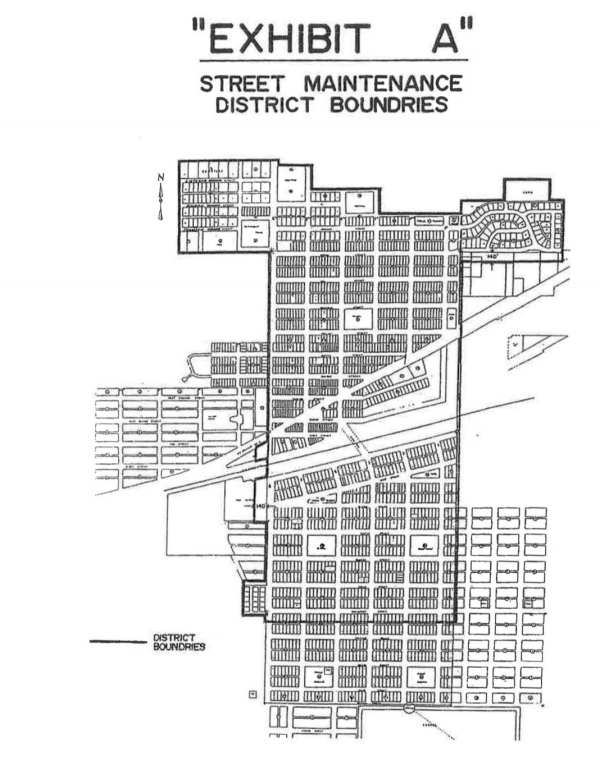
(1982 Code § 3.08.040)
9.24.020 Responsibility To Maintain
9.24.030 Clear Vision Triangle; Responsibility To Maintain
9.24.040 Vehicle Parking Prohibited; Exception
9.24.050 Encroachment Permit
9.24.060 Penalty
9.24.070 Drawing
For the purpose of this chapter, the following words and phrases used herein are defined as follows:
BOULEVARD: Within the city is that area within any street, avenue or highway right of way not occupied by street paving, curb and gutter, and sidewalks. An "inside boulevard" is the boulevard area on the property line side of the sidewalk. An "outside boulevard" is the boulevard area on the street side of the sidewalk. Except, as permitted under WPCC 9.24.050, no boulevard area may be encroached upon by any obstacle whatsoever.
OBSTACLE: Any strung wire or netting, any fence or railing, or any barrier or structure of any kind whatsoever, but does not include trees, ornamental lamp-posts, telephone or electric light poles, United States government mailboxes, signage for structures on the national historical register provided by the Montana historical society, or other structures erected by permit to aid owners in caring for the boulevards adjoining their property. The director of public works may grant a special permit for a temporary barrier to protect newly sown grass on boulevard areas if such barrier will not endanger passersby. (2004 Code)
It shall be the duty of the owners and tenants of any premises within the incorporated limits of the city to maintain the boulevard section in front of and adjoining their premises in a safe and substantial condition. (2004 Code)
- Definition: The "clear vision triangle" is the isosceles triangle having sides of forty five feet (45') as measured along the back of the curb section of each intersecting roadway. The triangle thus begins at the point where the intersecting back of each curb line would meet, thence forty five feet (45') along the back of each curb and diagonally across connecting the curb lines.1
- Signs, Fences, Plant Material Or Other Items: Any signed, fences, plant material, or other items placed in this area shall provide an unobstructed cross visibility at a level between three feet (3') and eight feet (8') above street surface elevation.
- Trees: Trees having over eight feet (8') of clear trunk, as measured from the surface elevation, with limbs and foliage trimmed in such a manner as not to extend into the cross visibility, are permitted in the clear vision triangle.
- Responsibility For Maintenance: It is the responsibility of the owner or tenant of a corner lot to maintain the clear vision triangle by trimming or removing the cause of any sight obstruction within the area described above.
- No Exemptions: No obstruction to cross visibility shall be exempted or excluded from the application of this section because of the obstruction's existence at the time of the adoption hereof. (2004 Code)
1See drawing in WPCC 9.24.070.
No vehicle shall be parked upon any boulevard area in the city except in the following instances:
- Exceptions:
- Driveways; Sidewalk: Except upon any lawfully constructed driveway, although no vehicle may be parked upon any sidewalk or sidewalk area;
- Boulevard Area: Except upon any boulevard area in a residential area if the boulevard area has no curbing or has a curb cut access to the boulevard area;
- Permit: Except by permit issued as authorized under WPCC 9.24.050. (2004 Code)
A temporary and revocable permit to allow encroachments upon any "inside boulevard" area within any area of the city may be granted to the owner or lessee of the adjoining property as approved by the director of public works. (2004 Code)
Any person who shall violate any of the provisions of this chapter shall, upon conviction thereof, be subject to penalty as provided in WPCC 1.16.010. (2004 Code)
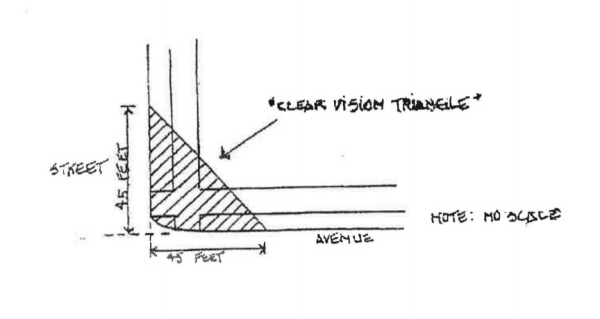
(2004 Code)
9.28.020 Sidewalk Maintenance
- Authority Of City Council To Order Construction: Whenever it is deemed necessary to construct any sidewalk or curb and gutter in the city, the city council may, by an order duly made and entered upon its minutes, order the construction of such sidewalk or curb and gutter, specifying in such order the name of the street along which and the number of the lot or lots and the block in front of which such sidewalk or curb and gutter is to be constructed. (1982 Code § 12.02.010; amd. 2004 Code)
- Construction And Maintenance Of Sidewalks, Curbs And Gutters:
- Power To Regulate: The city council has power to regulate and provide for the construction or repair of sidewalks, foot pavements, curbs, gutters, or any combination thereof.
- Failure To Comply: If the owner of any lot fails to comply with the provisions of the order within such time as may be prescribed thereby, the council may contract for the construction and repair of such sidewalks, pavements, curbs, gutters, or any combination thereof and the city may pay for the same. The amount so paid is a lien upon the lot and may be enforced or the amount may be recovered against the owner by a suit before any court of competent jurisdiction. (2004 Code)
- Regulation Of Sidewalks: The city council has power to prevent the riding or driving of animals or the drawing or riding of vehicles of any kind on the sidewalks of the city or doing damage in any way to the sidewalks. (2004 Code)
- Order For Construction; Notice:
- Written Notice: Whenever the city council shall order any sidewalk or curb and gutter constructed, it shall be the duty of the city clerk-treasurer to give written notice thereof to the owner, fully describing therein the width and character of the sidewalk by mailing a copy of such notice to the owner having property in front of which such sidewalk or curb and gutter shall be constructed at his last known address; that the service of such notice to construct said sidewalk or curb and gutter shall be deemed complete on the date of such first mailing. (1982 Code § 12.02.020; amd. 2004 Code)
- Form Of Notice: The notice issued by the city clerk-treasurer shall be in the following form: Office of the City Clerk-Treasurer, Wolf Point, Montana Notice is hereby given that the Council of the City of Wolf Point, Montana, at its regular meeting on ______, ordered concrete sidewalk and curb to be constructed as follows: The names of the streets along which said sidewalk or curb is ordered constructed appears upon the Minutes of the Council of the above date to which reference is hereby made, described as follows: All walk and curb remaining unbuilt at the expiration of thirty (30) days may be built by the City and all costs assessed as special tax to the abutting property in accordance with the provisions of paragraph F. _________________ City Clerk- Treasurer ______________ First Publication (1982 Code § 12.02.020)
- Contract For Construction: The construction of all new sidewalks and curbs and gutters as hereinbefore provided shall be by contract, the same to be let to the lowest responsible bidder and in accordance with the specifications prepared by the engineer, to be approved by the city council, which shall provide for the method of construction. All such construction shall be under the supervision and to the satisfaction of the director of public works and/or project engineer. (1982 Code § 12.020.040; amd. 2004 Code)
- Costs: The total cost of all sidewalks and curbs and gutters constructed, whether by a contractor or by the city, shall be assessed as a lien against the property abutting such sidewalk. (1982 Code 12.02.050; amd. 2004 Code)
- Grade; Driveway Crossings; Width; Slope:
- Grade: Sidewalk construction on all improved or graded streets must conform with the established grade and base lines. On all other streets, sidewalks must be laid to the sidewalk line and otherwise to the satisfaction of the director of public works.
- Driveway Crossings: Driveway crossings into private premises shall be of form and construction specified by the director of public works.
- Width: All sidewalks hereafter constructed shall be of the following widths or when otherwise ordered and approved by the city council:
- Business: On all streets, avenues used for business purposes, eight feet (8') wide or twelve feet (12') wide as directed by the director of public works.
- Residential: On all residential and other streets and avenues, five feet (5') wide.
- Slope: All sidewalks shall rise one-fourth inch (1/4) to the foot from the side adjacent to the curb to the side adjacent to the property line. (2004 Code)
- Substandard Sidewalks Condemned: Any sidewalks, which are now, or which may, by reason of natural deterioration or decay, or by reason of unevenness, steps, rapid slopes or from any cause whatsoever, become dangerous to the public safety, may be condemned by the director of public works, if after giving the property owner proper notice of the same and no action has been taken to correct, may be immediately removed, remodeled, rebuilt, repaired or newly built, as may be most expedient, and the cost thereof shall be a lien upon the lot abutting upon such sidewalk and may be enforced or the amount may be recovered against the owner by a suit before any court of competent jurisdiction or may be assessed and collected as a special tax against such lot. (2004 Code)
- Specifications For Construction: All curbing or sidewalks built or constructed on streets or avenues within the city shall be constructed in accordance with specifications on file in the office of the director of public works. (1982 Code § 12.02.080)
- Repair; Owner's Duty: It shall be the duty of the owners and tenants of any premises within the incorporated limits of the city to keep the sidewalk in front of and adjoining their premises in good, safe and substantial condition, and the owners shall see that all breaks or unsoundness of any character resulting from natural deterioration, or from any cause whatsoever, is repaired with all possible dispatch and when by reason of the construction or repairs of sidewalks from any cause whatsoever any sidewalk or section thereof is removed or rendered dangerous or impassable to the public, such spaces or openings shall be securely fenced, and from dark until sunrise red lights shall be maintained thereon, while such dangerous condition exists, and a plank walk not less than two inches (2") in thickness and not less than three feet (3') in width shall be constructed around such construction or dangerous walk, the same to extend from sidewalk to sidewalk on each side of the opening or obstruction. (2004 Code)
- Penalty: Any person who shall violate any of the provisions of this section shall, upon conviction thereof, be subject to penalty as provided in WPCC 1.16.010. (2004 Code)
- Definition: As used in this section, "obstruction" is intended to mean clothing, fruit or any kind of merchandise, boxes, crates, trunks, racks and stands of every nature and description. (2004 Code)
- Prohibited Uses: It is unlawful for any person or persons, firm or corporation to place, cause to be placed or to permit any obstruction to be placed or remain upon any of the sidewalks of the city, except in cases approved by the city council. (2004 Code)
- Snow And Ice Removal:
- Owner's Responsibility: It shall be the duty of the owner and tenant of any premises within the limits of the city to keep sidewalks in front of and adjoining the premises free from obstructions for pedestrians, and with all reasonable dispatch to remove snow, ice, slush, mud, and other threats to allow safe foot travel, and to prevent the accumulation of the same upon such sidewalks. If such removal is accomplished by a private contractor, it shall be prohibited for such contractor to pile such snow and/or ice onto any city right of way, alley or access road.
- Hours Designated For Completion: Snow, ice and similar material that has accumulated during the preceding hours shall be removed from sidewalks in commercial areas before eleven o'clock (11:00) A.M. each day and shall be removed from residential areas within twenty four (24) hours after the snowfall. Once cleared, all sidewalks shall be kept clear of snow, ice and similar material.
- Removal From Parking Lots; Deposit Prohibited: In no case shall the snow and ice or other such material removed from the parking lots within the business district of said city be dumped or deposited within the adjoining streets, avenues or alleys. (2004 Code)
- Notice To Be Given: If, in the opinion of the city council, the owner or tenant of any premises within the limits of the city fails to keep the sidewalk in front of and abutting his premises free and safe for pedestrians, the city council or their appointed representative shall notify the owner, tenant or occupant of property herein described, to remove or otherwise correct the objectionable matter herein legislated against, which notice shall be sent by registered mail to the last known address of such owner, tenant or occupant, notifying him that he has a period of twenty four (24) hours from and after receipt of such notice within which to correct or otherwise remove the objections set forth in said notice. (2004 Code)
- Failure To Comply: If the owners or tenants of property adjoining a sidewalk fail to comply with the provisions of this chapter, the city shall cause any and all obstructions to be removed and shall bill the cost thereof, together with a reasonable charge for the administration and supervision, to the parties. If the charges are not paid within sixty (60) days, the city council shall pass a resolution assessing the charges as a special tax against the premises. (2004 Code)
- Penalty: Any person who shall violate any of the provisions of this section shall, upon conviction thereof, be subject to penalty as provided in WPCC 1.16.010. (2004 Code)
9.32.020 Permit Required
9.32.030 Certificate Of Insurance
9.32.040 Exception
9.32.050 Responsibility Of Permit Holder
9.32.060 Notification Required Prior To Excavation
9.32.070 Liability For Damages To Underground Facilities
9.32.080 Completion
9.32.090 Appeal
9.32.100 Penalty
For the purpose of this chapter, the following words and phrases used herein are defined as follows:
EMERGENCY LOCATE: A locate and mark that is requested for:
- A condition that constitutes a clear and present danger to life or property; or
- A customer outage for which repairs on a previously installed utility-owned facility are required.
EXCAVATION: An operation in which earth, rock, or other material in the ground is moved, removed or otherwise displaced by means or use of any tools, equipment, or explosives. The term includes but is not limited to grading, trenching, digging, ditching, drilling, auguring, tunneling, scraping, and cable or pipe plowing and driving. Excavation does not include surface road grading maintenance or road or ditch maintenance that does not change the original road or ditch grade or flow line.
EXCAVATOR: A person conducting the excavation activities defined in the definition of "excavation".
ONE CALL NOTIFICATION CENTER: A service through which a person may request a locating and marking of underground facilities.
UNDERGROUND FACILITY: A facility buried or placed below ground for use in connecting with the storage or conveyance of water, sewage, electronic, telephonic or telegraphic communications, cablevision, fiber optics, electrical energy, oil, gas, or other substances. The term includes, but is not limited to, pipes, sewer, conduits, cables, valves, lines, wires, manholes, and attachments to the above listed items. (2004 Code)
Any person, persons, firm, partnership, copartnership, corporation, association, or any other entity, except as in 9.32.050, desiring to excavate in, or cut through, or tear open the surface of any street, avenue, alley, sidewalk, boulevard or other public place within the city, shall first obtain a permit, called an "excavation permit", therefor from the office of the city clerk-treasurer. (2004 Code)
Before any permit to open any public way be issued, such applicant must provide to the office of the city clerk-treasurer a certificate of insurance, or its equivalent, providing for public liability coverage in the sum of not less than five hundred thousand dollars ($500,000.00) for each person and not less than one million dollars ($1,000,000.00) in the aggregate for any one accident, and not less than ten thousand dollars ($10,000.00) property damage, to protect, indemnify and to save harmless the city, and, if the public way involved be U.S. highway no. 2, the state of Montana and their respective servants, agents and employees, from any expense, cost, damage and liability of any kind or character whatsoever resulting from or which may arise as a result of said permittee's excavating in, cutting through or tearing open any street, avenue, alley, sidewalk, boulevard or other public way, or which may in anywise or manner be connected with or related thereto. (1982 Code § 14.06.040; amd. 2004 Code)
Nothing in this chapter contained shall be construed as pertaining to any person, persons, firm, partnership, copartnership, corporation, association or other entity in excavating in, cutting through or breaking open a street, avenue, alley, sidewalk, boulevard or other public way under a contract with the city, or in the performance of work for, and under the supervision of, the city. (2004 Code)
- Injury To Persons Or Property: The permittee in accepting and acting under an excavation permit granted under the provisions hereof, thereby agrees to assume full responsibility for injury to persons or loss or damage to property incurred by reason of, or arising out of, any act or omission of such permittee in making any such excavation, cut or opening or in failing properly to barricade, guard and warn the public of such excavation or trench, and further thereby agrees to assume full responsibility for injury to person and losses or damage to property incurred by reason of, or arising out of, any settlement of a restored area occurring within one year of the date of the completion of the permanent resurfacing.
- Settlement Of Backfill: If any settlement in a restored area occurs within one year of the date of completion of the permanent surfacing, it shall be considered as conclusive evidence of defective backfill. Upon failure or refusal of such permittee to correct such settlement within ten (10) days after notice by the director of public works to do so, any expense incurred by the city in correcting such settlement shall be paid by the permittee. (1982 Code § 14.06.050; amd. 2004 Code)
As required by state statutes, before beginning an excavation or for an emergency locate, the excavator shall notify, through a one call notification center, all owners of underground facilities in the area of the proposed excavation. (2004 Code)
Failure to notify and obtain the information required by state statues pertaining to excavations, such person shall be liable for damages to the underground facility damaged. (2004 Code)
- City Public Way: Once all the requirements have been met and the permit granted, the permittee shall accomplish the proposed work within the time allowed by the director of public works, and under his supervision, and in accordance with rules, regulations and specifications prescribed by the director of public works, shall thoroughly backfill any such excavation or opening and restore the surface thereof to the condition it was in prior to such excavation or opening.
- U.S. Highway No. 2: If said permit shall authorize the excavating in, cutting through or breaking open of U.S. highway no. 2, the permittee shall, in accomplishing any such excavation or breaking through and in restoring the surface of said U.S. highway no. 2 to its prior condition, also perform the same in strict compliance with the specifications furnished by the Montana state highway commission and to the satisfaction of the state highway commission's engineers. (1982 Code § 14.06.020)
The director of public works may, in his discretion, grant or refuse to grant said permit. The refusal of the director of public works to grant any such permit may be appealed to the city council. (1982 Code § 14.06.020)
Any person who shall violate any of the provisions of this chapter shall, upon conviction thereof, be subject to penalty as provided in WPCC 1.16.010. (2004 Code)
9.36.020 Grounds Declared Sacred
9.36.030 Management
9.36.040 Monuments And Markers
9.36.050 Caretaker
9.36.060 Lot Prices
9.36.070 Opening And Closing Lots For Burial
9.36.080 Veterans' Circle And Veterans' Block
As used in this chapter, the following words and terms shall have the meanings ascribed to them in this section.
CEMETERY CARETAKER: The city of Wolf Point or its authorized representative, being the director of public works.
FAMILY LOT: A combination of single adjoining lots, which may be created by the owner's request to the city, as to provide for placing of a larger family type monument than allowed on a single lot. No family lot may be divided into single lots if there is a family sized monument on the family lot.
MARKER: Any gravestone which is placed flush with the ground, whether it is permanent or temporary.
MONUMENTS: Any permanent gravestone which protrudes above ground level.
SINGLE LOT: A lot as platted by the city of Wolf Point with size not exceeding five feet by ten feet (5' x 10'). (1982 Code § 6.02.010)
The grounds of the Greenwood Cemetery are sacredly devoted to the interment of human dead, and strict observance of the decorum which should characterize such a place will be required. All lots are held at burial places for the human dead and for no other purpose. (1982 Code § 6.02.020)
- All decorations must be placed upon the grave or marker in a manner that will be obstruct general maintenance activities, pose a hazard to the cemetery personnel or visitors, or appear unsightly.
- The cemetery prohibits the use of decorations if, in the opinion of the caretaker, such decorations potentially pose a hazard to visitors and cemetery personnel or interfere with general maintenance operations.
- Items of food, cans or bottles of alcohol or other beverages, and articles of clothing are not allowed upon a grave or marker.
- No decorations shall be allowed if, in the opinion of the caretaker, such decorations detract from the dignity and serenity of the cemetery.
- The city reserves the right to remove and dispose of decorations or items that fail to meet the standards specified herein. (Ord., 2-15-2010)
The city shall manage, operate and maintain the Wolf Point Greenwood Cemetery and additions thereto subject to any limitations and restrictions set forth herein or as contained in any applicable law. The caretaker of the cemetery is hereby duly appointed as a special policeman for the city for the maintenance of order and the arrest of trespassers and offenders within the exterior boundaries of the Wolf Point Greenwood Cemetery and additions thereto.
- Monuments:
- Size:
- Only one monument shall be erected on single lots and shall not exceed thirty sic inches (36") in length or twenty inches (20") in width.
- Only one monument shall be erected on family plots and shall not exceed seventy-two inches (72") in length and twenty inches in width.
- Location: No monument shall be nearer than twelve inches (12") from either side boundary of lot, or two inches (2") from end border of lot. (1982 Code § 6.02.040)
- Base: The concrete base for monuments shall be flush with the ground, and shall not extend beyond the boundary of the lot, and shall not be wider than twenty-four inches (24") or longer than eighty-four inches (84"). Before a concrete base is placed in the ground, the location must be checked and approved by the city.
- Size:
- Markers: Markers shall not be wider than twenty inches (20") or longer than twenty-four inches (24"). Temporary markers must be installed flush with the ground. All temporary markers must be attached to or set into a concrete base within thirty (30) days after the funeral date.
- Grave Covers: Grave covers of any type shall not be allowed in the cemetery. (1982 Code § 6.02.040; and Ord., 8-1-1986)
- Duty to Dig Graves, Inter Dead on Determination of Certain Facts: The cemetery caretaker shall dig graves and properly inter the dead when called upon to do so. No deceased person shall be interred until the caretake has found out that:
- The lot in which burial is to be made has been fully paid for or payment arrangements have been made with the city clerk-treasurer; and that
- Such lot is not being used beyond its capacity; and
- Before making a proper record of the name and age of the deceased persons and the exact location of the grave; and that
- The decedent's remains are enclosed within a rigid container of sufficient strength and durability and of such a material as to permanently withstand pressures of earth compaction, i.e., cement liner, and to resist decay and prevent settling of excavated area. (1982 Code § 6.02.050; amd. 2004 Code)
- Authority to Remove:
- Detrimental Trees or /Shrubs: If any tree or shrub situated on any lot shall be means of its roots, branches or otherwise become detrimental in any way to the adjoining lot, roadway or walk, it shall be the duty of the caretaker to enter upon said lot and remove the said tree or shrub or such parts thereof as he may consider detrimental, dangerous or inconvenient.
- Curb or Border Marker: If any curb or border marker situated on or about any lot shall be detrimental to or interfere with proper maintenance and beautification of that portion of the cemetery in which such lot is located, the caretaker may remove such curb or border marker.
- Authority to Install Cement Coping, Raise Turf Level: To facilitate maintenance and beautification of the cemetery property, the caretaker may install cement coping at the base of all cemetery monuments and lower or raise the level of turf on individual plats to conform to the level of surrounding grounds. (1982 Code § 6.02.060)
- Established by City Council: Values on all unsold lots in the Wolf Point Greenwood Cemetery and additions thereto are fixed and established from time to time by the city council.
- Repurchase/Resale: The city reserves the right to repurchase any burial space not actually used by the purchaser for burial purposes, and specifically limits the resale of any burial space to any individual, firm or corporation other than the city. Repurchase price shall be the original purchase price. Notwithstanding, unused burial spaces may be either sold or deed transferred by the owner to another person, only after the city has received written notification from the owner of their intentions and the proper paperwork has been completed and on file at the city office. (1982 Code § 6.02.070; amd. Ord., 8-1-1986; 2004 Code)
- Duty of Cemetery Caretaker: The cemetery caretaker shall supervise the opening and closing of the graves, and it shall be the caretaker's duty to determine that the lot and the charges for opening and closing shall have been fully paid, that the person arranging for the burial has the right to the use of such lot, and that such lost is not used beyond its capacity.
- Schedule of Charges: The schedule of charges for opening and closing cemetery plots for burial is established from time to time by the city council and is available for public inspection at the city office. (1982 Code § 6.02.080)
Only veterans with honorable and general discharges may be buried in Veterans' Circle and Veterans' Block of the cemetery. (2004 Code)
9.40.020 Hedges And Shrubbery
9.40.030 Injury To Trees Or Shrubbery
9.40.040 Trees Outside Property Line
9.40.050 Penalty
Any owner, agent, tenant or occupant of any real property shall trim all trees on property owned by him, overhanging the sidewalks, streets or alleys, so that the branches thereon will not interfere with pedestrian or public travel. (1982 Code § 14.04.010)
Any owner, agent, tenant or occupant of any real property shall trim all hedges and shrubbery adjacent to public sidewalks so that no part of said hedges and/or shrubbery shall extend over any part of a public sidewalk in the city. (1982 Code § 14.04.020)
It is hereby declared unlawful for any person not the owner thereof, or without lawful authority to do so, to willfully injure, deface, disfigure or destroy any fruit, shade or ornamental tree or shrub, or to injure, destroy, cut or pick any flower or plant, growing, standing or being either on private ground or any street, parking lot, public park or place within the city. (1982 Code § 14.04.030)
The mayor and/or director of public works are hereby given full and complete control over all trees growing within the confines of the city limits which are outside the property lines of the respective lots, plots and tracts. (Ord., 11-17-2003)
Any person who shall violate any of the provisions of this chapter shall, upon conviction thereof, be subject to penalty as provided in WPCC 1.16.010. (1982 Code § 14.04.050)
9.44.020 Members
9.44.030 Term Of Office
9.44.040 Compensation
9.44.050 Duties And Responsibilities
9.44.060 Operations
There is hereby established a Tree Board for the City of Wolf Point. The following provisions and rules shall apply to the Tree Board. (2004 Code § 14.04-060)
The Tree Board shall consist of three (3) members, to be appointed by the mayor with the consent of the city council. Members will be chosen from: (2004 Code § 14.04.061)
- Representative of advocacy group.
- Member of the city council.
- Citizen at large.
The term of office will be for three (3) years. In the event of a vacancy, a successor shall be appointed in the same manner as the original appointments for the unexpired portion of the term.
Members of the Board shall serve without compensation. (2004 Code § 14.040.063)
It shall be the responsibility of the Board to study, investigate, counsel and develop and/or update annually a written plan for the care, preservation, trimming, planting, replanting, removal or disposition of trees and shrubs in and around public ways, street rights of way, alleys and parks. Included in the plan will be appropriate educational programs for the public. Such plan will be presented annually to the city council and upon their acceptance and approval shall constitute the official comprehensive city tree plan for the City of Wolf Point, Montana.
The City Tree Board, or its agent, shall be responsible for an on-going inventory of Wolf Point's public tree resources. This inventory shall include aa yearly hazard tree assessment.
The City Tree Board, or its agent, shall be responsible for the planting, pruning and removal of all trees located within the street rights-of-way, easements, alley and parks of the city.
The Board, when requested by the city council, shall consider, investigate, make findings, report and recommend upon any special matter of question coming with the scope of its work. (2004 Code § 14.040.064)
The Board shall choose its own officers, make its own rules and regulations and keep a journal of proceedings. A majority of the members shall be a quorum for the transaction of business. (2004 Code § 14.040.065)
10.08 Street Names And Building Numbers
10.12 (Reserved)
10.16 (Reserved)
10.20 Demoltion
10.04.020 Permit Required; Fees
10.04.030 Code Enforcement
10.04.040 Administration And Enforcement; Appeal Procedure
10.04.050 Penalty
- Adoption: The current edition of the building code and all accompanying appendices, amendments and modifications adopted by the building codes bureau, Montana department of labor and industry (or its successor), as set out in the administrative rules of Montana, as amended from time to time by the building codes bureau, shall be adopted by reference by administrative order of the mayor, as authorized by MCA § 50-60-301(1)(b), except for any exceptions noted in this chapter or any regulations not applicable to local government jurisdictions.
- Applicability: This code is applicable to all buildings within the building code enforcement area of the city including, but not limited to, residential buildings containing less than five (5) dwelling units or their attached-to structures, any farm or ranch building, and any private garage or private storage structure used only for the owner's own use, as provided by MCA § 50-6-102(1)(a).
- Scope: The adopted building code shall regulate the erection, construction, enlargement, alteration, repair, moving, removal, demolition, conversion, occupancy, equipment, use, height, area and maintenance of all buildings and/or structures in the city and its jurisdictional area, providing for issuance of permits and collection of fees and penalties.
- Copy On File: One copy of the code shall be on file in the office of the city clerk-treasurer.
- Code Or Amendments: Any such code or amendments adopted by the building codes bureau which apply to local government jurisdictions, including the adoption of the latest editions of the model technical codes or applicable administrative rules of Montana, shall become effective in the city upon order of the mayor within thirty (30) days after the date that the bureau notifies the city of said amendments. (Ord., 5-20-2002)
Any person, firm, association or corporation prior to the commencement of any construction, alteration or repair of any building or structure within the corporate limits of the city, shall first file a written application for a permit authorizing such construction, alteration or repair with the city clerk-treasurer, setting forth in said application the proposed location, dimensions, manner of construction, alteration or repair, and the material to be used, which said application must be presented to the zoning administrator/director of public works who shall upon his approval submit it to the building inspector for his approval. The fees for a building permit are as set forth in uniform building code, as adopted by the city, and amendments and additions thereto. (Ord., 2-21-2000; amd. 2004 Code)
The city enforces the building codes adopted on residential structures, and all commercial structures located within the corporate limits of the city. (Ord., 2-21-2000)
- Administration; Enforcement: The zoning administrator (director of public works) shall administer and enforce the provisions of this chapter. The city contract with an engineering firm for the inspections.
- Appeals: Any person, firm or entity desiring to appeal the application of the building code or other codes adopted herein shall follow the appeal procedure set forth for the appeal of zoning decisions to the board of adjustments. The board of adjustments is hereby designated as the board of appeal for all appeals under this chapter. The procedures for appeal to the board of appeal are set forth in the zoning ordinance, WPCC 13. (Ord., 2-21-2000)
Any person violating a provision of this chapter shall, upon conviction thereof, be subject to penalty as provided in WPCC 1.16.010. (Ord., 2-21-2000)
10.08.020 Houses To Be Numbered
10.08.030 Odd And Even Numbers
10.08.040 Numbering Houses Fronting On Avenues
10.08.050 South Side Exceptions To General Rule
10.08.060 North Side Exceptions To General Rule
10.08.070 Numbering Houses Fronting On Streets
10.08.080 City Engineer To Designate Numbers
10.08.090 Penalty For Refusal To Number
- North And South: All streets, avenues and public highways running in a northerly and southerly direction within the city shall be known as avenues and be designated as such.
- Extensions:
- North Of South Front Street: The extensions of all avenues north of South Front Street shall bear the suffix "north" to distinguish the same, such as First Avenue North, Second Avenue North, and the same shall apply in all cases.
- South Of South Front Street: All avenues south of South Front Street shall bear the suffix "south" to distinguish the same, such as First Avenue South, Second Avenue South, and the same shall apply in all cases.
- Sixth Avenue: The street designated on the original plat of the townsite of Wolf Point as "West Boundary Street" shall be and the same hereby is changed to "Sixth Avenue" and shall be designated as such.
- Streets In Original Townsite: The streets in the original townsite of the city shall be known and designated as follows:
- Alder Street: The street designated on the original plat as North Boundary Street shall be known and designated as Alder Street.
- North Front Street: The street designated on the original plat as North Front Street shall be known and designated as such.
- South Front Street: The street designated on the original plat as South Front Street shall be known and designated as such.
- Main Street: The street designated on the original · plat as Assinniboine Avenue shall be known and designated as Main Street.
- Anaconda Street: The street designated on the original plat as "A" Street shall be known and designated as Anaconda Street.
- Benton Street: The street designated on the original plat as "B" Street shall be known and designated as Benton Street.
- Custer Street: The street designated on the original plat as "C" Street shall be known and designated as Custer Street.
- Dawson Street: The street designated on the original plat as "D" Street shall be known and designated as Dawson Street.
- Edgar Street: The street designated on the original plat as "E" Street shall be known and designated as Edgar Street.
- Fairweather Street: The street designated on the original plat as South Boundary Street shall be known and designated as Fairweather Street.
- Streets In The First Addition: Thee streets in the first addition to the city shall be known and designated as follows:
- Granville Street: The street designated on the original plat as "G" Street shall be known and designated as Granville Street.
- Helena Street: The street designated on the original plat as "H" Street shall be known and designated as Helena Street.
- Idaho Street: The street designated on the original plat as "I" street shall be known and designated as Idaho Street.
- Streets In Sibbits Addition: The streets in Sibbits Addition to the city shall be known and designated as follows:
- Blaine Street: The street designated on the original plat as Valley Avenue shall be known and designated as Blaine Street.
- Cascade Street: The street designated on the original plat as Sheridan Avenue shall be known and designated as Cascade Street.
- Dayton Street: The street designated on the original plat as Western Avenue shall be known and designated as Dayton Street.
- Erueka Street: The street designated on the original plat as Montana Avenue shall be known and designated as Erueka Street.
- Streets In North Wolf Point Addition: The streets in the addition to the city known as North Wolf Point shall be known and designated as follows:
- Fallon Street: The street designated on the original plat as North "A" Street shall be known and designated as Fallon Street.
- Garfield Street: The street designated on the original plat as North "B" Street shall be known and designated as Garfield Street.
- Hill Street: The street designated on the original plat as North "C" Street shall be known and designated as Hill Street.
- Indian Street: The street designated on the original plat as North "D" Street shall be known and designated as Indian Street. (Ord. 75, 11-24-1919)
In order to establish a uniform system of numbering houses within the city, all houses fronting on streets, avenues and public highways within the city shall be numbered in conformity with the following provisions. (Ord. 76, 11-24-1919)
Odd numbers shall be given to houses on the east and south side of the streets, avenues and highways, and even numbers to those on the west and north sides of the same. (Ord. 76, 11-24-1919)
On avenues in the city, the numbering of houses shall commence with number "one" at South Front Street and its extensions both east and west, and increase in each direction from South Front Street, one hundred (100) numbers for each block or space between streets; and to distinguish such numbers, the streets, avenues and highways shall be designated, reckoning from South Front Street, as First Avenue North, First Avenue South, Second Avenue North, Second Avenue South and the same with all other streets running at right angles with and crossing of said South Front Street. (Ord. 76, 11-24-1919)
On account of triangular blocks in the original townsite, and the subsequent intersection of Main Street with Anaconda Street, and with Benton Street, the numbering of houses fronting on avenues will be resumed at Benton Street with the number three hundred (300) and increase one hundred (100) numbers for each block or space between streets in a southerly direction. The general rule will be followed in numbering houses from South Front Street to Benton Street. (Ord. 76, 11-24-1919)
On account of triangular blocks in the original townsite and the subsequent intersection of North Front Street and Alder Street, the numbering of houses fronting on avenues will be resumed at "A" Street with number two hundred (200) and increase one hundred numbers (100) for each block or space between streets in a northerly direction. The general rule will be followed in numbering houses from North Front Street to Alder Street. (Ord. 76, 11-24-1919)
The numbering of houses fronting on streets in the city shall commence with number "one" at the line which forms the east boundary of the original townsite of the city and upon the same line in its extensions both north and south and increase in each direction from said line, one hundred (100) numbers for each block or space between streets, and to distinguish such numbers, the extension of each and every street, avenue or highway easterly of said east line of the original townsite, or east of any extension of said line, either north or south, shall be designated, reckoning from said line as East Alder Street, East Benton Street; and the same shall apply in all cases where streets run at right angles with and cross said east line of the original town site and its extensions. (Ord. 76, 11-24-1919)
The city engineer shall designate the numbers of all houses in conformity with the provisions of this chapter, allowing two (2) numbers for each twenty five feet (25') of ground, and shall furnish the owner of each house now or hereafter built, with its proper number as soon as completed. When any house is not correctly numbered or not numbered at all, the city engineer shall give such house its proper number, and require the same to be put on such house in a conspicuous place next to the street, at the expense of the owner. (Ord. 76, 11-24-1919)
In case any owner, occupant or agent, after having been requested as aforesaid by the city engineer, or his authorized agent, shall refuse or neglect for ten (10) days to number a house as required, or shall number or attempt to number such house otherwise than in conformity with this chapter, and the requirements of the city engineer, such person shall, upon conviction thereof, be subject to penalty as provided in WPCC 1.16.010. When such fine is paid, the city engineer shall cause such house to be correctly numbered at the expense of the city. (Ord. 76, 11-24-1919; amd. 2004 Code)
Trailer Homes; Trailer Courts - REPEALED 1/21/2016
(See WPCC 11 - Zoning Regulations)
Signs & Awnings - REPEALED 1/21/2016
(See WPCC 11 - Zoning Regulations)
10.20.020 Permit Fee
10.20.030 Landfill Fee
10.20.040 Permit
10.20.050 Responsibility
10.20.060 Exceptions
10.20.070 Completion Deadline
10.20.080 Penalty
Any person, persons, firm, partnership, copartnership, corporation, association, or any other entity, except as in WPCC 10.20.060, desiring to demolish any building within the city, shall first obtain a permit therefor from the city clerk-treasurer. Permit shall be as set forth in WPCC 10.20.040. All fees required shall be paid prior to the demolition. (Ord., 3-16-1987; amd. 2004 Code)
A fee of ten dollars ($10.00) shall be charged for each permit issued, payable at time of issuance of the permit. (Ord., 3-16-1987)
The public works director shall determine the landfill fee required for the building to be demolished and such fee shall be paid prior to the commencement of the demolition. (Ord., 3-16-1987)
The permit, to be called a "demolition permit", a copy of which is on file and of record in the office of the city clerk-treasurer, will be issued on a form provided by the city and issued by the city clerk-treasurer. (Ord., 3-16-1987; amd. 2004 Code)
The permittee in accepting and acting under a demolition permit, granted under the provisions hereof, thereby agrees to assume full responsibility for injury to persons or losses or damage to property incurred by reason of, or arising out of any act or omission of such permittee in demolishing said structure. The permittee will be required to indemnify the city against such injury to persons or losses to property prior to issuance of the permit. (Ord., 3-16-1987)
Nothing in this chapter contained shall be construed as pertaining to any person, persons, firm, partnership, copartnership, corporation, association or other entity in demolishing a building under a contract with the city, or in performance of work for, and under the supervision of the city. (Ord., 3-16-1987)
Any demolition project under permit shall be completed within thirty (30) days of commencement of the demolition unless the permittee obtains an extension from the city council for cause. (Ord., 12-19-1988)
Violators of this chapter shall, upon conviction thereof, be subject to penalty as provided in WPCC 1.16.010. (Ord., 3-16-1987; amd. 2004 Code)
11.08 Zoning Districts - General
11.12 Zoning Districts - Standards
11.16 Zoning Districts - Special Regulations
11.20 Nonconformities
11.24 Annexations
11.28 Vacating
11.32 Board Of Adjustment
11.36 Amendments
11.40 Mobile Home Courts
11.44 Zoning Applications
11.48 Street Design Standards
11.04.020 Administration
11.04.030 Definitions - General Provisions
- General Provisions:
- Title: This title shall be known as the Zoning Regulations for the City of Wolf Point.
- Authority: It is the intention of the City Council in adopting these Zoning Regulations to fully exercise all of the powers reserved to the City under MCA § 76-2-301 et seq.
- Purposes: The purposes of these Zoning Regulations are to assure the orderly and sensitive development of land within Wolf Point; to protect and enhance the quality of life in the City and its environs; and to establish a clear, consistent, predictable and efficient land development review process. To achieve these purposes, this title establishes regulations which:
- Implement the Growth Policy
- Promote Public Health, Safety and General Welfare
- Protect Property Values
- Preserve Neighborhoods
- Manage Development with Uniform District Standards
- Prevent Hazardous Development
- Applicability:
- Conformance with these Zoning Regulations shall apply to all land, buildings, structures and uses located within the City of Wolf Point, or annexed to the City, and as shown on the official zoning map of the City.
- No building or land shall be used or occupied, and no building shall be erected, moved or altered, unless in conformity with the regulations specified for the district in which it is located.
- No building shall be erected or altered:
- To exceed the height allowances,
- To accommodate or house a greater number of families,
- To occupy a greater percentage of lot area, or
- To have narrower or smaller rear yards, front yards, side yards·, inner or outer courts than is specified herein for the district in which such building is located.
- No part of a yard or other open space about any building required for the purpose of complying with the provisions of this title shall be included as part of a yard or other open space similarly required for another building.
- Existing Uses and Structures: The City of Wolf Point recognizes the existence of buildings and uses which fail to meet required height, setback, site coverage, density, parking, and other regulations. These situations are addressed in Nonconformities WPCC 11.20, providing review standards for changes to nonconforming uses and buildings.
- Minimum Requirements: The provisions of the title are the minimum requirements necessary to protect the public health, safety and general welfare of the City.
- Severability: If any section, provision or portion of this title is adjudged invalid by a court of competent jurisdiction, the remainder of this title shall not be affected thereby.
- Private Restrictions: This title is not intended to revoke or repeal any easement, covenant or other private agreement. However, where this title is more restrictive or imposes higher standards than such easement, covenant or private restriction, the requirements of this title shall govern. In no case shall the City be obligated to enforce the provision of any easement, covenant or agreement between private parties. The City may enforce private restrictions if it is a party to such restrictions if such restrictions were required by the City during the land permitting and development process, in order to meet the requirements of this title.
- Enforcement:
- Duties of the Zoning Administrator: It is the intent of this title that the Zoning Administrator or his/ her authorized representatives shall enforce these regulations. If during this procedure, the Zoning Administrator determines that the proposed plan or construction does not comply with this title, he shall inform the applicant of the infraction and shall not issue the requested permit and/or shall stop all construction of the project until such time as the applicant, builder, or principal revises his plans or applies for a variance, conditional use permit or a zone change and the reviewing body (as specified in this Ordinance) has officially approved the application.
- Permit Required: It is unlawful to commence the excavation for, or the construction of, any building or structure, or to store building materials, earth or fill, or to construct entrances or parking lots, or to commence the moving, structural alteration or conversion of any structure, fence, or wall, until a permit has been issued by the City Clerk for such work.
- Expirations and Extensions: If the work described in any permit has not begun within one (1) year from the date of issuance, said permit shall expire; it shall be canceled by the Zoning Administrator and written notice given to the persons affected. However, if the applicant applies to the Zoning Administrator at least ten (10) days prior to the expiration date of said permit, an extension may be granted by the Zoning Administrator for good cause. Such extensions shall be valid for sixty (60) days. A total of two extensions may be allowed. Additional extensions beyond those two which are allowed administratively can be requested directly from the City Council.
- Conformity of Construction and Use: Permits issued on the basis of plans and applications approved by the Zoning Administrator authorizes only that which was set forth in such approved plans, and nothing else.
- Penalties and Violations:
- Notification: If the Zoning Administrator or other appointed official finds that any provision of this title is being violated, he shall provide written notification to the person responsible for such violation and order corrective action. He shall have the authority to order discontinuance of any illegal use of land, structures or buildings; or shall take any necessary action authorized by this title to insure compliance.
- Violations are a Misdemeanor: Violations of any of the provisions of this title or failure to comply with any of its requirements, or any of the requirements or conditions imposed by the Zoning Administrator and/or City Council shall constitute a misdemeanor. Any person who violates this title or fails to comply with any of its requirements shall, upon conviction thereof, be fined not more than five hundred dollars ($500.00), or imprisoned for not more than six (6) months, or both, and in addition shall pay all costs and expenses involved in the case. Each day such violation continues shall be considered a separate offense and punishable as such.
- The owner or tenant of any building, structure, premises, or part thereof, and an architect, builder, contractor, agent or other person who commits, participates in, assists in, or maintains such violation, may each be found guilty of a separate offense and suffer the penalties herein provided.
- Abatement: In the event of violation of this title, the City may additionally institute appropriate action to prevent, enjoin, abate, or remove the violation, to prevent the occupancy of the building, structure, or land, or to prevent any illegal act or use in or on such premises. The City may also compel recision of any sale or lease made in violation of this title.
- Complaints: Any person aggrieved by a violation or apparent violation of the provisions of this title may file a written complaint with the Zoning Administrator or other duly authorized person, who shall investigate as soon as reasonably possible and take appropriate action within a reasonable amount of time.
- Types of Applications: This section sets forth standard review procedures for applications within this ordinance:
- Review Procedures for Applications that Require a Public Hearing:
- Applications that require a Public Hearing:
- Conditional Uses
- Variances/Zoning Appeals
- Amendments to the Zoning Ordinance or the Official Zone District Map
- Pre-Application Meeting: A pre-application meeting shall be held between the applicant and the Zoning Administrator to discuss the project and required application elements. See paragraph F,1 regarding the contents of the pre-application meeting.
- Submit Application: Following the pre-application meeting, the applicant shall submit a complete application containing at a minimum those materials listed in paragraph C.
- Staff review of the development application: to determine its completeness and compliance with the requirements of the underlying zone district, and its conformance with all applicable review standards.
- Public notice: of a public hearing, as applicable.
- Staff completes recommendation to the reviewing body (as specified in this Ordinance).
- Public action on the application: by the appropriate reviewing body (as specified in this Ordinance).
- Actions following application approval: by the applicant in order to obtain permitting.
- Zoning Permits
- Sign Permits
- Home Occupations
- Applications that require a Public Hearing:
- Contents for Applications that Require a Public Hearing:
- Minimum Contents:
- The applicant’s name, address and telephone number. If applicant is acting as a representative of the property owner, the property owner must submit signed authorization allowing applicant to act on their behalf and include owner’s contact information.
- Legal description of the property where development is proposed.
- Proof of ownership of the property where development is proposed. The disclosure of ownership may be in the form of a deed, tax assessment record, contract for purchase and sale, current commitment from a title insurance company or other similar documentation.
- Vicinity map locating the subject property within the City of Wolf Point.
- Site Plan which clearly identifies:
- Lot dimensions and square footage.
- Setbacks, dimensions from property lines.
- Size and locations of existing buildings and utilities.
- Points of ingress and egress from the structure to the property and from the property to the public right of way.
- Locations and dimensions of proposed buildings or alterations.
- Structures adjacent to the property.
- Natural or topographic peculiarities of the property including general drainage patterns.
- Written narrative which clearly identifies:
- The nature and frequency of the use, number of people and number of vehicles associated with the use.
- Impacts of the use generally expected on the community and specifically to adjacent properties.
- Current zoning and any changes being requested
- Effect of the use on the City’s services and infrastructure.
- Effect of the use on parking in the area, specifying the amount of parking needed for the development.
- Site and structure improvements necessary to accomplish the requested use.
- Review fee:
- Each development application on file with the City of Wolf Point Zoning Administrator shall be accompanied by a review fee to cover the cost of processing as established by resolution.
- No final approval shall be granted to an applicant for which the property owner is delinquent with any payment due to the City of Wolf Point
- Minimum Contents:
- Review Procedures for Applications that are Reviewed Administratively:
- Applications that are reviewed administratively:
- Zoning Permits
- Sign Permits
- Home Occupations
- Submit Application: applicant shall submit a complete application containing at a minimum those materials listed in paragraph E.
- Staff review of the development application: to determine its compliance with the requirements of the underlying zone district, and its conformance with all applicable review standards.
- Staff action on the development application.
- Applications that are reviewed administratively:
- Contents for Applications that are Reviewed Administratively:
- Minimum Contents:
- The applicant’s name, address and telephone number. If applicant is acting as a representative of the property owner, they must submit signed authorization to act on their behalf and include owner’s contact information.
- Legal description of the property where development is proposed.
- Proof of ownership of the property where development is proposed. The disclosure of ownership may be in the form of a deed, tax assessment record, contract for purchase and sale, current commitment from a title insurance company or other similar documentation.
- Vicinity map locating the subject property within the City of Wolf Point.
- Site Plan which clearly identifies:
- Lot dimensions and square footage
- Setbacks dimensions and square footage
- Size and locations of existing buildings and utilities
- Points of ingress and egress from the structure to the property and from the property to the public right of way.
- Locations and dimensions of proposed buildings or alterations
- Structures adjacent to the property
- Natural or topographic peculiarities of the property and general drainage patterns
- Review Fee:
- Each development application on file with the City of Wolf Point Zoning Administrator shall be accompanied by a review fee as established by resolution to cover the cost of processing.
- No final approval shall be granted to an applicant for which the property owner is delinquent with any payment due to the City of Wolf Point.
- Minimum Contents:
- Staff Review/Processing for Applications that Require Public Hearing:
- Contents of a Pre-Application Meeting:
- Applicant provides verbal description of the proposed development accompanied by a site plan or other illustrative element.
- Zoning Administrator explains applicable procedural requirements and review standards.
- Zoning Administrator identifies any special agencies or departments to which the application will be referred to for comment.
- Zoning Administrator makes applicant aware of applicable applications, fees and submittals including components of site plan review.
- The Zoning Administrator may, at the pre-application meeting or thereafter, waive certain submittal requirements they deem duplicative or unnecessary for review of the proposed development; although, the reviewing body (as specified in this Ordinance) may determine that information is needed before taking final action.
- Staff Review of the formal application:
- Completeness determination by Zoning Administrator for all requirements in paragraph C.
- Compliance determination by Zoning Administrator with the requirements of the underlying zone district.
- Zoning Administrator schedules public hearing with reviewing body (as specified in this Ordinance) when the application is determined to be complete.
- Referral and review from other departments or agencies may be solicited by the Zoning Administrator when deemed appropriate.
- Staff report shall be compiled by the Zoning Administrator and transmitted to the governing body.
- Contents of a Pre-Application Meeting:
- Public Notice: Adequate notice of governmental actions should be given to those affected by such actions. Depending on the application, fifteen (15) days notice is typically required, but applicant should confirm their specific requirement with staff. Notice of the time and place of such hearings shall be published in an official paper, or a paper of general circulation in the City/County.
- The following elements shall be included in notices issued pursuant to this title:
- Address or other description to identify the affected property
- Legal description of the property
- Name and address of the applicant and owner of record, if different
- Number, date, time and place of scheduled public hearings at which recommendations or final decisions will be made by the reviewing body (as specified in this Ordinance), or the date of any final public comment deadline
- Description of how and where additional information regarding the action may be obtained including address and phone number of the City
- Brief description of the subject of the notice
- A location map of the area of the proposed development
- For Zoning Ordinance or Official Zoning Map Amendments, notice shall include a summary explanation of the intent of the change, with reference to the exact text being available for public review.
- The following elements shall be included in notices issued pursuant to this title:
- Appeal: An applicant may appeal to the City Council a reviewing authority’s denial of a project. The following general procedures shall govern that appeal process.
- Persons who may appeal:
- The applicant
- The property owner
- Any property owner adjoining the subject property
- Any property owner within 150 feet of the subject property
- Any person whom the City Attorney determines would have standing to litigate an adverse outcome.
- Written notice of the appeal must be filed with the City Clerk within ten (10) working days of the decision or final action. The notice shall include:
- Appellant contact information
- Property owner, applicant and subject property
- Complaint of the reviewing body’s (as specified in this Ordinance) action including description of any injury or harm resulting from the action
- The factual and legal basis of the appeal with specific reference to the city regulations, procedures or otherwise upon which the appeal is based
- Certification that a copy of the appeal has been mailed to the applicant and, if applicable, the reviewing body (as specified in this Ordinance)
- Public Hearing shall be scheduled by the City Clerk before the City Council within thirty (30) days after the written notice is filed.
- Public Notice shall be given in accordance with paragraph G.
- Action by the City Council shall be taken within ten (10) working days after the conclusion of an appeal hearing, or as soon thereafter as may be reasonably accommodated.
- Persons who may appeal:
- Consolidation: The required review processes are designed to encourage the simultaneous review of multiple aspects of a development request. Applicants may request and the Zoning Administrator may permit the consolidated review of more than one (1) development application for the same parcel of land. The Zoning Administrator is authorized to waive any overlapping requirements in the submission.
- Purpose: For the purpose of this title, certain terms and words are hereby defined. Words used in the present tense shall include the future tense; the singular number shall include the plural and the plural, the singular; the word “building” shall include the word “structure” and the word “shall” is mandatory and not directory; the word “lot” shall include the word “plot”, “piece” and “parcel”.
- Definitions:
ACCESS: The place, means or way by which pedestrians and vehicles shall have adequate and usable ingress and egress to property.
ACCESSORY BUILDING: A subordinate building or structure on the same lot, or part of the main building, exclusively occupied by or devoted to a use incidental to the main use.
ACCESSORY USE: A use subordinate to the main use on a lot which is customarily incidental to those of the main use.
ALLEY: A public thoroughfare which affords only secondary means of access to property abutting thereon.
APARTMENT: A room or suite of rooms located in a one, two, or multiple family structure, which shall include a bath and kitchen accommodations, intended or designed for use as an independent residence by an individual or single family.
APARTMENT BUILDING: A multiple family dwelling designed and constructed to accommodate three (3) or more apartments, designed with more than one (1) dwelling unit connecting to a common corridor or entranceway, in contrast to single or two-family dwellings converted for multiple family use or attached row dwelling (party wall type) as defined herein.
AUTOMOBILE SERVICE STATION: Any building or premises used for the dispensing or sale of automobile fuels, lubricating oil or grease, tires, batteries, or minor automobile accessories. Services offered may include the installation of tires, batteries and minor accessories; minor automobile repairs; and greasing or washing of individual automobiles. When sales, services and repairs as detailed here are offered as incidental to the conduct of public garages, the premises shall be classified as a public garage.
BLOCK: That property abutting on one side of a street and lying between the two nearest intersecting or intercepting streets or intersecting or intercepting a street and waterway or other barrier or a gap in the continuity of development along such street.
BOARDING HOUSE: A building other than a hotel, where for compensation and by prearrangement for definite periods, meals, or lodging and meals, are provided for three (3) or more persons, but not exceeding ten (10) persons.
BOARD OF ADJUSTMENT: A Board established and operated under the terms of MCA §§ 76-2-321 through 76-2-326 (as amended) to hear and decide appeals and other actions as specified in this Ordinance.
BUILDING: Any structure intended for the shelter and use of persons, animals or property.
BUILDING, HEIGHT OF: The vertical distance measured from the average elevation of the finished grade around the building to the highest point of the coping of a flat roof, or to the top of a mansard roof, or to two-thirds (2/3) the height of the highest gable of a pitch or hip roof.
BUILDING AREA: That portion of the lot that can be occupied by structures, excluding the front, rear and side yards.
CELLAR: A story having more than one-half (1/2) of its height below grade, A cellar is not included in computing the number of stories for purpose of height measurement.
CENTRAL WATER and SEWER SYSTEMS: Utility systems serving a group of buildings, lots or an area.
COMMERCIAL FEEDING OPERATION: A non-agricultural business which confines for feeding or fattening purposes fifty (50) or more cattle, swine, sheep or horses for marketing purposes. Wintering or dairying operations are not included.
CONDITIONAL USE: Any use to which this title, or the City of Wolf Point, may set specific conditions, all of which must be met prior to approval of said use.
DWELLING: A building or portion thereof, designed or used exclusively for residential occupancy, including one family, two-family and multiple-family dwelling units, but not including hotels, motels, boarding or lodging houses.
DWELLING, ATTACHED (GROUP, ROW, or TOWNHOUSE): A dwelling joined to another building by a party wall or walls.
DWELLING, DETACHED: A dwelling entirely surrounded by open space, said open space being on the same lot as the dwelling.
DWELLING, MULTIPLE FAMILY: A building containing three (3) or more dwelling units designed with more than one (1) dwelling unit connecting to a common corridor or entranceway; and not including converted dwellings or attached row dwellings (party-wall type) as defined herein.
DWELLING, SINGLE FAMILY: A detached dwelling containing accommodations for and intended-for occupation by one (1) family only.
DWELLING, TWO FAMILY: A dwelling designed exclusively for the occupancy of two (2) families living independently of each other.
DWELLING, MOBILE HOME: A detached residential dwelling unit designed for transportation on streets or highways on its own wheels or upon a flatbed or trailer, and arriving at the site where it is to be occupied as a permanent dwelling complete and ready for occupancy except for minor and incidental unpacking and assembly operations, location on jacks or other temporary foundations, connections to utilities and the like. If a mobile home is located on a permanent foundation, it is considered a single-family dwelling. A travel trailer is not considered a mobile home.
FAMILY: One or more persons occupying a dwelling unit as members of a single housekeeping organization. A family may include not more than five (5) persons not related by blood, marriage or adoption.
FUTURE LAND USE MAP: A graphic representing the City’s vision of future growth. The map proposes future land use designations to certain lands in or around the City of Wolf Point.
GARAGE, PRIVATE: An accessory building or portion of a main building on the same lot and used for the storage of private belongings and private passenger motor vehicles, not more than two of which are owned by others than the occupants of the main building.
GARAGE, PUBLIC: A building or portion of a building, except any herein defined as a private garage or as a repair garage, used for the storage of motor vehicles, or where any such vehicles are kept for remuneration or hire, in which any sale of gasoline, oil and accessories is only incidental to the principle use.
GARAGE, REPAIR: A building or space for the repair or maintenance of motor vehicles, but not including factory assembly of such vehicles, auto wrecking establishments or junk yards.
HOME OCCUPATION: “Home occupation” means an occupation which is carried on in a dwelling unit, and meets the special regulations of WPCC 11.16.040.
HOTEL: A building or group of buildings occupied as the more-or-less temporary abiding place of individuals or families who are lodged with or without meals in which there are more than ten (10) sleeping rooms and no provisions are made for cooking in any individual room.
JUNK YARD: Land or buildings where waste, discarded or salvaged materials are bought, sold, stored, exchanged, cleaned, packed, disassembled or handled, including, but not limited to, scrap metal, rags, paper, hides, rubber products, glass products, lumber products and products resulting from the wrecking of automobiles or other vehicles.
KENNEL: A place where dogs or cats are kept commercially.
LODGING HOUSE: A building or place where lodging or lodging and boarding is provided (or equipped to provide lodging regularly) by prearrangement for definite periods of time, for compensation, for three (3) or more persons in contra-distinction to hotels or motels open to transients.
LOT: Land occupied or to be occupied by a building and its accessory buildings together with such open spaces as are required under this title and having its principal frontage upon a street or officially approved place.
LOT COVERAGE: The area or percentage of a lot occupied by the principal building or buildings and accessory buildings.
LOT DEPTH: The average horizontal distance between the front and rear lot lines.
LOT WIDTH: The horizontal distance between the side lot lines measured at right angles to the lot depth at the established or required front building line.
LOT, CORNER: A lot located at the intersection of two (2) streets or a lot bounded on two (2) sides by a curving street two (2) chords of which form an interior angle of one hundred twenty degrees (120°) or less.
LOT, DOUBLE FRONTAGE: An interior lot having frontage on two (2) parallel or approximately parallel streets.
LOT, INTERIOR: A lot other than a corner lot.
LOT OF RECORD: A lot or parcel of land, the deed to which was recorded in the official record of the City of Wolf Point at the time of adoption of this ordinance.
MOTEL: A building providing temporary lodging for individuals or families, with or without meals. Parking space is made available for vehicles or customers or guests frequenting the establishment.
MOBILE HOME: A structure in one or more sections that is eight (8) body feet or more in width or forty (40) body feet or more in length in the traveling mode; when erected on-site, is three hundred twenty (320) or more square feet in size; is built on a permanent chassis; and is designed to be used as a dwelling for human occupancy or use upon connection to required utilities, including plumbing, heating, and electrical systems.
MOBILE HOME PARK: Any plot of ground upon which two (2) or more mobile homes occupied for dwelling or sleeping purposes, are located; regardless of whether a charge is made for such accommodation.
NONCONFORMING USES: Any building or land lawfully occupied by a use at the time of adoption of these regulations, which does not conform with the use regulations of the district in which it is situated.
PARKING SPACE: A land area of not less than one hundred eighty (180) square feet (typically 9’ x 20’) exclusive of driveways and aisles, of such shape and dimensions and so prepared as to be usable for the parking of a motor vehicle and so located as to be readily accessible to a public street or alley.
REST HOME, NURSING HOME or CONVALESCENT HOME: A private home for the care of children or the aged or infirm, or a place of rest for those suffering bodily disorders. Such home does not contain equipment for surgical care or for treatment of disease or injury.
SIGNS: Any outdoor advertising having a permanent location on the ground, or attached to or painted on a building, including bulletin boards, billboards and poster boards, or any device designed to inform or attract attention.
STORY: That portion of a building, other than a cellar, included between the surface of any floor and the surface of the floor next above it, or, if there is no floor above it, then the space between the floor and the ceiling next above it.
STORY, HALF: A story with at least two (2) opposite exterior sides meeting a slope roof not more than two feet (2’) above the floor of such story.
STRUCTURE: Anything constructed or erected, the use of which required more or less permanent location on the ground or attachment to something having a permanent location on the ground.
STRUCTURAL ALTERATIONS: Any change in the supporting members of a building such as bearing walls, columns, beams, or girders, or any substantial changes in the roof and exterior walls.
TRAVEL TRAILER: A vehicular, portable structure built on a chassis designed to be used as a temporary dwelling for travel and recreational purposes.
USE: The purpose for which land, or a structure thereon, is designed, arranged, intended, occupied or maintained for.
VARIANCE: The relaxation of the terms of the Zoning Regulations where such variance will not be contrary to the public interest and where, owing to conditions peculiar to the property and not the result of the actions of the applicant, a literal enforcement of the Zoning Regulations would result in unnecessary and undue hardship. As used in this title, a variance may be authorized for dimensional requirements such as height, area and size of structure or size of yards and open spaces. Establishment or expansion of a use otherwise prohibited may be allowed by variance.
YARD: An open space on the same lot with a building, unoccupied and unobstructed by any portion of a structure from the ground upward, except as otherwise provided herein. In measuring a yard, for the purpose of determining the width of side yard, the depth of front yard or the depth of a rear yard, the minimum horizontal distance between the lot line and the main building shall be used.
YARD, REAR: An open space unoccupied except for accessory buildings on the same lot with a building between the rear lines of the building and the rear line of the lot, for the full width of the lot.
YARD, FRONT: A yard extending across the front of the lot between the side yard lines and lying between the front property line of the lot and the nearest line of the building.
YARD, SIDE: An open, unoccupied space on the same lot with a building between the building and the side line of the lot and extending from the front lot line to the rear yard.
ZONING COMMISSION: The Wolf Point City Planning Board.
ZONING MAP: The map or maps incorporated into this title as a part hereof, designating the zoning districts.
11.08.020 Area Regulations For Zoning Districts
11.08.030 Official Zoning Map
11.08.040 District Boundaries
11.08.050 Minimum Requirements
For the purpose of promoting public health, safety and general welfare, the City of Wolf Point is divided into Zone Districts of such common unity of purpose or use as is deemed most suitable. To manage land development, each Zone District has a stated purpose, permitted and conditional uses, dimensional standards, and off-street parking requirements. All development within each Zone District shall be consistent with the purposes stated for that Zone District.
The following Zone Districts are classified according to the predominant character of development and current or intended use of the area:
R-1: One and Two Family Dwelling District
R-2: Multiple Family Dwelling District
MU-1: Multi-Use District
C-1: Central Commercial District
C-2: Highway Commercial District
M-1: Light Industrial District
| Area Regulations for Zoning Districts Subject to the modifications of WPCC 11.16.020 - Special Regulations | ||||||
| One and Two Family Dwellings (R-1) | Multi-Family Dwelling (R-2) | Multi-Use District (MU-1) | Central Commercial (C-1) | Highway Commercial (C-2) | Light Industrial (M-1) | |
| Minimum Lot Area | 7,200 sq.ft. - single 8,650 sq.ft. - duplex 1/2 acre lot (if not served by public sewer and water) | 7,200 sq.ft.- single lot 8,000 sq. ft. -duplex, multi, or lodging house lots (1,450 sq.ft. per unit on duplex & multi) | refer to abutting commercial district | no minimum standards | no minimum standards | no minimum standards |
| Minimum Lot Frontage | 60 ft. - single 75 ft - duplex 75 ft. (for other principal structures) | 60 ft.- single lots 75 ft. - duplex, multi, or lodging lots | refer to abutting commercial district | no minimum standards | no minimum standards | no minimum standards |
| Minimum Front Yard | 25 ft. 50 ft. (when property fronts highway) | 25 ft. 50 ft. (when property fronts highway) | refer to abutting commercial district | no minimum standards | no minimum standards | no minimum standards |
| Minimum Rear Yard | 20 ft. | 20 ft. | refer to abutting commercial district | no minimum standards | no minimum standards | no minimum standards |
| Minimum Side Yard | 5 ft. (for existing lots) 10 ft. (for new subdivisions) | 5 ft. (for existing lots)
10 ft. (for new subdivisions) | refer to abutting commercial district | no minimum standards | no minimum standards | no minimum standards |
| Maximum Building Height | 2 stories or 25 ft. | 2 stories or 25 ft. | 40 ft. or 3 stories* | 40 ft. or 3 stories* | 40 ft. or 3 stories* | 40 ft. or 3 stories* |
| Maximum Heigh of Screening | 4 ft. (6 ft. maximum) | 4 ft. (6 ft. maximum) | 4 ft. (6 ft. maximum) | 4 ft. (6 ft. maximum) | ||
| Minimum Buffer Zone | 40 ft. between commercial and residential uses** | 40 ft. between commercial and residential uses** | 40 ft. between commercial and residential uses** | 40 ft. between commercial and residential uses** | ||
* Note #1 - When a lot is within 20 feet of the R-1 or R-2 Zone Districts, the structure shall not exceed 25 feed in height.
**Note #2 - When the residential use is located in another district.
The boundaries of the districts set out in this title are shown on the City’s official zone district map, titled “Zoning Map of the City of Wolf Point,” first adopted May 21, 1979, and certified by the City Clerk. This map may be amended from time to time.
Where uncertainty exists with respect to the boundaries of any of the zoning districts, as shown on the official zone district map, the following rules shall apply:
- Where district boundaries are indicated as approximately following the center lines of streets or highways, street lines, or highway right-of-way lines, such lines shall be construed as the boundaries.
- Where district boundaries are so indicated that they approximately follow the lot lines, such lot lines shall be construed to be said boundaries.
- Where district boundaries are so indicated that they are approximately parallel to the center lines or street lines of streets or the center lines of right-of-way lines of highways, such district boundaries shall be construed as being parallel thereto and at the distance as is indicated on the Zoning Map. If no distance is given, such dimension shall be determined by the scale of the map.
- Where district boundaries are so indicated that they approximately follow shorelines, such shorelines shall be construed to be said boundaries and in the event of change in the shoreline shall be construed as moving with the actual shoreline.
In their interpretation and application, the provisions of this title shall be held to be minimum requirements adopted for the promotion of the public health, safety, and general welfare. Whenever the requirements of this title are at variance with the requirements of any other lawfully adopted rules, regulations or ordinances, the most restrictive or that imposing the higher standards shall govern.
11.12.020 R-2 Multiple Family Dwelling District
11.12.030 MU-1 Multi Use District
11.12.040 C-1 Central Commercial District
11.12.050 C-2 Highway Commercial District
11.12.060 M-1 Light Industrial District
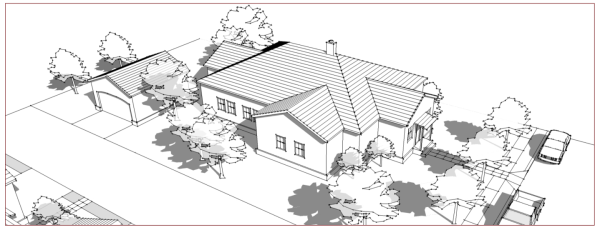
- Purpose: To provide low density residential areas which restrict incompatible commercial and industrial uses.
- Use Table: The permitted and conditional uses in the R-1 One and Two Family Dwelling District as as follows:
One and Two Family Dwelling District (R-1) Use Table Permitted Uses Conditional Uses 1. One and Two Family Dwellings 1. Water reservoirs, water storage tanks, water pumping stations and sewer lift stations. 2. Churches, Libraries Community Centers and other Public Buildings 2. Cemeteries 3. Domestic Animals, provided such animals are household pets. Kennels are prohibited. 3. Electric substations and gas regulator stations. 4. Colleges, Public Schools, Private Educational Institutions having the same curriculum as ordinarily given in public schools 4. Golf Courses 5. Public Parks, Playgrounds, Recreational Facilities and Open Space. 5. Nursing Homes and Hospitals, provided the state and local health jurisdictions approve the locations. 6. Fire stations and police stations 6. Barber shops and beauty shops as a home occupancy also subject to the special regulations of WPCC 11.16.040 7. Accessory Buildings and uses customarily incidental to the uses permitted in this district. 8. Home occupations, subject to the special regulations of WPCC 11.16.040 - Building Height Limit Except as provided in Special Regulations WPCC 11.16, no dwelling shall exceed two (2) stories or twenty-five feet (25’) in height.
- Area Regulations Subject to the modifications set forth in Special Regulations WPCC 11.16, the area regulations are as follows: These area regulations, with the exception of off-street parking, apply only to new subdivisions and any dividing of existing platted property.
- Minimum Lot Area:
- A lot upon which there is erected a single-family dwelling shall contain not less than seven thousand two hundred (7,000) square feet.
- A lot upon which there is erected a two-family dwelling shall not contain less than eight thousand six hundred and fifty (8,650) square feet, unless it is not served by public sewer and water, in which case the minimum shall be one-half (1/2) acre.
- A lot having an area less than herein required which was recorded under separate ownership from adjoining lots at the effective date of this title may be occupied by a one-family dwelling or by a nonresidential use permitted in this district.
- Minimum Lot Frontage:
- A lot occupied by a single-family dwelling shall have a minimum frontage of sixty feet (50’).
- A lot occupied by a two-family or multiple-family dwelling shall have a minimum frontage of seventy-five feet (75’) and seventy-five feet (75’) for other principal structures.
- Minimum Front Yard: Measured from the front property line there shall be a front yard of not less than twenty-five feet (25’) unless the property fronts on a state or federal highway, the minimum shall be fifty feet (50’).
- For corner lots, a minimum fifteen foot (15’) yard shall be provided to the side street.
- For corner lots, if parking in front of a garage is provided, a minimum twenty-foot (20’) yard shall be provided to the garage, to avoid vehicles extending into the street right-of-way/sidewalk.
- Minimum Rear Yard: Measured from the real property line every principal structure shall have a rear yard of not less than twenty feet (20’).
- Minimum Side Yard: Measured from the side property lines there shall be side yards of not less than five feet (5’) on each side of a lot in existing platted areas. New subdivisions shall have side yards of not less than ten feet (10’).
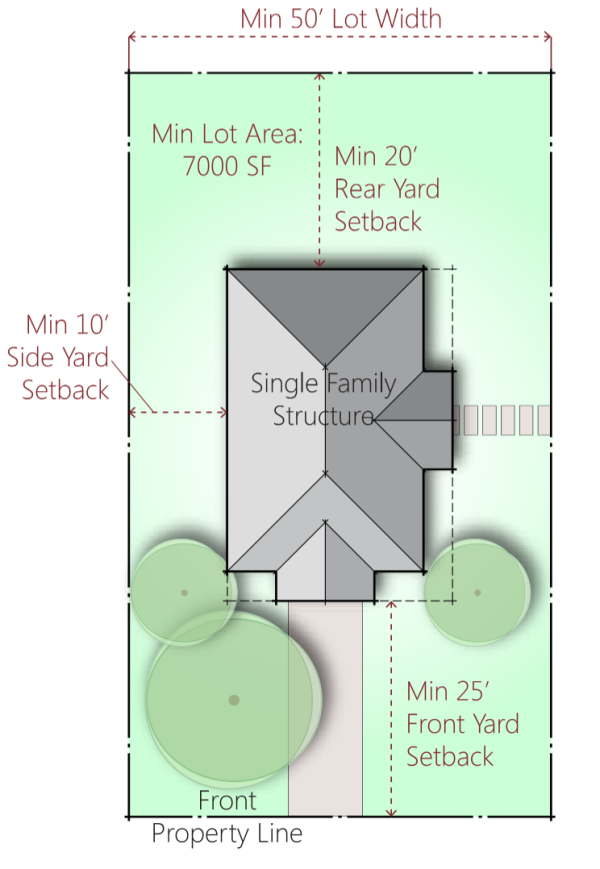
- Off-street Parking: For off-street parking regulations for One and Two Family Dwelling Districts (R-1), see the table in Special Regulations WPCC 11.16.
- Swimming Pools: All swimming pools on private property must be enclosed by protective fencing.
- Minimum Lot Area:
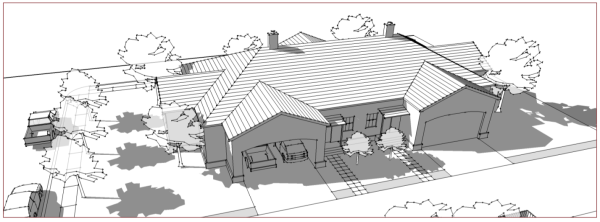
- Purpose: To provide a district which will allow two-family dwellings, townhouses, apartment complexes and mobile home courts which maintain structure and yard standards similar to single family residential development and which will properly relate to other land uses as provided in the Growth Policy.
- Building Height Limit: Except as provided in Special Regulations WPCC 11.16, no structure shall exceed two (2) stories or twenty-five feet (25’) in height.
- Use Table: The permitted and conditional uses in the R-2 Multiple Family Dwelling District are as follows:
Multiple Family Dwelling District (R-2) Use Table Permitted Uses Conditional Uses 1. All permitted uses in the R-1 District. 1. All conditional uses as established in R-1 District. 2. Two-Family Dwellings, Multi-Family Dwellings and Apartment Houses. 2. Mobile Home Park, pursuant to WPCC 11.40. 3. Boarding and Lodging Houses. 4. Private Clubs and Lodges, except those whose primary activity is carried on as a business 5. Parking lots for Multi-Family Dwellings. 6. Accessory Buildings and uses customarily incidental to the uses permitted in this district. - Area Regulations Subject to the modifications set forth in Special Regulations WPCC 11.16, the area regulations are as follows:
- Minimum lot area:
- A lot upon which there is erected a single-family dwelling shall contain not less than seven thousand two hundred (7,000) square feet.
- A lot upon which there is erected a two-family or multiple-family dwelling shall contain not less than fourteen hundred fifty (1,450) square feet per unit; however, in no instance shall such structure be built on a lot containing less than eight thousand (8,000) square feet.
- A lot upon which there is erected a boarding or lodging house shall contain not less than eight thousand (8,000) square feet.
- A lot having an area less than herein required and which was recorded under separate ownership from adjoining lots at the effective date of these regulations may be occupied by a single family dwelling or by any permitted nonresidential use.
- Minimum Lot Frontage:
- A lot occupied by a single-family dwelling shall have a minimum frontage of sixty feet (60’) in new subdivisions only.
- A lot occupied by a two-family or multiple-family dwelling shall have a minimum frontage of seventy-five feet (75’) in new subdivisions only.
- A lot occupied by a boarding or lodging house shall have a minimum frontage of seventy-five feet (75’) in new subdivisions only.
- A lot having a frontage of less than herein required and which was recorded under separate ownership from adjoining lots at the effective date of these regulations may be occupied by a single-family, two-family, multiple-family dwelling or by any permitted nonresidential use.
- Minimum Front Yard: Measured from the front property line there shall be a front yard of not less than twenty-five feet (25’), unless the property fronts on a state or federal highway, the minimum shall then be fifty feet (50’).
- For corner lots, a minimum fifteen-foot (15’) yard shall be provided to the side street.
- For corner lots, if parking in front of a garage is provided, a minimum twenty-foot (20’) yard shall be provided to the garage to avoid vehicles extending into the street right-of-way/sidewalk.
- Minimum Rear Yard: Measured from the rear property line every principal structure shall have a rear yard of not less than twenty feet (20’).
- Minimum Side Yards: Measured from the side property lines there shall be side yards of not less than five feet (5’) on each side of a lot in existing platted areas. New subdivisions shall have yards of not less than ten (10’) feet.
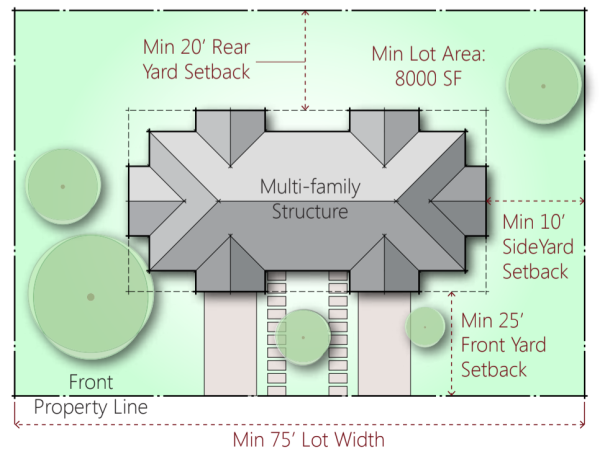
- Off-street Parking: For off-street parking regulations for Multi-Family Dwelling Districts (R-2), see the table in Special Regulations WPCC 11.16.
- Swimming Pools: All swimming pools on private property must be enclosed by protective fencing.
- Minimum lot area:
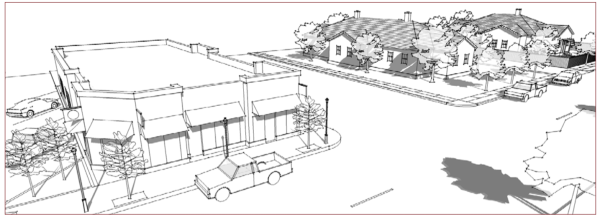
- Purpose: To provide a district abutting the C-1 or C-2 District to allow for future expansion. It is intended that this district can include both residential and commercial properties and will not prevent any property owner from altering, expanding or structurally changing buildings within this district.
Multi-Use District (MU-1) Use Table Permitted Uses Conditional Uses 1. All permitted uses in the abutting Commercial District. 1. All conditional uses permitted in the abutting Commercial District. 2. All permitted uses in the abutting Residential District. 2. All conditional uses permitted in the abutting Residential District.
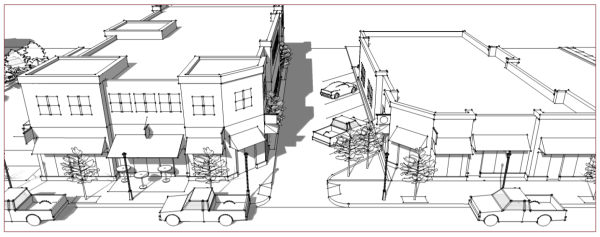
- Purpose: To provide a district which accommodates a variety of basic retail, service and office functions. Certain residential uses are also permitted in order to support the continued vitality of the district. It is intended that such a district be compatible with and reasonably adjoin multiple family residential development.
- Use Table: The permitted and conditional uses in the C-1 Central Commercial Business District are as follows:
Central Commercial Business District (C-1) Use Table Permitted Uses Conditional Uses 1. Retail Stores and Shops, limited to the following and similar uses;
a. Building Supplies (retail only)
b. Photography and Camera Stores
c. Bakeries with on-premise retail for distribution
d. Saddlery Stores
e. Bars and Liquor Stores
f. Plumbing Stores
g. Printing and Office Supply Stores
h. Print Shops
i. Furniture and Antique Stores
j. Grocery Stores
k. Other similar retail uses as determined of the Zoning Administrator1. Hospitals/Medical Clinic
2. Laundromat/Dry Cleaning
3. Auto Sales and Service
4. Public Garages
5. Bus Stations2. Offices 3. Personal Service (e.g. Barber/Beauty shops, Massage Therapist, Locksmith, Shoe Repair and similar services) 4. Restaurants and other Dining Establishments 5. Hotels, Motels and other Lodging Facilities 6. Public, Private and Commercial Recreational Facilities 7. Libraries, Fire, Police Stations and other Public Buildings 8. Membership Clubs/Assembly Halls 9. Accessory Buildings and uses customarily incidental to the uses permitted in this district. 10. Apartments (residential units) when located on a second or subsequent floor of a building 11. Apartment Buildings (containing three or more residential units) 12. Nursing Homes/Assisted Living Facilities - Building Height Limit: Except as provided in Special Regulations in WPCC 11.16, no structure shall exceed three (3) stories or forty feet (40’) in height, provided, that no structure or portion of a structure shall be erected to a height exceeding twenty-five feet (25‘) on any portion of a lot less than twenty feet (20’) in distance from any portion of a lot in any R-1 or R-2 district.
- Area Regulations: Subject to the modifications as set forth in Special Regulations in WPCC 11.16, the area regulations are as follows:
- Minimum lot area: There are no minimum requirements.
- Minimum lot frontage: There are no minimum requirements except as contained in Special Regulations in WPCC 11.16.
- Minimum front, rear, and side yards: There are no minimum requirements except as contained in Special Regulations in WPCC 11.16.
- Buffers and Screening:
- Buffering: Whenever a nonresidential use or off-street parking area abuts a residential use in another district, the nonresidential use must not be less than forty feet (40’) from such property.
- Screening: The use shall be effectively screened at the property line on all sides which adjoin or face the residential district by an acceptably designed, sight obstructing wall, fence or planting screen. Such fence, wall, or planting screen shall be not less than four feet (4’) or more than six feet (6’) in height and shall be maintained in good condition.
- Buffering Off-street Parking: When off-street parking is provided within the forty foot (40’) buffer area the screen shall be five feet (5’) from the property line. In the event that terrain or other natural features are such that the erection of such fence, wall, or planting screen will not serve the intended purpose, then no such wall, fence, or planting screen shall be required.
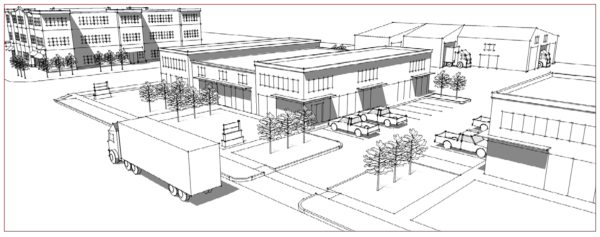
- Purpose: The purpose of this district is to provide an area of service facilities to the motoring public, the location of such activities should be developed within commercial spheres adjacent to arterial traffic.
- Use Table: The permitted and conditional uses in the C-2 Highway Commercial District are as follows:
Conditions: Note #1: Community Shopping Centers shall have the following conditions: • A group of not less than five (5) joined retail stores, planned and developed as a single unit having a total gross floor area of at least thirty-five thousand (35,000) square feet and a common parking area. • There shall be one parking space for each two hundred fifty (250) square feet of floor space. • There shall be not more than one entrance and one exit point per structure but they may be combined in a single driveway. • There shall be not more than one free-standing sign per structure.Highway Commercial District (C-2) Use Table Permitted Uses Conditional Uses 1. Retail Stores and Shops, limited to the following and similar uses:
a. Grocery Stores
b. Building Supplies (retail and wholesale)
c. Bars and Liquor Stores
d. Sundries (retail, wholesale and storage)
e. Auto Sales
f. Mobile Home and Travel Trailer Sales (sales and service)
g. Plumbing Stores (no outdoor storage of materials)
h. Florists and Greenhouses (retail and wholesale)
i. Printing and Office Supply Stores
j. Paint Stores (no outdoor storage of materials)
k. Auto Parts Stores (not including junk, salvage or wrecking yards)
l. Other unspecified retail uses at the discretion of the Zoning Administrator1. Truck stops
2.Food Processing Facilities
3. Veterinary Clinic/Kennels2. Service Commercial Uses, limited to the following and similar uses:
a. Medical Offices, including dental and optometry
b. General Offices
c. Theaters and Assembly Halls
d. Contractors, outside storage shall be allowed when its contained within an enclosed fence
e. Membership Clubs
f. Coin Machines (rental or repair service)
g. Bowling Alleys
h. Food Storage Locker Plants (no slaughtering)
i. Water Softening Equipment (service and repair)
j. Upholstery Shops (no outdoor storage of materials)
k. Sign Shops (no outdoor storage of materials)
l. Auto Service Stations
m. Tire Shops (sales and service, including vulcanizing, but not involving manufacturing on site)
n. Car Washes
o. Heavy Machinery (sales and service)
p. Tourist Information Centers
q. Bus Stations
r. Museums
s. Other similar service uses as determined by the Zoning Administrator3. Restaurants and other Dining Establishments 4. Hotels, Motels and other Lodging Facilities 5. Public, Private and Commercial Recreational Facilities 6. Libraries, Fire, Police Stations and other Public Buildings 7. Hospitals/Medical Clinics 8. Parking Lots 9. Community Shopping Centers as limited by Note #1 below 10. Accessory Buildings and uses customarily incident to the uses permitted in this district. - Building Height Limit: Except as provided in Special Regulations in WPCC 11.16, no structure shall exceed three (3) stories of forty feet (40’) in height.
- Area Regulations: Subject to the modifications set forth in Special Regulations in WPCC 11.16, the area regulations are as follows:
- Minimum lot area: There are no minimum requirements except as contained in Special Regulations in WPCC 11.16.
- Minimum lot frontage: There are no minimum requirements except as contained in Special Regulations in WPCC 11.16.
- Minimum front, rear and side yards: There are no minimum requirements except as contained in Special Regulations in WPCC 11.16.
- Buffers and Screening:
- Buffering: Whenever a nonresidential use or off-street parking area abuts a residential use in another district; the nonresidential use must not be less than forty feet (40’) from such property.
- Screening: The use shall be effectively screened at the property line on all sides which: adjoin or face the residential district or institutional use by an acceptably designed, sight obstructing wall, fence or planting screen. Such fence, wall or planting screen shall be not less than four feet (4’) nor more than six feet (6’) in height and shall be maintained in good condition.
- Buffering Off-street Parking: When off-street parking is provided within the forty foot (40’) buffer area the screen shall be five feet (5’) from the property line. In the event that terrain or other natural features are such that the erection of such fence, wall, or planting screen will not serve the intended purpose, then no such wall, fence, or planting screen shall be required.
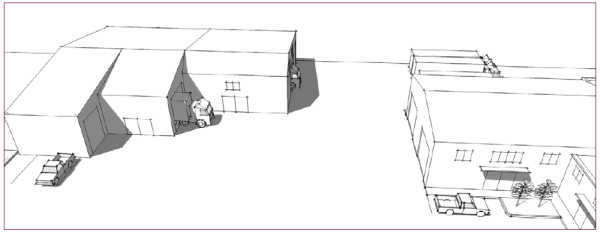
- Purpose: To provide a district where light industrial uses may locate subject to regulatory controls from nuisance characteristics and that they maintain an acceptable appearance from streets and adjoining property by employing landscaping and buffering techniques.
- Use Table: The permitted and conditional uses in the Light Industrial District (M-1) are as follows:
M-1 Light Industrial District Use Table Permitted Uses Conditional Uses 1. All permitted uses in the C-1 and C-2 Districts except for residential uses unless the residential dwelling existed there prior to the effective date of this title. 1. All uses of land, buildings and structures, or industrial processes that may be considered noxious or injurious by reason of production, emission of dust, smoke or refuse matter, odor, gas fumes, noise or vibration (e.g. meat and fish processing, fat and oil refining, etc). 2. Lumber or Building Materials Storage or Supply Yards, including Cement or Concrete Products 3. Contractors Plants or Storage Yards 4. Dairy Processing and Distribution Plants 5. Bottling Plants 6. Machine, Roofing and Sheet Metal Shops 7. Electrical Central Power Stations 8. Storage Warehouses 9. Storage of Oil, Gasoline and Petroleum Products, limited to 1,000 gallons above grade. 10. Blacksmith, Welding or other Metal Shops, excluding punch presses over twenty (20) tons rated capacity (drop hammers and similar) 11. Printing Plants 12. Grain Elevators or facilities for collection, storage, processing and marketing grain and feed products 13. Manufacturing, Processing and Packaging of Cosmetics, Pharmacology, Electronic Components, Food Products 14. Manufacturing and Processing of Brick, Ceramic and other Clay Products - Building Height Limit: Same as Highway Commercial District (C-2), WPCC 11.12.050.
- Area Regulations: Same as Highway Commercial District (C-2), WPCC 11.12.050.
- Buffers and Screening:
- Buffering: Whenever a nonresidential use or off-street parking area abuts a residential use in another district; the nonresidential use must not be less than forty feet (40’) from such property.
- Screening: The use shall be effectively screened at the property line on all sides which: adjoin or face the residential district or institutional use by an acceptably designed, sight obstructing wall, fence or planting screen. Such fence, wall or planting screen shall be not less than four feet (4’) nor more than six feet (6’) in height and shall be maintained in good condition.
- Buffering Off-street Parking: When off-street parking is provided within the forty foot (40’) buffer area the screen shall be five feet (5’) from the property line. In the event that terrain or other natural features are such that the erection of such fence, wall, or planting screen will not serve the intended purpose, then no such wall, fence, or planting screen shall be required.
11.16.020 Additional Height And Area Regulations
11.16.030 Site Features
11.16.040 Home Occupations
- Purpose: This section is intended to reduce the need for parking on public streets and the associated traffic congestion and hazards, and to provide for adequate off-street parking for each development type in terms of both amount and location.
- Access:
- Parking and loading areas in the commercial and industrial districts must be designed so that ingress to or egress from a parking or loading space is from an aisle or driveway, not directly from the public street or right-of-way.
- No access way to and within any parking or loading area may be located within fifty (50) feet of any corner formed by the intersection of the rights-of-way of two or more streets. At intersections where traffic control devices are installed, the Zoning Administrator may increase this requirement as necessary to prevent traffic hazards.
- The access way to every parking lot must be at least twenty-four (24) feet wide, unless two (2) one-way drives; each twelve (12) feet wide, are provided and signed accordingly.
- A commercial loading space must have minimum dimensions of not less than twelve (12) feet in width, fifty (50) feet in length, exclusive of driveways, aisles, and other circulation areas, and fifteen (15) feet of overhead.
- No access drive for a commercial or industrial use district may be located within two hundred (200) feet of a residential district, an institutional use for human care, or fire station, school, library, church, park, playground, or other place of public assembly.
- For all commercial, industrial, and institutional parking areas, the frontages between access points must be provided with wheel stops or other acceptable curbing material.
- The distance between access ways in the Highway Commercial (C-2) and the Light Industrial (M-1) Districts must not be less than fifty feet (50’). The outside point of any access way may be not less than twenty-five feet (25’) from the abutting property line. When road alignment and associated sight distance, road width, abutting topography, existing or potential traffic volume in relation to the road capacity of the public right-of-way warrant an increase in the required distance between access points, the Zoning Administrator may require an increase in such distance.
- Design Standards:
- Accessory off-street parking, required for the uses specified herein, shall be for use only by automobiles of employees, customers and resident of the activity served.
- All or a portion of the off-street parking requirements for commercial uses shall be met on the same lot as the building served or on a lot within seven hundred feet (700’) measured on a satisfactory pedestrian route of travel. Such off-site parking areas shall meet the design standards of this title and its use shall be guaranteed by a long-term, lease or use agreement to be verified by the Zoning Administrator.
- An off-street parking space shall be at least nine feet (9’) in width and at least twenty feet (20’) in length, exclusive of access drives, yards, aisles, ramps, or sidewalks. Such spaces are not less than the total requirements of the separate uses and provided that other requirements are met.
- All open parking areas with four (4) or more parking spaces shall be effectively screened by a wall, fence, or landscaping from any property in an adjacent residential district.
- No lighting used to illuminate a parking area shall face any residential property in any district.
- Any use having more than three thousand five hundred (3,500) square feet of required parking shall have two percent (2%) of the gross required parking area landscaped with proper parking lot trees and shrubs having a low profile. Such landscaping will be properly maintained at all times.
- A snow storage area at least 2% of the size of the parking lot area shall be provided to avoid the loss of required parking spaces to snow storage.
- Required Spaces:
- No building shall be erected, enlarged to the extent of increasing the floor area by as much as fifty percent (50%), or changed in use unless there is provided on the lot, space for the parking of automobiles or trucks in accordance with the following minimum parking requirements.
- Disabled parking spaces shall also be provided subject to federal standards enumerated in the Americans with Disabilities Act (ADA) as currently adopted.
- Bicycle parking - Any use that requires or provides more than ten (10) parking spaces shall also provide an on-site bicycle parking rack in an accessible and visible location.
*Note: "Employees" based on max number on site during a shift.Parking Requirements by Use Use Category Required Parking 1. One and Two Family Dwellings 1. Two (2) spaces per unit 2. Multiple Family Dwellings 2. Two (2) spaces per unit 3. C-1 District Residential Uses 3. Buildings containing five or less units are not required to provide any off-street parking 4. Hospitals 4. One (1) space for each bed, plus three (3) spaces for each staff doctor and one (1) space for every three (3) employees* 5. Medical/Dental Offices 5. Three (3) spaces per doctor plus one (1) space per employee* 6. Professional Offices 6. One (1) space for each 300 SF of floor area 7. Libraries, Art Galleries or Museums 7. Two (2) spaces for each one thousand square feet of floor area 8. Public Utility and Public Service Uses 8. One (1) space for each three employees*, plus five (5) spaces for public use 9. Community Centers or Recreations Buildings 9. One (1) space for each three employees, plus one (1) space for each three seats or 200 SF of public floor area (auditoriums etc.) 10. Schools, Nurseries, Elementary or Boarding (except High) 10. One (1) space for each three employees*, plus five (5) extra 11. High schools 11. One (1) space for each two employees*, plus one (1) for each thirty students and one (1) space per 300 SF of floor area 12. Private Clubs and Lodges 12. One (1) space for each rentable room, plus one (1) for each one hundred square feet of floor space, plus one (1) space for each three employees* 13. Churches 13. One (1) space for each four seats or pews or 200 SF of public floor area 14. Gas Stations/Convenience Stores 14. One (1) space for each two employees* and one (1) space per 300 SF of floor area 15. Bowling Alleys 15. Four (4) spaces for each alley 16. Restaurants, Bars, Cafeterias and other Eating/Drinking Establishments 16. One (1) space for each one hundred square feet of floor area, plus (1) space for each three employees* 17. Furniture, Appliance, Vehicle or Wholesale Stores, Repair Shops, Radio, TV and Machinery Sales Establishments 17. One (1) space for each four hundred square feet of floor area, plus one (1) for each five employees* 18. Hotels and Motels 18. One (1) space for each rentable room, plus one (1) space for each three employees* 19. Retail Stores, Personal Service Establishments, Shoe Repair, Barber and Beauty Shops, etc. 19. One (1) space for each one hundred fifty square feet of floor area 20. Theaters and Auditoriums 20. One (1) space for each four seats or 200 SF of public floor area 21. Production, Manufacturing, Cleaning, Servicing, Testing or Repair of Materials, or Warehousing and Storage Buildings 21. One (1) space for each three employees* 22. Motor Freight Companies 22. One (1) space for each three employees* 23. Other Uses 23. For all other unspecified uses, the Zoning Administrator shall determine the parking requirements to be applied while using the existing list of uses as a guide.
- Purpose: This section is intended to provide additional parameters or clarifications relative to the zoning districts in WPCC 11.12.
- Special Height Regulations:
- Public, quasi-public, or public service buildings, hospitals, institutions or schools, when permitted in a district, may be erected to a height not exceeding sixty (60) feet, and churches may be erected to a height not exceeding seventy-five (75) feet, provided that the front yard depth shall be thirty (30) percent in excess of those specified in these regulations, and further provided that the side yards of an interior lot shall be twenty (20) feet and the side yard on a corner lot shall be equal to the front yard requirements as stated above.
- Exempt Appurtenances: Chimneys, church steeples, cooling towers, elevator bulkheads, fire towers, monuments, stacks, stage towers or scenery lofts, tanks, water towers, ornamental towers, spires, communication towers, grain elevators, or necessary mechanical appurtenances are exempt from the height regulations herein provided.
- Accessory Buildings: Accessory buildings may be built in a required rear yard, but such accessory buildings shall not occupy more than thirty (30) percent of a required rear yard and shall not be nearer than five (5) feet to any side or rear lot line, except that when a garage is entered from an alley at right angles, it shall not be located closer than ten (10) feet to the alley line. If a garage is located closer than ten (10) feet to the main building, the garage shall be regarded as a part of the main building for the purposes of determining side and rear yards.
- Yards and Open Space:
- Every part of a required yard shall be open to the sky, unobstructed by any structure, except for the projection of sills, cornices and ornamental features which are not to exceed twelve (12) inches.
- An open unenclosed porch or paved terrace may project into a front yard for a distance not exceeding ten (10) feet.
- Terraces, uncovered porches, platforms and ornamental features which do not extend more than three (3) feet from the floor level of the ground story may project into a required yard provided these projections be at least five (5) feet from the adjacent side lot line.
- For side yard regulations, a two-family dwelling or a multiple dwelling shall be considered as one building occupying one lot.
- Where a lot or tract is used for a commercial or industrial purpose, more than one primary building may be located upon the lot or tract, but each such primary building shall conform to all open space requirements around the lot for the district in which the lot or tract is located.
- Where an open space is more than fifty (50) percent surrounded by a building, the minimum width of the open space shall be at least twenty (20) feet for one (1) story buildings, thirty (30) feet for two (2) story buildings, and forty (40) feet for three (3) or more story buildings.
- Where lots have double frontage, the required front yards shall be provided on both streets.
- The required side yard on the street side of a corner lot shall be one-half (1/2) the required front yard on such street, provided that no adjacent structures front on the same street, in which case the entire required front yard must be provided, and no accessory building shall project beyond the required front yard on either street
- The front yards heretofore established shall be adjusted in the following cases:
- Where forty (40) percent or more of the frontage on the same side of a street· between two (2) intersecting streets is developed with two (2) or more buildings that have (with a variation of five (5) feet or less) a front yard greater in depth than herein required, new buildings shall not be erected closer to the street than the front yard so established by the existing building nearest the street line.
- Where forty (40) percent or more of the frontage on one side of a street between two (2) intersecting streets is developed with two (2) or more buildings that have a front yard of less depth than herein required, then: where a building is to be erected on a parcel of land that is within one hundred (100) feet of existing buildings on both sides, the minimum front yard shall be a line drawn between the two (2) closest front corners of the adjacent buildings on each side; or, where a building is to be erected as close to the street as the existing adjacent building.
- Signs: The following regulations shall govern the location, area, and type of signs permitted within the city.
- Sign Permit Required: It shall be unlawful to erect, place, construct or relocate a sign without first obtaining a sign permit from the Zoning Administrator. The following procedures shall apply:
- Submit Application: applicant shall submit a complete application provided by the city containing at a minimum those materials listed in paragraph A,2.
- Sign Application Minimum Contents:
- The applicant’s name, address and telephone number. If applicant is acting as a representative of the property owner, they must submit signed authorization to act on their behalf and include owner’s contact information.
- Legal description of the property where the signage is being proposed.
- Proof of ownership of the property. The disclosure of ownership may be in the form of a deed, tax assessment record, contract for purchase and sale, current commitment from a title insurance company or other similar documentation.
- Vicinity map locating the subject property within the City of Wolf Point.
- Sign Plan which clearly identifies:
- Type of sign being proposed
- Dimensions of the proposed sign
- Its location on the building or property
- Any lighting proposed as part of the signage
- Prohibited:
- “Revolving Beacon” or similar signs are not allowed in any district.
- Roof signs, located upon or projecting above a any portion of a roof, are not allowed in any district.
- No sign in any district shall conflict in any manner with the clear and obvious appearance of public devices controlling public traffic.
- It is prohibited to erect, paint, or attach any notice, political poster, or handbill, advertisement, or any other sign upon any power or telephone pole, fire hydrant, official public sign, or in any portion of a public right-of-way.
- No sign, outdoor commercial advertising device or lighting device constituting a nuisance to an adjacent residential district because of lighting glare, focus, animation or flashing of a sign, lighting or advertising device shall be erected or continued in operation.
- Permitted Signs (see illustrations in this section):
- Freestanding Signs: include any sign structurally separate from the building, being supported on itself or on a stand or on legs. Freestanding signs are allowed only when located entirely on private property.
- Projecting Signs: include any sign supported by a building wall and projecting therefrom. Projecting signs shall be a minimum of eight (8) feet above grade when located adjacent to or projecting over a pedestrian way; and shall not extend more than four (4) feet from the building wall except when approved as part of a canopy or awning.
- Wall Signs: include any sign painted on, incorporated in or affixed to the building wall, or any sign consisting of cut-out letters or devices affixed to the building wall. No part of the sign shall project more than six (6) inches from the building wall.
- General Requirements:
- All signs shall be structurally safe and shall be securely anchored or otherwise fastened; suspended, or supported so that they will not be a menace to the safety of persons or property.
- Ground signs shall not be located on public property except by specific approval of the governing body.
- Temporary signs or banners on or over public property are only allowed by specific approval of the Zoning Administrator (or other appointed official).
- Signs projecting over a street, alley, or other public property may be authorized by the governing body for a period not to exceed ten (10) days.
- Roadside market signs advertising produce grown and sold on the premises on which they are located shall be removed when market is not in use.
- All signs existing at the time of the adoption of these zoning revisions are exempt from obtaining a sign permit. Existing signs not in compliance with these regulations are subject to the “Nonconformities” regulations of WPCC 11.20.
- Residential Uses:
- One (1) unlighted identification sign shall be permitted per residential use provided such sign does not exceed two (2) square feet in area; said sign may be wall, or projecting type (but not projecting over public property).
- One (1) sign of a temporary nature, such as “For Sale” or “For Rent” shall be permitted per residential use provided such sign does not exceed six (6) square feet and is not lighted; said sign may be wall, or freestanding.
- Public or Quasi-public Uses: One identification sign shall be permitted per public or semi-public use provided such sign does not exceed twenty (20) square feet in area; said sign may be wall, freestanding, ground or projecting type.
- C-1, C-2 and MU-1 Districts: One (1) projecting or freestanding sign advertising the particular use of the primary building shall be permitted provided such sign does not exceed fifty (50) square feet in area, and does not exceed a height of thirty-five (35) feet. Such signs shall be allowed only on the premises of the establishment being advertised. Wall signs are also permitted, however, total site signage shall not exceed a total of fifty (50) square feet.
- M-1 Districts: One (1) projecting or freestanding sign advertising the particular use of the property shall be permitted provided such sign does not exceed two hundred (200) square feet in area, and does not exceed a height of thirty-five (35) feet. Such signs shall be allowed only on the premises of the establishment being advertised. Wall signs are also permitted, however, total site signage shall not exceed a total of fifty (50) square feet.
- Sign Permit Required: It shall be unlawful to erect, place, construct or relocate a sign without first obtaining a sign permit from the Zoning Administrator. The following procedures shall apply:
- Fences:
- Corner lots in all zones shall not be permitted to have any fencing or other sight-obstruction which constitutes a hazard to the traveling public within the area designated as the “clear-view triangle” (see exhibit below). This area can be determined by measuring eighty (80) feet from the center lines of each street, then connecting the two points with a straight line forming the hypotenuse of the clear-view triangle. Trees within the clear-view triangle shall have their branches removed at the trunk from ground level to a minimum of seven (7) feet above ground level. Shrubs within the clear-view triangle shall be maintained no higher than three (3) feet above grade elevation of the center line of the adjacent street.
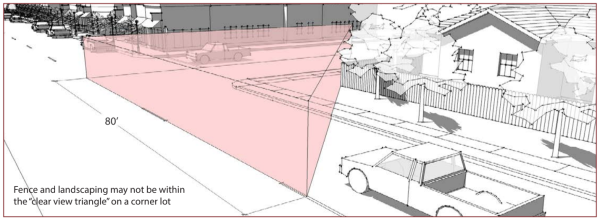
Sign Standards Table Use or Zone Sign Type Number Permitted Sign Area Standard Sign Height Standard Residential Uses (All Zones) Identification Sign 1 per Residential Use 2 Sq. Ft. Maximum Temporary for Sale or Rent 1 per Residential Use 6 Sq. Ft. Maximum Public Uses (All Zones) Identification Sign 1 per Public or Semi-Public Use 20 Sq. Ft. Maximum C-1, C-2 and MU-1 Zones Advertising Sign, Projecting, Wall or Freestanding 50 Sq. Ft. Maximum 35 Ft. Maximum M-1 Advertising Sign, Projecting, Wall or Freestanding 200 Sq. Ft. 35 Ft. Maximum 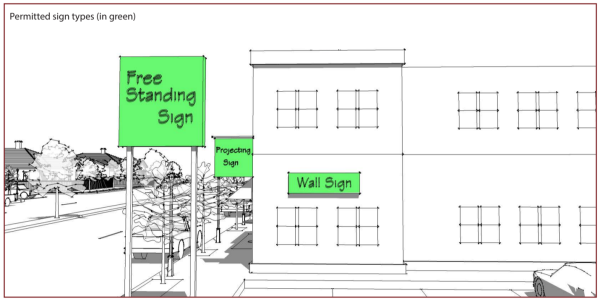
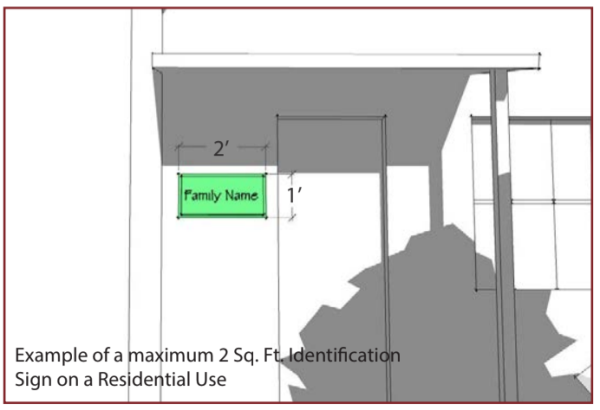
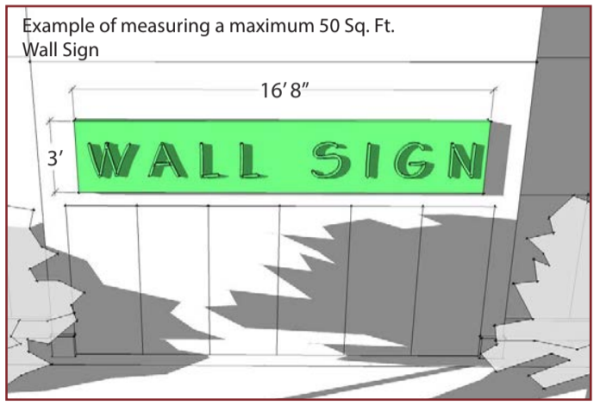
- Corner lots in all zones shall not be permitted to have any fencing or other sight-obstruction which constitutes a hazard to the traveling public within the area designated as the “clear-view triangle” (see exhibit below). This area can be determined by measuring eighty (80) feet from the center lines of each street, then connecting the two points with a straight line forming the hypotenuse of the clear-view triangle. Trees within the clear-view triangle shall have their branches removed at the trunk from ground level to a minimum of seven (7) feet above ground level. Shrubs within the clear-view triangle shall be maintained no higher than three (3) feet above grade elevation of the center line of the adjacent street.
- Landscaping: The following provisions shall govern the requirements for landscaping and to establish the requirement for the submittal of a landscaping plan in conjunction with certain land uses in order to provide a visual buffer between land uses of differing character, to preserve and enhance the value of land and buildings and to enhance the beauty of the City.
- The provisions of this section shall apply to all new land uses within each zoning district within the City. The only uses exempt from these requirements are single and two family dwelling units (and accessory uses), home occupations and uses within the C-1 (Central Commercial) District unless required under the Buffers and Screening section of the C-1 district.
- The provisions of this Section shall also apply whenever specific buffers and screening requirements within a zoning district are triggered.
- A fully dimensioned landscaping plan shall be submitted as part of Zoning Compliance permit or Conditional Use application materials. The plan shall provide a list and location of all plant and landscaping materials. Planting symbols shall be clearly drawn and plants labeled by common name, container size, spacing and quantities or each group of plants selected. Natural features such as existing trees, shrubs or other landscape features that will remain shall be indicated. On-site snow storage areas shall also be indicated.
- Minimum Landscaping Requirements:
- A minimum of five (5) percent of a lot, or ten (10) percent of proposed parking area, shall be landscaped with appropriate landscaping material.
- All areas not developed with either structures or parking shall be landscaped.
- Landscaped areas within or along the perimeter of parking areas shall be protected from vehicular traffic through the use of continuous concrete curbing, extruded asphalt or other approved permanent barriers.
- Landscaping shall be permitted within required front, side and rear yard (setback) areas. No landscaping shall be placed within public right of ways without first obtaining written approval from the Zoning Administrator (or other appointed official).
- All landscaped areas shall be irrigated. All landscaping elements shall be maintained in good growing condition and kept free of weeds, debris and litter, and whenever necessary, replaced with new plant materials to ensure continued compliance with this title.
- Appropriate Landscaping Materials: Appropriate landscaping material shall include turf, shrubs, trees, flower beds, vines or other plant cover and shall make up at least eighty five (85) percent of the required landscaping. No more than fifteen (15) percent of the landscaped area shall contain fountains, rock, bark chips, stepping stones or similar features.
- No occupancy or other authorization for the use of a property may be granted or conducted until the landscaping is completed according to the approved plan or a financial guarantee (bond, letter of credit or cash) is supplied to the City guaranteeing the completion of the required landscaping. The cost of completion of the landscaping shall be provided by a professional landscaping business approved by the City. The financial guarantee supplied to the City shall be for 150% of the cost estimate to complete the landscaping and shall be valid for no less than six (6) months. If the landscaping is not completed according to the specified (written) agreed upon terms by the City and the property owner at the time the financial guarantee is supplied, the City may complete the landscaping with the funds from the supplied guarantee.
- Transitions:
- Garage Entrances: No public garage for more than five (5) motor vehicles shall have an entrance or exit for motor vehicles within fifty (50) feet of a residential district.
- Side and Rear Yard Transition: where a lot in a business or industrial district abuts a lot in a residential district, there shall be provided along such abutting lines, a yard equal in width or depth to that required in the abutting residential district.
- Front Yard Transition: Where the frontage on one side of a street between two intersecting streets is zoned partly as residential and partly as business or industrial, the front yard depth in the business or industrial district shall be equal to the required front yard depth in the abutting residential district.
- Corner Yard Transition: On every corner lot in a residential district, there shall be provided on the side street a side yard at least fifteen feet (15’) in width.
- Regulations: The following regulates the development of home occupations.
- The home occupation is carried on only within the principal building.
- The home occupation is incidental and secondary to the use of the dwelling unit for residential purposes.
- The home occupation conforms to the following conditions:
- Exterior signs or display shall be in conformance with provisions of this title regulating same.
- There shall be no exterior storage of materials or exterior indication of the home occupation or variation from the residential character of the principal building.
- No offensive noise, vibration, smoke, dust, odors, heat, or glare shall be produced.
- Employment of not more than one person not a member of the immediate family is permitted.
- Home occupations include the following or similar activities which in the opinion of the regulating agency meet the intent of this section:
- Art studio
- Dress and drapery making
- Teaching of musical instruments--limited to small groups
- Preparation of food for off-premise sales
- Home occupation shall not be interpreted to include the following:
- Barbershops/Beauty shops unless approved as a Conditional Use and subject to the terms of this section
- Restaurants
- Commercial stables and kennels
- Doctors and dentists offices
- Plumbers.
- Auto/Small engine repair
- Real estate offices
11.20.020 Change Of Regulations
11.20.030 Existing Nonconformities
11.20.040 Lots Of Record
11.20.050 Structures
11.20.060 Unlawful Use Not Authorized
The lawful use of a lot, structure or use of land existing at the time of the adoption or amendment of this title may be continued although such use does not conform with the provisions of this title. It is the intent of this title to permit these nonconformities to continue until they are removed or discontinued, but not to encourage their survival. Further, the intent of this title is that nonconformities shall not be used as grounds for adding other structures or uses prohibited elsewhere in the same district. To avoid undue hardship, nothing in this title shall be deemed to require a change in the construction plans or designated use of any building on which construction or preparatory excavation or demolition was lawfully begun prior to the effective date of adoption or amendment of this title.
The lawful use of a building or lot at the time of adoption of these regulations or alteration of district boundaries may be continued although such use does not conform to these provisions. Such buildings and lots may also be changed to another nonconforming use of a more restricted classification. Whenever a nonconforming use has been changed to a more restricted use or to a conforming use, such use shall not thereafter be changed to a less restricted use.
- Abandonment or Discontinuance: Where a nonconforming use has been discontinued for at least one (1) year, it may only be resumed, expanded or replaced by a use which conforms to the provisions of these regulations.
- Alterations: No nonconforming existing use of a building or lot - except when required to do so by law and order - shall be enlarged, extended, or reconstructed unless such use is changed to a use permitted in the district in which such building is located. Also, no such nonconforming use shall be moved in whole or in part to any portion of the parcel other than that occupied by such use at the effective date of adoption of these regulations.
- Additions: No additional nonconforming structures shall be erected on, or in connection with, a nonconforming parcel of land.
- Parking Provisions: In order to provide for off-street parking and loading, for an existing nonconforming use of a building or lot, no parking area may be expanded by more than twenty-five percent (25%) of its size existing at the time of adoption of these regulations.
- On all lots of record, authorized uses of the district in which the lot exists can be established even if the lot’s area regulations (coverage, width, area) are nonconforming, provided that yard dimensions (setback) for the district can be met. Such lots must be in separate ownership from other continuous lots with common frontage in the same ownership.
- If two or more lots, or combination of lots with continuous frontage in single ownership, are of record at the time of passage or amendment of this title, and if any of the lots do not meet the requirements established for lot width and area, the lands involved shall be considered to be an undivided parcel for the purposes of this title. No portion of said parcel shall be used or sold in a manner which diminishes compliance with lot width and area requirements established by this title, nor shall any division of any parcel be made which creates a lot with width or area below the requirements stated in this title.
- Destruction:
- Should any portion of a nonconforming structure be destroyed to an extent of more than seventy percent (70%) of its replacement cost at time of destruction, it shall not be reconstructed except in conformity with the provisions of this title.
- When a nonconforming building or use therein is damaged by fire, explosion, act of God, or the public enemy to the extent of fifty percent (50%) of its assessed valuation (as shown in the office of the Department of Revenue, Assessor, Roosevelt County, Montana), it shall not be restored except in conformity with the district regulations in which the building is situated.
- Said replacement or reconstruction costs shall be supplied by two (2) contractor estimates unless this requirement is waived by the Zoning Administrator.
- Relocation: Should any nonconforming structure be moved for any reason or for any distance, it shall thereafter conform to the regulations of the district in which it is relocated.
- Safety: Nonconforming buildings, buildings that contain nonconforming uses, or buildings on a nonconforming lot may be restored to a safe condition if the building has been declared damaged or unsafe by any official charged with protecting the public safety, unless the official has ordered that such building must be condemned.
Nothing in these regulations shall be interpreted as authorization or approval of the continuance of the use of a building or premises in violation of any regulations in effect at the time of adoption of these regulations.
11.24.020 Regulations
All territory which may hereafter be annexed to the city shall, in conjunction with the annexation, be subject to an amendment to the Official Zone District Map in order to assigned to a city zoning district.
The territory annexed shall be governed by the provisions of that district. Any ordinance shall not be effective prior to the effective date of such annexation.
Whenever any street, alley or other public way is vacated by official action of the City Council, the zoning district adjoining each side of such street, alley or public way shall be automatically extended to the center of such vacated way and all area included in the vacation shall then and henceforth be subject to all appropriate regulations of the extended district.
11.32.020 Appointment
11.32.030 Powers
11.32.040 Variances
11.32.050 Conditional Use
11.32.060 Procedure
11.32.070 Notice Of Hearing
11.32.080 Action Taken
11.32.090 Public Access
11.32.100 Appeals From Board To Court Of Record
The Board of Adjustment (Board) is hereby established to act on variance and conditional use applications as herein detailed. This Board shall consist of five (5) members appointed by the Mayor for three (3) year terms. Appointments are subject to confirmation by the City Council and will be staggered terms to allow for member overlap/continuance.
The Board shall appoint one of its members as chairman and will set its operating rules in accordance with state laws.
- To hear and decide requests for variances and conditional uses;
- To hear and decide appeals where it is alleged there is an error in any order, requirement, decision or determination made by an administrative official in the enforcement of this title;
- To hear and decide special exceptions to the terms of the regulations upon which such board is required to pass under this title;
- In exercising the above-mentioned powers, such board may, in conformity with the provisions of this part, reverse or affirm, wholly or partly, or modify the order, requirement, decision, or determination appealed from and may make such order, requirement, decision, or determination as ought to be made and to that end shall have all the powers of the officer from whom the appeal is taken.
- Such other and further powers as are allowed by MCA § 76-2-323, 1995, as may be amended from time to time.
A variance is a modification of the area regulations of this title and shall only be granted where it will not be contrary to the public interest and where, owing to conditions peculiar to the property and not the result of the applicant’s actions, a literal enforcement of these regulations would result in unnecessary hardship. The Board of Adjustment may, after public notice and hearing, approve, deny, or approve with conditions the request to modify the following requirements of this title, which are referred to as “variances:”
- Street setback requirements
- Yards requirements
- Area requirements
- Height requirements
- Parking space requirements and improvements set forth in Special Regulations in WPCC 11.16.
Conditional uses are those which may be considered compatible with the permitted uses of a district, if reviewed by the Board of Adjustment to ensure the appropriateness of the land use. The authorized conditional uses are listed within each district use table in these regulations. Conditions may be applied to the approval of the conditional use including a requirement for periodic review.
Written applications for variances or conditional uses shall be filed in the office of the Zoning Administrator on forms provided by the City. The filing fee shall be paid in full at the time of application. No application will be regarded as having been filed until such fees are paid. An applicant seeking approval of a variance or conditional use shall follow the steps below.
- Pre-Application Conference: Applicant discusses requirements and procedure with the Zoning Administrator.
- Submit Application: Applicant submits application containing the materials listed in Minimum Requirements in WPCC 11.16.020 paragraph C.
- Staff Review: The Zoning Administrator reviews for completeness and compliance. If the application if found to be incomplete or noncompliant, it is returned to the applicant.
- Public Notice: The Zoning Administrator gives appropriate notice of public hearing in accordance with WPCC 11.16.020 paragraph G.
- Staff Report: Zoning Administrator prepares report for the Board of Adjustment.
- Hearing and Public Action: Public Hearing is held to review the application and Board of Adjustment renders a decision. The Board of Adjustment shall cause to be made such investigation of facts bearing on the application as will provide the necessary information to assure the action on each application is consistent with the intent and purpose of these regulations. The Board will receive and consider the recommendations of the Zoning Administrator on each variance and conditional use application.
Notice of said hearing shall be published in the official newspaper of general circulation within the county once, at least fifteen (15) days prior to the hearing date. Testimony may be taken by the Board of Adjustment from persons interested in speaking on the variance or conditional use request.
The concurring vote of four members of the board shall be necessary to reverse any order, requirement, decision, or determination of any such administrative official to decide in favor of the applicant on any matter upon which it is required to pass under this title.
All meetings of the Board shall be open to the public.
Appeals from a decision of the Board of Adjustment to a Court of Record shall be in accordance with MCA § 76-2-327.
11.36.020 Procedure
11.36.030 Notice Of Hearing
11.36.040 Hearing By City Council
11.36.050 Enforcement
11.36.060 Zoning Commission
Amendments, supplements, changes or repeals of this title or any section thereof, or amendments of the Zone District Map may be initiated by application from:
- Owners of property located in Wolf Point,
- Zoning Commission, or
- City Council.
Whenever an applicant desires a reclassification of their property or change in the applicable regulations, they may file with the city on forms provided for this purpose, a petition duly signed and verified by them requesting such an amendment. The filing fee shall be paid in full at the time of application to cover the cost of advertising and processing. The common review procedures are as follows:
- Pre-Application Conference: Applicant discusses requirements and procedure with the Zoning Administrator.
- Submit Application: Applicant submits application containing the materials listed in WPCC 11.04.020 paragraph C.
- Staff Review: The Zoning Administrator reviews for completeness and compliance. If the application if found to be incomplete or noncompliant, it is returned to the applicant.
- Public Notice: The Zoning Administrator gives appropriate notice of public hearing in accordance with WPCC 11.04.020 paragraph G.
- Staff Report: Zoning Administrator prepares report for the Zoning Commission.
- Hearing and Public Action: Public Hearing is held to review the application and Zoning Commission renders a recommendation to the City Council. The Zoning Commission shall cause to be made such investigation of facts bearing on the application as will provide the necessary information to assure the action on each application is consistent with the intent and purpose of these regulations.
Notice of said hearing shall be published in a newspaper of general circulation within the county once, at least fifteen (15) days prior to the hearing date. After said hearing and/or hearings, the Zoning Commission will make reports and recommendations on the amendment petition to the City Council.
When the Zoning Commission has recommended an amendment or supplement to this title, including a change in the district boundaries, a public hearing shall be held by the City Council for the purpose of acting upon the proposed amendment or supplement after public notice.
This title shall be enforced by the Zoning Administrator and his authorized representatives. No building permit or business or other license shall be issued except in compliance with the provisions of this title.
The establishment of a Zoning Commission by the City Council shall be made to carry out the provisions of this section under the provisions MCA § 76-2-307.
11.40.020 Design Standards
To provide for the orderly development of mobile home parks within the R-2 Multiple Family Dwelling District in order that a safe and attractive residential environment is maintained, while assuring compatibility with adjacent land uses.
Mobile home courts shall meet or exceed the following design standards:
- Minimum Density and Area Requirements: Lot areas and density as hereby established shall be considered the minimum requirements within a mobile home park.
- A minimum of ten percent (10%) of the gross land area within the mobile home park shall be provided for definable play areas and open space. Such areas of open space and/or play area shall not be areas included within any setback nor shall they include any areas of less than twenty feet (20’) in length or width.
- Density: A minimum of five thousand (5,000) square feet of land area, including underground utility easements, private drives and parking spaces, but excluding street rights-of-way shall be provided per unit within the park.
- Individual lots/sites for each unit shall be a minimum of thirty (30) feet wide and fifteen-hundred (1,500) square feet.
- Lot Coverage and Setback Requirements:
- Maximum lot coverage for the mobile park development shall be fifty percent (50%). Computations shall be based on all structures within said park.
- Minimum distance between units shall be not less than fifteen feet (15’), or the sum of the heights of the two (2) units, whichever is greater; the point of measurement being a straight line between the closest point of the units being measured. Any addition, with walls and a roof, attached to or set next to a mobile home will be taken into consideration when measuring the number of feet between the addition and the adjacent mobile home.
- When a mobile home park abuts a single family residential use area, there shall be a minimum setback on that side of fifty (50) feet between the property line and any mobile home park structure which setback area shall act as a buffer zone and shall be landscaped according to a landscape plan, to be submitted at the time of application. Such plan shall show the type of planting material, size and planting schedule.
- All mobile home parks shall have access to a public street.
- General Internal Park Development Requirements:
- There shall be a minimum front yard setback from the mobile home unit to the street right-of-way or easement line of fifteen (15) feet except where otherwise stipulated in this paragraph.
- Each mobile home site shall be at such elevation, distance and angle relative to the street and driveway that placement and removal of the mobile home with a car, tow truck, or other customary moving equipment is practical. Each mobile home site shall have a longitudinal grade of less than four (4) percent and transverse crown or grade to provide adequate surface drainage. Each site shall be compacted and surfaced with material which will prevent the growth of vegetation while supporting the maximum anticipated loads during all seasons.
- Parking and Street Requirements:
- Parking:
- Off-street parking areas shall be surfaced in accordance with the street surface standards below.
- All required off-street parking spaces shall be located no further than two hundred (200) feet from the unit or units for which they are designated.
- A minimum of one and one-quarter (1 1⁄4) spaces of parking must be provided for each mobile home unit space provided within the park. One unit space for occupant use must be within the distance from the unit established above. The remaining spaces may be in group compounds at an appropriate location within the park.
- Streets:
- Streets shall be of sufficient width so as to permit ease of access to the mobile home parking sites and the placement and removal of mobile homes without causing damage to or otherwise jeopardizing the safety of any occupants or mobile homes in the park.
- Streets shall have a minimum width so as to permit two (2) moving lanes of traffic. Minimum lane width shall be twelve (12) feet.
- A minimum of two (2) vehicular access points to the park shall be provided to assure emergency access. However, public access to a mobile home park shall be so designed as to limit the number of ingress and egress points to control traffic movement and to keep undesirable traffic out of the park.
- Streets shall be graded to insure adequate surface drainage.
- Streets and parking areas shall be surfaced for all weather travel with crushed stone, gravel, or other suitable material.
- Parking:
- Storage: Storage of large items such as boats, boat trailers, etc., shall not be accomplished at the site of the mobile home unit, but rather shall be provided in separate screened areas of the park designed and designated for such storage.
- Maintenance: The operator of any mobile home park, or duly authorized attendant or caretaker, shall be in charge at all times to keep the mobile home park, its facilities and equipment, in a clean, orderly and sanitary condition. The attendant or caretaker shall be answerable, with said operator, for the violation of any provisions of these regulations to which said operator is subject.
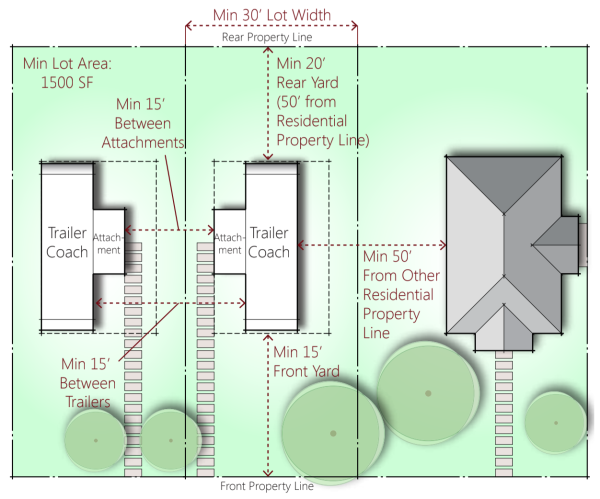
11.44.020 Zoning Permit Application
11.44.030 Zoning Amendment Application
11.44.040 Conditional Use Application
11.44.050 Variance Application
11.44.060 Zoning Appeal Application
11.44.070 Zoning Permit: Home Application
Click to view the Wolf Point Planning Department Sign Permit Application.
Click to view the Wolf Point Planning Department Zoning Permit Application.
Click to view the Wolf Point Planning Department Zoning Amendment Application.
Click to view the Wolf Point Planning Department Conditional Use Application.
Click to view the Wolf Point Planning Department Variance Application.
Click to view the Wolf Point Planning Department Zoning Appeal Application.
Click to view the Wolf Point Planning Department Zoning Permit: Home Application.
Urban Street Design Standards
| Classification | Category | Lanes | Zoning Class | Parking | Paved Width (curb face to curb face) | Sidewalks | Right-of-Way | Volume (ADT) | Max Grade (%) | Min Pavement Thickness (In) | Min Base Course Thickness (In) |
| Local | L-1 | 2 | R-1, R-2, MU-1 | Both sides | 37 | 5 | 66 | 0–4,999 | 10 | 4 | 6 |
| 2 | One side | 33 | 5 | 66 | |||||||
| 2 | None | 29 | 5 | 66 | |||||||
| L-2 | 2 | C-1, C-2, M-1 | Both sides | 39 | 5 | 80 | |||||
| 2 | One side | 35 | 5 | 80 | |||||||
| 2 | None | 31 | 5 | 80 | |||||||
| Collector | C-1 | 2 | R-1, R-2, MU-1 | Both sides | 41 | 5 | 80 | 5,000–9,999 | 8 | 4 | 8 |
| 2 | One side | 35 | 5 | 80 | |||||||
| 2 | None | 33 | 5 | 80 | |||||||
| C-2 | 2 | C-1, C-2, M-1 | Both sides | 47 | 5 | 80 | |||||
| 2 | One side | 41 | 5 | 80 | |||||||
| 2 | None | 39 | 5 | 80 | |||||||
| Minor Arterial | Mi-1 | Roadway characteristics subject to City Engineer approval | 120 | 10,000–19,999 | 6 | 6 | 10 | ||||
| Typical street width 51 feet | |||||||||||
| Major Arterial | Ma-1 | Roadway characteristics subject to City Engineer approval | 120 | 20,000–29,999 | |||||||
| Typical street width 63 feet | |||||||||||
Rural Street Design Guidelines (area outside of corporate limits)
| Classification | Lanes | Parking | Pavement Width | Inslope/ Backspace/ Ditch Width | Right-of-Way | Volume (ADT) | Max Grade (%) | Min Pavement Thickness (In) | Min Base Course Thickness (In) |
| Local | 2 | None | 26 | 5:1 / 4:1 / 8' | 80 | 0–4,999 | 10 | 4 | 6 |
| Collector | 2 | None | 32 | 6:1 / 6:1 / 10' | 120 | 5,000–9,999 | 8 | 4 | 3 |
| Arterial | 2 | None | 42 | 8:1 / 8:1 / 10' | 150 | 10,000–29,999 | 6 | 6 | 10 |
12.08 Cable Television Franchise
12.04.020 Franchise Granted; Rights
12.04.030 Duties Of Grantee
12.04.040 Nonexclusive
12.04.050 Reservation Of Right
12.04.060 Indemnification
12.04.070 Right Of Assignment
12.04.080 Written Acceptance
12.04.090 Term
For convenience, herein, said municipal corporation is designated and referred to as "municipality", and Montana-Dakota Utilities Co., is designated and referred to as "Grantee." Any reference to either includes their respective successors and assigns. (Ord., 5-21-1990)
There is hereby granted to Montana-Dakota Utilities Co., a division of MDU Resources Group, Inc., a corporation, grantee, its successors and assigns, subject to the limitations herein stated, the right and franchise to occupy and use the streets, alleys and public grounds of the municipality as now, or hereafter constituted, for the purpose of constructing, maintaining, and operating, within, upon, in and under the same, a gas distribution system for transmitting and distributing natural or manufactured gas, or a mixture of both, for public and private use. (Ord., 5-21-1990)
Grantee shall maintain an efficient distribution system for furnishing natural or manufactured gas, or a mixture of both for public and private use at such reasonable rates as may be approved by the public service commission of the state wherein said municipality is located and under such orders, rules or regulations as may be issued by any federal or state agency having jurisdiction thereof. (Ord., 5-21-1990)
This franchise shall not be exclusive and shall not be construed to prevent the municipality from granting to any other party the right to use the streets, alleys, and public grounds of the municipality tor like purposes. (Ord., 5-21-1990)
The municipality reserves any right it may have under its police power or otherwise to control or regulate the use of said streets, alleys and public grounds by grantee. (Ord., 5-21-1990)
Grantee shall indemnify and save and hold the municipality harmless from any loss or damage due to the construction, installation, and maintenance of its distribution system and its use of the streets, alleys, and public grounds of the municipality. (Ord., 5-21-1990)
Grantee shall have the right to assign this franchise to any party or corporation, but all obligations of grantee hereunder shall be binding upon its successors and assigns. (Ord., 5-21-1990)
Within thirty (30) days after grantee is notified of passage and final approval of the ordinance codified herein, grantee shall file with the clerk or auditor of the municipality its written acceptance of this franchise. (Ord., 5-21-1990)
This franchise shall continue and remain in full force and effect tor a period of twenty five (25) years from the date upon which the ordinance codified in this chapter shall become effective as provided by law. (Ord., 5-21-1990)
12.08.020 Grant
12.08.030 Term
12.08.040 Conditions Of Street Occupancy
12.08.050 Restoration Of Public Ways
12.08.060 Safety Requirements
12.08.070 Franchise Fee
12.08.080 Renewal Of Franchise
12.08.090 Transfer Of Franchise
12.08.100 Insurance Requirements
12.08.110 Notice Of Violation
12.08.120 Acts Of God
12.08.130 Notice (Reserved)
12.08.140 Channel Reservation (Reserved)
For the purpose of this chapter, the following terms, phrases, words, and abbreviations shall have the meanings below. When not inconsistent with the context, words used in the present tense include the future tense, words in the plural number include the singular number, and words in the singular number include the plural number:
CABLE SYSTEM: A facility, consisting of a set of closed transmission paths and associated signal generation, reception, and control equipment or other communications equipment that is designed to provide cable service and other service to subscribers.
FRANCHISE AUTHORITY: The city of Wolf Point, Montana, or the lawful successor, transferee or assignee thereof.
GRANTEE: TCI Cablevision of Montana, Inc., or the lawful successor, transferee or assignee thereof1.
GROSS REVENUES: The monthly cable service revenues received by grantee from subscribers of the cable system; provided, however, that such phase shall not include revenues received from any national advertising carried on the cable system, that portion of pay or premium service revenues that grantee is required to pay to a third party for the carriage or reception thereof, or any taxes on cable service which are imposed directly or indirectly on any subscriber thereof by any governmental unit or agency, and which are collected by the grantee on behalf of such governmental unit or agency.
PUBLIC WAY: The surface of, and the space above and below, any public street, highway, freeway, bridge, land path, alley, court, boulevard, sidewalk, parkway, way, lane, drive, circle or other public right of way, including, but not limited to, public utility easements, dedicated utility strips or rights of way dedicated for compatible uses and any temporary or permanent fixtures or improvements located thereon now or hereafter held by the franchise authority in the city which shall entitle the franchise authority and the grantee to the use thereof for the purpose of installing, operating, repairing and maintaining the cable system. (Ord., 8-20-1990)
1The assignment of this franchise to Bresnan Communications, LLC, was approved by the franchise authority on April 20, 2002.
The city hereby grants to grantee a nonexclusive franchise to construct and operate a cable system in, along, among, upon, across, above, over, under or in any manner connected with public ways within the city and for that purpose to erect, install, construct, repair, replace, reconstruct, maintain or retain in, on, over, under, upon, across or along any public way and all extensions thereof and additions thereto, such poles, wires, cables, conductors, ducts, conduits, vaults, manholes, pedestals, amplifiers, appliances, attachments, and other related property or equipment as may be necessary or appurtenant to the cable system. (Ord., 8-20-1990)
The franchise granted pursuant hereto shall be for an initial term of fifteen (15) years from its passage and final adoption. (Ord., 8-20-1990)
All transmission and distribution structures, poles, other lines, and equipment installed or erected by the grantee pursuant to the terms hereof shall be so located so as to cause a minimum of interference with the proper use of public ways and with the rights and reasonable convenience of property owners who own property that adjoins any of said public ways. (Ord., 8-20-1990)
If during the course of grantee's construction operation or maintenance of the cable system there occurs a disturbance of any public way by grantee, it shall, at its expense, replace and restore such public way to a condition reasonably comparable to the condition of the public way existing immediately prior to such disturbance. (Ord., 8-20-1990)
Construction, installation and maintenance of the cable system shall be performed in an orderly and workmanlike manner. All such work shall be performed in substantial accordance with applicable federal communications commission or other federal, state and local regulations. The cable system shall not unreasonably endanger or interfere with the safety of persons or property in the city. (Ord., 8-20-1990)
Grantee shall pay to the franchising authority a franchisee fee equal to three percent (3%} of gross revenues received by grantee from the operation of the cable system on an annual basis. The franchise fee payment shall be due and payable between June 30 and July 30 of each year. Each payment shall be accompanied by a brief report from a representative of grantee showing the basis for the computation. (Ord., 8-20-1990)
The franchising authority and the grantee agree that any proceedings undertaken by the franchising authority that relate to the renewal of the grantee's franchise shall be governed by and comply with the provisions of the cable communications policy act of 1984, as amended. (Ord., 8-20-1990)
Grantee's right, title, or interest in the franchise shall not be sold, transferred, assigned or otherwise encumbered, other than to an entity controlling, controlled by, or under common control with grantee, without the prior consent of the franchising authority, such consent not to be unreasonably withheld. No such consent shall be required, however, for a transfer in trust, by mortgage, by other hypothecation, or by assignment of any rights, title, or interest of grantee in the franchise or cable system in order to secure indebtedness. (Ord., 8-20-1990)
Grantee shall maintain in full force and effect, at its own cost and expense, during the term of the franchise, comprehensive general liability insurance providing an amount of three hundred thousand dollars ($300,000.00) for bodily injuries, (including accidental death) to any one person, and subject to an aggregate limit in the' amount of five hundred thousand dollars ($500,000.00) for any one occurrence, and the amount of five hundred thousand dollars ($500,000.00) for property damage. (Ord., 8-20-1990)
In the event that the franchising authority believes that the grantee has not complied with the terms of the franchise, it shall notify grantee of the exact nature of the alleged noncompliance. Grantee shall have thirty (30) days from receipt of the notice to respond to the franchising authority to cure such default or, in the event that, by the nature of default, such default cannot be cured within the thirty (30) day period, to initiate reasonable steps to remedy such default and notify the franchising authority of the steps being taken and the projected date that they will be completed. (Ord., 8-20-1990)
The grantee shall not be held in default or noncompliance with the provisions of the franchise, nor suffer any enforcement or penalty relating thereto, where such noncompliance or alleged defaults are caused by strikes, acts of God, power outages, or other events reasonably beyond its ability to control. (Ord., 8-20-1990)
13.08 Sewer (Reserved)
13.12 Garbage And Refuse
13.16 Liter Regulations
13.20 Eating And Drinking Establishments
13.24 Rural Garbage Route
13.28 Recycling
13.12.020 Definitions - Garbage And Refuse
13.12.030 Location Of Containers
13.12.040 Accessibility Of Containers
13.12.050 Collection
13.12.060 Equipment Required; Independent Contractor
13.12.070 Equipment Specifications; Identification
13.12.080 Use Of Containers; Garbage Deemed Too Large For Containers
13.12.090 Prohibited Waste
13.12.100 Use Of Containers
13.12.110 Construction Waste Or The Like
13.12.120 Cost Of Collection; Billing
13.12.130 Separation Of Units
13.12.140 Schedule Of Fees
13.12.150 City Landfill Dump Fees; Freon Removal
13.12.160 Penalties
The purpose of this ordinance is to provide for the collection and disposition of garbage & refuse and to provide specifications for containers, the assessment of the cost of the collection and removal thereof again the real estate from which such garbage is removed (1982 code; 1997 Code, Chapter 7.02)
- The word "container" as used in this ordinance is intended to mean the receptacle in which waste is place for the pickup of the City of Wolf Point to be disposed. (2018 Code)
- The word "garbage" as used in this ordinance is intended to mean animal and vegetable matter, store sweepings, paper and rubbish and other indestructible waste matter; but it shall not be construed to mean or include manure, basement or lawn excavations, trees or house wreckage or construction waste or hazardous waste or other like debris. (1982 Code; 1997 Code § 7.02.01)
All garbage must be removed and disposed of in a manner prescribed by this ordinance or by the Public Works Director or other personnel designated by the City Council who shall have final say as to the location of garbage racks on any lot and the final disposition of any garbage located within the city limits. (1982 Code; 1997 Code § 7.02.02)
All containers must be made accessible to the City of Wolf Point in such a way that there are no obstacles to restrict collection of said containers. Any gates, vehicles, or other obstacles hindering collection by the garbage vehicle will result in uncollected refuse. (2018 Code)
The collection, removal and disposal of garbage shall be done and performed under the exclusive supervision, direction and control of the Public Works Director and in strict conformity with the provisions of this ordinance and with the additional rules and regulations that may be made from time to time by the City Council. No person or entity may contract to haul garbage of any type from any location within the city limits without the express written permission of the City Council. (1982 Code; 1997 Code § 7.02.03)
The disposition of garbage within the city limits is hereby exclusively reserved to the City. No person, entity, or independent contractor may haul or dispose of garbage without first obtaining the prior written consent of the City Council, whether said hauling or disposing occurs with or without charge. (1982 Code; 1997 Code § 7.02.03)
The Public Works Director with the approval of the Mayor and the Council shall have the power to hire and discharge the collectors and such additional labor as found necessary to collect, remove and dispose of all garbage in the proper manner. (1982 Code; 1997 Code § 7.02.03)
It shall be optional with the City Council whether the City shall own and supply to said collectors, garbage wagons or trucks, operating supplies used in connection with the removal of garbage or require the same to be furnished by said collectors. The City reserves the right to contract garbage services with an independent contractor if the City Council determines such is appropriate (1982 Code; 1997 Code § 7.02.04)
All garbage wagons, trucks and other conveyances used for the collection of garbage shall be of such style, size and description as the City Council may from time to time require, and shall be marked for identification as the Public Works Director may direct. (1982;1997 Code § 7.02.05)
The Council may, from time to time, provide, and the Public Works Director may distribute, convenient, large refuse containers for use by certain classes of garbage generators. Whenever such containers are provided in accordance with this Ordinance and with such additional regulations as the Public Works Director may prepare, they shall be used exclusively for the deposit of garbage to be removed. (1982 Code; 1997 Code § 7.02.06)
Whenever any garbage generator accumulates garbage too large or bulky or otherwise unsuited for such containers, such as trees, refrigerators, hot water tanks and the like, the garbage generator shall dispose of such items, or may notify the Public Works Director who shall notify the garbage generator of the approximate cost and convenient time to dispose of said garbage or other waste and, should the garbage generator agree, shall collect the cost paid in full, and dispose of said garbage or other waste within 14 working days after notice to proceed with disposal. If said garbage is not disposed of within said time period by the garbage generator, the City may dispose of said garbage and assess the generator and/or the real estate upon which the garbage is located for all costs associated with the disposition of said garbage. (1982 Code; 1997 Code § 7.02.06)
All refuse, animal or vegetable matter, upon any premises in the City of Wolf Point, which is not otherwise disposed of, shall be deposited in the container or vessels above-mentioned, provided however, that no person shall place ashes from a stove or fireplace in the refuse containers of the City; with the exception of ashes from commercial incinerators, which may be placed in the refuse containers. Waste generated from construction or hazardous waste shall not be allowed in the containers. (1982 Code, 1997 Code § 7.02.07)
Use of the refuse containers within the city of Wolf Point is restricted to person and entities paying for such service, or persons residing in the City of Wolf Point otherwise directly or indirectly paying for such service. Use of the containers by non-residents or persons not paying for disposal purposes is prohibited. This section shall not apply to occasional use of the containers for refuse disposal by travelers, visitors, and itinerants. (1982 Code; amd. 7-18-1994; 1997 Code; amd. Ord., 2010.02)
Vendors of food, beverages or other merchandise generating garbage or refuse from private property not owned by the vendor shall be charged a daily garbage collection service fee. The Council shall set the daily rate by resolution, which may be amended as deemed necessary by the Council. (Ord., 2010-02)
No such vendor will be permitted to commence sales from private property without displaying a payment receipt from the City for such garbage collection service. (Ord., 2010-02)
Any construction waste generated from general construction, remodeling, reconstruction, and new construction to include, but not limited to: roofing, lumber, insulation, sheetrock, siding, concrete, or other construction debris or demolition debris, shall not be included in the residential or commercial collection rates. This waste shall be considered above and beyond that of which is covered in the residential and commercial rates and shall be paid for according to the schedule of fees set by the City Council, which schedule may be amended from time to time by resolution of the Council. (1982 Code; 1997 Code § 7.02.09)
The cost of collection of garbage from streets, alleys, and private premises within the Wolf Point City shall in all cases be assessed against the deeded real property. Cost of collection for any non-deeded property owners within the City of Wolf Point shall in all cases be assessed against the Monthly Utility Billing. Said fee is a mandatory charge which shall be assessed to the real property and/or the account holder upon which any residence, business, governmental entity or other garbage generator utilizes the City's garbage service. Abatement of said charge may only be obtained after written application to the City Council and shall be routinely granted in the case of seasonal occupation of a business, residence, or other building. The City Council reserves the right to deny any such application with or without reason. (1982 Code; 1997 Code § 7.02.10)
In the residential and business areas where there is more than one residence or business on a lot or group of lots, each residence or business shall constitute a separate unit and be assessed accordingly, and each trailer home shall constitute a residence. (1982; 1997 Code § 7.02.11)
A schedule of fees shall be adopted by Resolution passed by the Council for the collection and disposal of disposable garbage, which schedule shall be filed with the Clerk, and which may be amended or altered by the Council from time to time. (1982 Code; 1997 Code § 7.02.13)
The City Council shall, by resolution, establish fees to be charged for dumping by commercial contractors and non city residents of household and construction waste. The City Council shall also establish, by resolution, fees to be charged for dumping by city residents of construction waste. The classification of said waste will be at the discretion of the landfill gatekeeper or other authorized City employee(s). Freon must be removed from appliances before disposal at the landfill. If available, the city shall provide this service for a fee to all customers. Fees for Freon removal shall be established, by resolution, by City Council. (2018 Code)
Any person, firm, or corporation violating any of the provisions of this ordinance shall, upon conviction thereof, be fined in accordance with the General Penalty Section of the City Ordinances. (1982 Code; 1997 Code § 7.02.12)
13.16.020 Littering From Vehicles
13.16.030 Littering By Pedestrians
13.16.040 Throwing Or Breaking Glass Objects
13.16.050 Posting Of Litter Regulations
13.16.060 Penalty
For the purpose of this chapter, the following terms, phrases and words shall have the meanings given herein: (1982 Code)
TO LITTER: The throwing, scattering, depositing, or dropping any waste materials, such as paper, containers, boxes, bottles, cans, wrappers, or like items of whatsoever material or whatsoever use, upon any street, public way, alley, public premises or sidewalks, or upon private premises. (1982 Code)
FOOD, DRINK AND LIKE ITEMS: Shall pertain only to those prepared and sold for immediate consumption and in which it is reasonably conceivable that the container is to be thrown away or discarded. They will in no instance mean the usual packaged foods or drinks usually sold in grocery stores or markets for home preparation and consumption. (1982 Code)
It shall be unlawful for any person to little, throw, toss, drip or push any of the materials mentioned in WPCC 13.16.010 from any car, truck, public conveyance or other type vehicle, either moving or standing still, upon any street, alley or public parking lot, or any private premises. (1982 Code)
It shall be unlawful for any pedestrian to litter, discard, throw, toss, place or drip any of the materials mentioned in WPCC 13.16.010 upon any street, alley, public grounds, public parking lot or sidewalk or any private premises, except in specially designed containers or places. (1982 Code)
It shall be unlawful for any person to throw and break, or attempt to break any bottle or other glass object against a building, on a street, alley, sidewalk, or parking lot, or any private premises, and to leave the broken sections thereupon. (1982 Code)
It shall be required of all places of business engaged in selling at retail, foods, soft drinks, beer, coffee or like items where the container is usually to be discarded after consumption of the product, such as hot lunches, sandwiches, coffee, soft drinks, beer, ice cream and like items to post in a conspicuous place near where said items are displayed or dispensed, a copy of WPCC 13.16.010 through WPCC 13.16.040. The copy shall be supplied by the city at the time of purchase a city license. (1982 Code)
Any person violating the provisions of this chapter shall be subject to a fine of not less than twenty-five dollars ($25.00). (1982 Code)
13.20.020 Penalties
The Sanitary Code of the Montana State Board of Health is hereby adopted by reference, in its entirety, as though written herein and set out and is hereby made a part hereof with the exception of the section pertaining to penalties, which said section is provide for in this code, three (3) copies of which code, with the amendment herein, are on file and of record in the office of the city clerk. (1982 Code)
Any eating and drinking establishment within the city which does not meet the requirements of the Sanitary Code of the Montana State Board of Heath may have it license suspended. (1982 Code)
13.24.020 Types Of Service
13.24.030 Service Area
13.24.040 Application
13.24.050 Cost Of Collection; Fees; Billing
13.24.060 Discontinuation Of Services
13.24.070 Acceptable Materials; Waste
13.24.080 Location Of Containers; Accessibility
13.24.090 Penalties
The city of Wolf Point offers garbage collection options for customers not residing in city limits. This ordinance provides general rules, regulations, and fees associated for said services with the city of Wolf Point. (Ord.,7-16-2018)
The City of Wolf Point offers garbage collection services to customers residing outside of city limits. A customer that resides outside city limits but within the City of Wolf Point's rural garbage route service area is eligible to sign up for service to purchase and have a garbage can placed at their residence and City of Wolf Point will dump refuse for a monthly fee, Customers not residing within the City's rural service area have the option of applying for a "courthouse dumpster" account and placing garbage in City owned garbage containers located in city limits for a monthly fee. (Ord., 7-16-2018)
The area the City of Wolf Point may furnish rural garbage service to shall be determined by the City Council, the Public Works Director, or the City Foreman. Any requests for new service will be submitted to the Public Works Director or City Foreman for approval dependent on proposed location. (Ord., 7-16-2018)
All customers wishing to acquire garbage collection services through the City of Wolf Point will be required to fill out an application and pay any fees necessary for service at the city office. (Ord., 7-16-2018)
The cost of collection of garbage from "rural customers' shall be assessed as a monthly charge, if there is a failure of the person against whom the collection has been charged to services shall cease after said bill is deemed delinquent according to City of Wolf Point policy. Fees to be paid may include the cost of the container and ring, replacement parts, and any fees deemed necessary by the City Council or its authorized agents. The monthly billing will be mailed out and due in conjunction with the water/sewer bills sent out to residents of City of Wolf Point. Charges for rural garbage collection shall be established, by resolution, by City Council. (Ord., 7-16-2018)
Any rural customers wishing to discontinue services with the City of Wolf Point will be responsible for requesting to discontinue at the city office, if said customer fails to request discontinuation of services the customer will be responsible for any bill incurred for failure to report their wishes with the city office. If a customer wishes to discontinue rural garbage service and no longer wishes to own the container, they may return it to the City of Wolf Point for a partial refund of the original amount of the container. Amount refunded shall be determined by the Public Works Director and/or the City Foreman. (Ord., 7-16-2018)
All containers in service by the City of Wolf Point are restricted to household garbage such as: animal and vegetable matter, sweepings, paper, rubbish, and other indestructible waste matter. All other waste such as manure, basement or lawn excavations, trees, house wreckage and construction waste, or hazardous and other like debris must be disposed of by different means. (Ord., 7-16-2018)
All containers must be made accessible to the City of Wolf Point in such a way that there are no obstacles to restrict the collection from said containers. Any gates, vehicles, or other obstacles hindering collection by the garbage vehicle will result in uncollected refuse. (Ord., 7-16-2018)
Any person, firm or corporation violating any of the provisions of this ordinance shall, upon conviction thereof, be fined in accordance with the General Penalty Section of the City ordinances. (Ord., 7-16-2018)
13.28.020 Materials
13.28.030 Availability Of Service
13.28.040 Cost; Billing
13.28.050 Rules And Regulations
13.28.060 Penalties
The intent of this ordinance is to provide guidelines and rules pertaining to recycling services provided by the City of Wolf Point. (2018 Code)
Materials accepted by the City of Wolf Point for recycling include aluminum, corrugated cardboard, and newspaper. (2018 Code)
Recycling services shall be available to all persons/entities wishing to participate. Anyone wishing to participate may bring their recyclables to the recycling shop located at 233 Cascade Street. Residential customers will not be permitted to have a container that will be collected by the City of Wolf Point. Commercial customers wishing to have a cardboard only container placed on their property to be collected by City of Wolf Point shall submit such request to the Public Works Director and/or City Council in writing for consideration. Said customer, upon approval, will be responsible for purchasing the container and following rules set by the City Council and Public Works Director pertaining to Recycling. (2018 Code)
The City of Wolf Point offers this recycling service free of charge residential customers. Commercial customers will be expected to pay for a cardboard container before the container will be placed. The cost of the container will depend on price of materials and labor and will be determined by the Public Works Director. The City Council will, from time to time, re-assess these ordinances and may initiate charges pertaining to recycling for residential and/or commercial accounts. Should the City Council establish, by resolution, monthly fees pertaining to recycling, said charges may be assessed on the water/sewer bill. (2018 Code)
Rules and regulations shall be determined by the Recycling Operator or Public Works Director. Failure to follow rules by commercial customers may result in discontinuation of collection services.
Any person, firm or corporation violating any of the provisions of this ordinance shall, upon conviction thereof, be fined in accordance with the General Penalty Section of the City ordinances. (2018 Code)